Atrium Bed & Breakfast
700 N. Main St. — A pair of old North Main houses joined into one inn, carrying Fort Bragg's residential, business, and traveler history under those steep Victorian rooflines.
Last updated: October 3, 2026
Two neighboring North Main Street Victorian houses joined by a central atrium, with a history that includes the Wood family, an antique shop, Mendocino Coast movie memories and their later transformation into a bed-and-breakfast property.
Overview
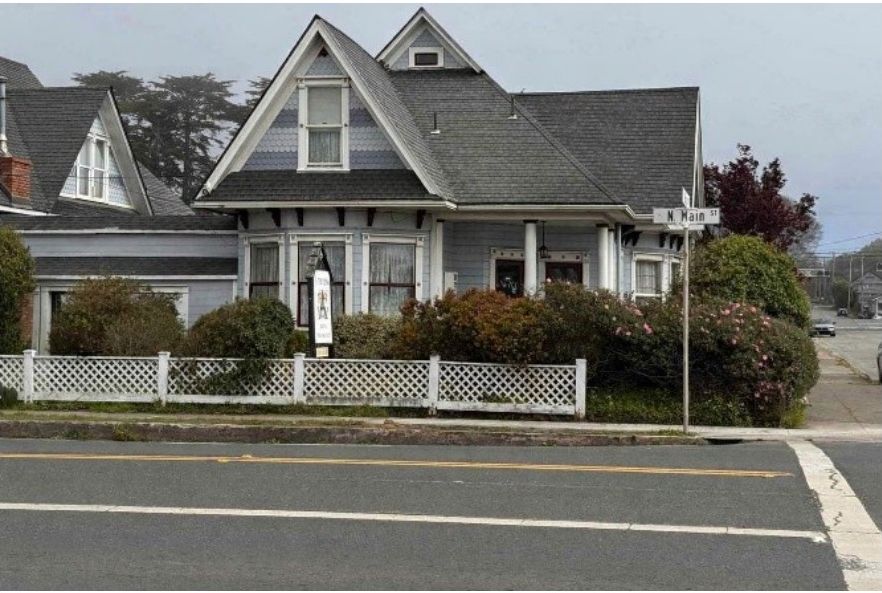
The Atrium Bed & Breakfast at 700 N. Main Street is one of the most distinctive older residential properties along Fort Bragg’s northern Main Street corridor.
Its steep gables, decorative shingles, porches and large old-house proportions make clear that this was not originally built as a conventional lodging property.
The Atrium developed from two neighboring Victorian houses that were eventually connected by a central structure. That joining space gave the inn its name and turned the two residences into one larger property.
Community memories add the people and businesses behind that transformation, including the Wood family in the 1930s and Mary and Whitey White beginning in the late 1960s.
Location
The property stands at 700 N. Main Street, north of Fort Bragg’s traditional downtown core.
This stretch of Main Street developed with a mixture of substantial residences, lodging properties and commercial uses as the town expanded northward.
The two original houses remain easy to distinguish despite their later connection.
History
Community memory places C. Louis Wood and his wife, Halley, in one of the houses during the 1930s.
Wood is remembered as Fort Bragg’s Dodge automobile dealer and as being active in community life as a Mason, Presbyterian Church deacon and member of the Fort Bragg City Council.
By the late 1960s, Mary and Whitey White were remembered as owning the property.
Mary operated an antique store from the house. The downstairs served the business while the upstairs retained much of the character of a large old residence.
Whitey worked as a logging-truck driver, adding another connection to Fort Bragg’s working history.
One particularly colorful memory involves Mary renting antiques to motion-picture productions working on the Mendocino Coast.
Local recollection specifically connects some of her antiques with The Russians Are Coming, The Russians Are Coming, filmed extensively in the Mendocino area during the 1960s.
Exactly which objects were used has not been independently documented, but the story remains part of the property’s local history.
The property’s defining change came when the neighboring house became available.
Community memory credits the Whites with purchasing the house next door and constructing the center section that connected the two residences.
That joining structure created the atrium and allowed the property to function as one larger complex.
The Whites eventually began renting rooms, beginning the transition from private residence and antique business toward lodging use.
By the 1990s, local residents remember the property as an established and well-kept bed and breakfast.
Later property descriptions identify the Atrium as a ten-room inn formed from the two Victorian buildings and note extensive remodeling in 2013.
Community Memories
Local memories preserve chapters that property listings never could.
People remember the Wood family and the connection with Fort Bragg’s Dodge dealership, church and civic life.
Others remember Mary and Whitey White, the antique shop, the beautiful upstairs rooms, Whitey’s logging-truck work and Mary’s antiques being rented for movie productions.
The purchase of the neighboring house and construction of the connecting atrium are especially important memories because they explain the unusual property seen today.
Later residents remember the Atrium as a pleasant bed and breakfast operated by people they knew through the local community and church.
Taken together, those memories trace a progression from family residences to antique business, connected houses, rented rooms and eventually an established lodging property.
Why It Matters
The Atrium matters because its history remains visible in the building itself.
It did not begin as a purpose-built inn. It grew from two neighboring homes whose owners adapted them as Fort Bragg changed.
Its story includes an automobile dealer and civic leader, an antique shop, logging, Mendocino Coast movie memories, room rentals and eventually the creation of a bed and breakfast.
Most importantly, the joining of the two houses preserved them rather than replacing them.
What stands at 700 N. Main Street today still shows the outlines and character of the two old residences beneath the later additions.
The Atrium is an example of how older Fort Bragg homes survived by finding new uses while retaining much of their original character.
Sources & Original Research
This article blends verifiable historical records with personal recollections shared by longtime Fort Bragg residents. Much of this information comes from community memory and is not available in any published source.
Original post text, photographs and historical material provided by Gee Bee.
Community recollections provided by Rus Jewett, Heather Capps and Sandra Liljeberg.
Zillow property record for 700 N. Main Street — description of two side-by-side Victorian buildings connected by an atrium, ten-room inn configuration and later remodeling.
LoopNet commercial-property listing — lodging configuration and property information for 700 N. Main Street.
Tripadvisor — Atrium Bed & Breakfast listing at 700 N. Main Street.
HotelsCombined — Atrium Bed & Breakfast lodging listing.
WineCountry — Atrium Bed & Breakfast listing, currently marked temporarily closed.
InFortBragg.com — Atrium Bed & Breakfast historical archive.
