Caito Fisheries
19400 S. Harbor Dr. — A working Noyo Harbor fish plant tied to the Caito family's commercial fishing history reaching back to early-1920s Fort Bragg operations.
Last updated: August 30, 2026
Overview
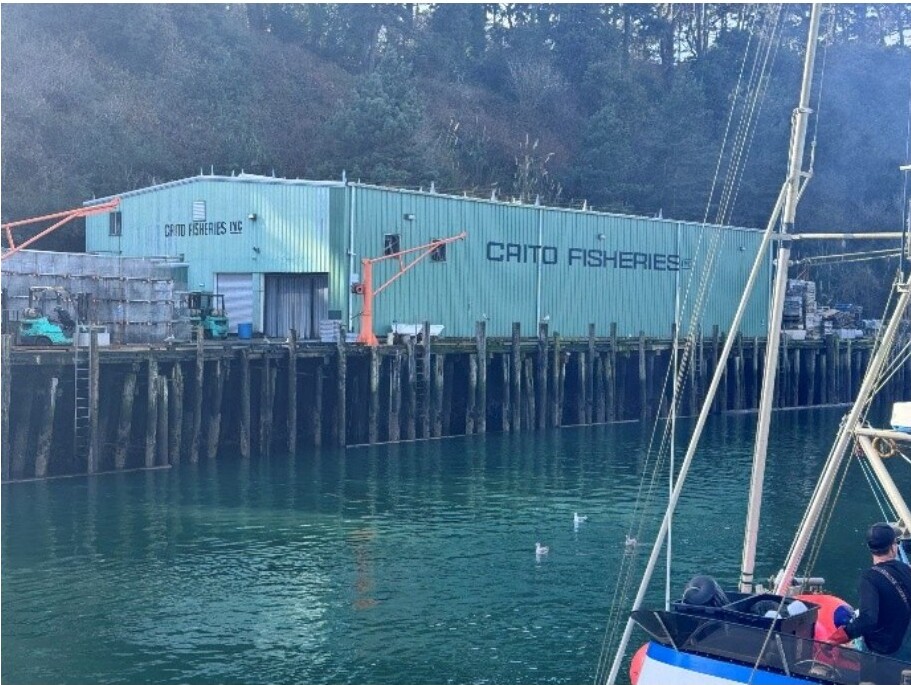
Some Noyo Harbor buildings were never intended to be pretty. They were built to receive fish, move product, load trucks and keep the harbor working.
Caito Fisheries at 19400 South Harbor Drive is one of those buildings.
The fish plant sits directly on the working side of Noyo Harbor, where boats, docks, cold storage, processing, trucking and wholesale seafood all come together. Its plain industrial appearance tells the story almost as clearly as any historical record. This was a building designed around work.
The Caito family's connection with Fort Bragg's commercial fishing industry reaches back to the early 1920s. Over the decades, the family became part of the network that connected fishermen and their catch with processors, wholesalers, truckers and seafood markets far beyond the Mendocino Coast.
That gives this South Harbor Drive property a connection to one of Fort Bragg's oldest continuing industries.
Location
Caito Fisheries is located at 19400 South Harbor Drive on the south side of Noyo Harbor.
This is the practical side of the waterfront, where fishing vessels, fish plants, loading areas and trucks share a narrow strip of land between the road and river.
The location is important because a commercial fish plant needed immediate access to both boats and transportation. Fish could come directly from a vessel into the plant, be weighed, handled, chilled or processed, and then move out by truck.
That boat-to-dock-to-truck connection is one of the basic systems that made Noyo Harbor work as a commercial fishing port.
History
The Caito family's Fort Bragg fishing and seafood history reaches back to the early 1920s.
The family became associated with fishing, seafood buying, processing and distribution at a time when the ocean was one of Fort Bragg's major economic engines.
Commercial fishing was never only about what happened aboard a boat.
Once a vessel returned to Noyo Harbor, the catch had to be unloaded, weighed, sorted, chilled and moved quickly. Fish houses provided the shore-side infrastructure that made the entire industry possible.
Caito Fisheries became part of that system.
The South Harbor Drive building was designed around function. Its relationship to the dock, loading areas and roadway allowed seafood to move efficiently from boat to processing area and then into refrigerated transportation.
For decades, that kind of activity was part of the everyday rhythm of Noyo Harbor.
Community memories recall times when the river was crowded with fishing boats unloading their catches. The harbor was remembered through sounds and smells as much as buildings — diesel engines, fish, coffee, trucks and boats working along the river.
One person who grew up in a fishing family remembered spending much of childhood around the harbor and later helping aboard boats tied near the Caito fish house.
Another nearby resident remembers watching skilled truck drivers back large trucks down South Harbor Drive to reach the plant. That small detail captures something important about this building: the property was laid out for industrial harbor work, not visitor convenience.
The dock beside the building also appears in Coast Guard memories. A former Coast Guard crew member recalled the cutter Point Ledge tying up at the end of the building.
The business also developed a strong reputation among people who worked there.
Former employees and drivers remembered the Caito family as good people to work for. One community recollection identified John Caito and his son as operating the Fort Bragg business after Jim Caito retired.
Another recent memory reports that the Caito family may have sold the Fort Bragg operation around 2025.
I have not yet located documentation establishing the exact date of that sale, the purchaser or the terms of the transaction. Until those details can be confirmed, that ownership change remains an open part of the story.
The earlier history remains an open part of the story as well. The Caito family's long connection with Fort Bragg is established, but the exact construction date of the present South Harbor Drive fish plant and the complete ownership and development history of this particular property still need additional documentation.
The business was remembered primarily as a wholesale operation rather than a conventional public seafood market. When someone asked in the original discussion whether the plant sold retail seafood, the answer given was that it was wholesale only.
That distinction helps explain why many Fort Bragg residents may recognize the Caito name or building without ever having been inside.
This was a workplace.
It served fishermen, buyers, employees, truck drivers and the seafood distribution system.
Community Memories
The memories attached to Caito Fisheries are strongly tied to the working character of Noyo Harbor.
One longtime resident remembers the river being full of boats unloading fish and recalls growing up around the harbor because a grandfather was a fisherman. Later, that person spent time helping aboard boats that tied near the fish house.
Another memory focuses on the truck drivers who maneuver large vehicles down the narrow harbor road to reach the plant.
A former Coast Guard crew member remembers the Point Ledge tying up at the end of the building.
Former employees and drivers remembered the Caito family as good people to work for.
Others remembered buying fish there, working around the docks or simply seeing the building as part of the everyday landscape of the harbor.
Taken together, those memories describe more than a seafood company.
They describe an entire working environment.
Timeline
Early 1920s — The Caito family's Fort Bragg commercial fishing and seafood history reaches back to this era.
Mid-20th century — The Caito name becomes firmly associated with commercial fishing, seafood buying and distribution connected with Fort Bragg.
Later 20th century — Caito Fisheries operates as part of the working commercial fishing system in Noyo Harbor.
Late 20th and early 21st centuries — Community memories place fishing vessels, Coast Guard activity, seafood trucks and harbor workers around the South Harbor Drive plant.
Recent years — Community recollections identify John Caito and his son with operation of the Fort Bragg business following Jim Caito's retirement.
Around 2025 — A community report says the Caito family sold the operation. Exact transaction details remain to be independently documented.
Today — The property remains part of the industrial working landscape of South Noyo Harbor.
Sources & Original Research
This article blends verifiable historical records with personal recollections shared by longtime Fort Bragg residents. Much of this information comes from community memory and is not available in any published source.
Gee Bee — original photograph and original research for Buildings and Businesses in Fort Bragg, California — with History.
Original Caito Fisheries Facebook history posts and associated discussion supplied by Gee Bee.
Community recollections supplied by Gisele Reaney, Sherri Mello, Rick Wylie, Sarah Ginskey, Richard Shafer, Dale Graham, Darilyn Fenech, Skip Simkins, Cindy Randy, Rod Tennison, Marci Pieratt, Joni Goble and others.
Caito Fisheries company history — background on the Caito family's commercial fishing and seafood operations and the family's Fort Bragg connection beginning in the early 20th century.
Caito Fisheries company location information — Fort Bragg/Noyo Harbor operating location.
Noyo Harbor commercial fishing information — background on the harbor's fishing, seafood handling and shore-side infrastructure.
Federal Motor Carrier Safety Administration records for Caito Fisheries LLC — transportation and company information associated with the seafood operation.
California Employment Development Department employer information associated with Caito Fisheries.
Community report concerning a possible sale of the Fort Bragg operation around 2025. Exact ownership-transfer details have not yet been independently confirmed.
www.infortbragg.com — Gee Bee's Fort Bragg and Mendocino Coast historical archive.
