Community Center of Mendocino
998 School Street, Mendocino — A 1930 grammar school that still serves the village as a nonprofit center for children, adults, recreation, and community events.
Last updated: August 5, 2026
Overview
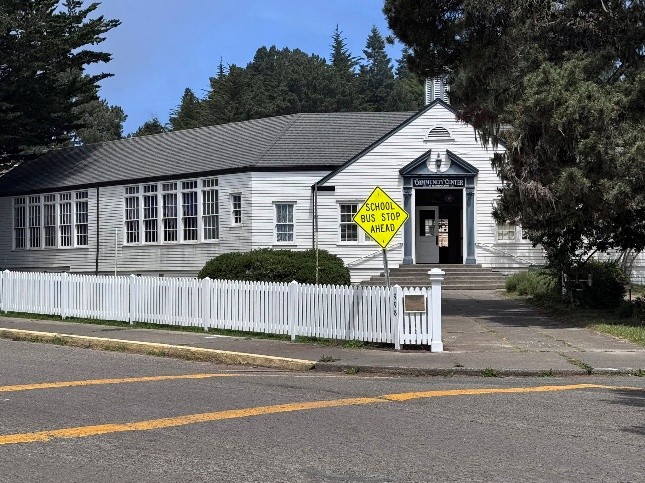
Some buildings tell you what they were before you even read the sign. This one still looks like a school, with its long row of classroom windows, white clapboard siding, front steps, and the kind of plain public-building dignity that never really goes out of use.
The Community Center of Mendocino stands at 998 School Street in a building constructed as the Mendocino Grammar School in 1930. For generations of local families, this was the place where children attended elementary classes, moved from room to room, climbed the front steps, looked out through the long classroom windows, and formed some of their earliest memories of Mendocino.
The building no longer operates as the village grammar school, but its public purpose never disappeared. Today, the Community Center of Mendocino uses the former school as a nonprofit gathering place offering children's programs, summer camps, adult activities, community events, recreational areas, and rooms available for community use. It is a particularly fitting second life for an old school. The building still brings people together, still supports learning and recreation, and still belongs to the everyday life of the village.
Location
The Community Center of Mendocino is located at 998 School Street, near the northeast corner of School and Pine streets.
Even the street name preserves the property's original purpose. School Street was not simply a convenient location chosen by a later community organization. The building and its surroundings were part of Mendocino's educational landscape for generations. The site is within easy walking distance of the village's homes, churches, businesses, and other public buildings. That central location helped make it practical as a school and continues to make it useful as a community gathering place.
History
The present building was not the first grammar school on the property. An earlier schoolhouse had been constructed there in 1885. That building served Mendocino children until it was destroyed by fire late in 1929.
The loss created an immediate need for replacement classrooms. Rather than abandon the site, the community moved quickly to build a new school on the same property. On March 3, 1930, Mendocino School District voters considered an $18,500 bond for construction of a new grammar school. Because the measure required approval by a two-thirds majority, the district needed strong public support. The bond passed by a vote of 176 in favor and 52 opposed. The bond money, combined with $4,750 received through insurance on the burned school, provided the funding for the replacement building.
The new grammar school was designed by architect Ivan Satterlee of the Davis-Pearce Company in Stockton. Eight sealed construction proposals were opened on May 6, 1930, in the office of Justice of the Peace William Shaw. Carl Nelson of Stockton submitted the low bid of $20,000 and was awarded the construction work, with a planned completion period of 75 days.
Work began quickly. Crews excavated trenches for the foundation and dug a pit for the school's furnace. Lumber was hauled to the property, while gravel and sand were brought from Little River Beach for use in the concrete foundation. Although the architect and principal contractor came from Stockton, the project also involved workers and businesses from the Mendocino Coast. Local carpenters participated in the construction, and Windlinx Hardware Company of Fort Bragg installed the plumbing. The speed of the project reflected how urgently the village needed its school restored.
The new Mendocino Grammar School was dedicated on August 23, 1930. Classes began inside the building on September 1, only about six months after voters approved the construction bond. The completed school included multiple classrooms arranged in a practical one-story plan. Its broad shape, rows of windows, white wooden exterior, and straightforward institutional design gave Mendocino a modern school while allowing the building to fit naturally among the village's older wooden structures. The large windows were especially important in an era when classrooms depended heavily on natural daylight. They remain one of the clearest visual reminders of the building's educational past.
For many years, the building served as Mendocino's grammar school and was part of the daily routine of village life. Children arrived from Mendocino and the surrounding area to study, play, make friends, and move through their elementary-school years. Parents attended school functions, teachers became familiar community figures, and the property served as both an educational facility and a neighborhood meeting place.
As Mendocino's educational facilities and school arrangements changed, the old grammar-school building eventually took on a new public role. The Community Center of Mendocino identifies itself as the heart of the community since 2012. Operating as a nonprofit organization, it has preserved the property as a place for education, recreation, meetings, and social connection rather than allowing the former school to lose its community purpose. The transition from grammar school to community center represents continuity more than replacement. Children still gather there. Adults still participate in classes and activities. Rooms designed for groups are still used by groups. The playground and outdoor spaces remain part of village life.
The Building Today
The Community Center of Mendocino hosts after-school enrichment, summer camps, children's activities, adult programs, workshops, and community events. The property also includes rooms available for rent, a playground, two dog parks, and a pétanque court. These different uses allow the grounds to serve children, families, organizations, pet owners, recreational groups, instructors, and residents looking for a place to gather.
The Community Center is a long, primarily single-story wooden building with white clapboard siding, broad banks of windows, front steps, and a low institutional profile. Its design is practical rather than decorative. The repeated classroom windows create much of its visual rhythm, while the horizontal shape reflects its original arrangement as a multiroom grammar school.
The property's open outdoor areas were once essential to recess and school activities. Today they support playground use, dog parks, pétanque, camps, recreation, and community gatherings. The survival of both the building and its open grounds makes the property especially valuable. Together, they provide a kind of community space that would be difficult to recreate in the center of Mendocino today. The former classrooms and school grounds have become flexible spaces, but the building has not been stripped of its identity. It is still immediately recognizable as an old school, and that visible history gives the center much of its character.
Why It Matters
The Community Center of Mendocino is an example of historic preservation that works because the building is still useful.
It has not been frozen as an exhibit or emptied of daily life. Children continue to play there. Adults attend activities and workshops. Community groups use its rooms. Residents gather on grounds where earlier generations once spent recess.
The property also preserves an important chapter of Mendocino's educational history. The 1930 building grew out of a community response to the destruction of the earlier school. Residents approved the money, construction moved forward quickly, and the new classrooms opened in time for the next school year. Nearly a century later, the same building remains a place devoted to learning, participation, recreation, and community life. It was built as a school, and in many ways it has never stopped being one.
Community Memories
A former student remembers attending school in this building from second grade through sixth grade.
That simple memory helps connect the present Community Center with the generations of Mendocino children who once filled its classrooms. To visitors, it may look like a well-preserved former school. To former students, it can still be the place where they spent a large part of childhood.
More memories may remain with former students, teachers, parents, and neighbors who remember classroom locations, school plays, playground games, special teachers, holiday programs, graduations, and the years when this was still Mendocino's working grammar school.
Contributors: Richard Shafer.
Timeline
1885 — An earlier Mendocino grammar-school building is constructed on the property.
Late 1929 — The earlier grammar school is destroyed by fire.
March 3, 1930 — Mendocino School District voters approve an $18,500 construction bond by a vote of 176 to 52.
May 6, 1930 — Eight construction bids are opened. Carl Nelson of Stockton submits the successful $20,000 proposal.
Spring and summer 1930 — The new grammar school is constructed with participation from local carpenters and coastal businesses.
August 23, 1930 — The new Mendocino Grammar School is formally dedicated.
September 1, 1930 — Classes begin in the new building.
Later decades — Generations of Mendocino children attend elementary school on the property.
2012 — The present Community Center of Mendocino begins its identified role as a nonprofit community gathering place.
Today — The former grammar school supports children's enrichment, summer camps, adult programs, workshops, community events, recreation, room rentals, a playground, dog parks, and pétanque.
Sources & Original Research
This article blends verifiable historical records with personal recollections shared by longtime Fort Bragg residents. Much of this information comes from community memory and is not available in any published source.
This article blends verifiable historical research with community recollections supplied through the original Buildings and Businesses in Mendocino post. Historical construction information comes from the Kelley House Museum article "Grammar School Bond," including the 1885 school, the 1929 fire, the March 3, 1930 bond vote, construction financing, architect Ivan Satterlee, contractor Carl Nelson, local construction participation, the August 23 dedication, and the opening of classes on September 1, 1930. Current information about the organization and its programs comes from the official Community Center of Mendocino website and the Mendocino Coast Chamber of Commerce directory.
Sources: Original post text provided by Gee Bee; comment thread provided by Gee Bee with a community memory contributed by Richard Shafer.
