Cotton Auditorium
500 N. Harold St. — A true community auditorium holding generations of Fort Bragg school, performance, and public memory.
Last updated: July 31, 2026
Overview
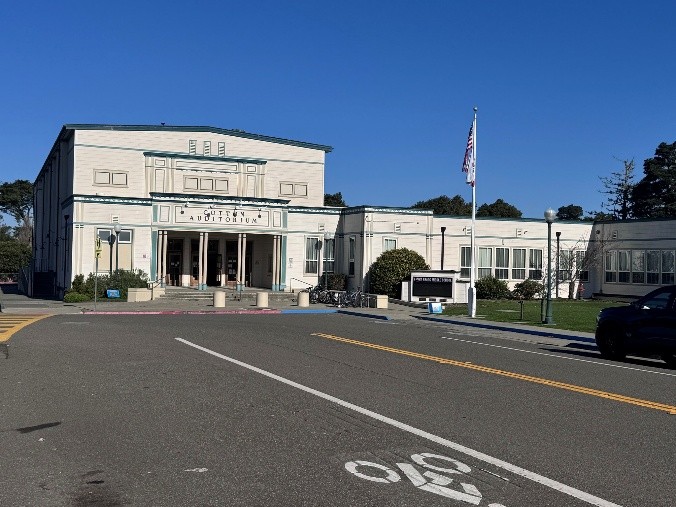
Cotton Auditorium is one of Fort Bragg's true community landmarks.
This is one of those places where the memories almost become bigger than the building itself. Located on the historic school campus now associated with Fort Bragg Middle School, Cotton Auditorium has never belonged only to the school.
It was built as a real public gathering place—a large auditorium with a stage, balcony, backstage areas, rooms beneath the stage, and seating for more than 800 people.
That size mattered. Fort Bragg has never had many indoor spaces large enough to hold a major community event, and Cotton became one of the few places where much of the town could gather under one roof.
School programs, graduations, band concerts, chorus performances, operettas, plays, benefits, public speakers, touring performers, talent shows, community concerts, memorials, and civic events all passed through that room.
Cotton Auditorium did not simply host events. It became part of how Fort Bragg gathered, performed, celebrated, mourned, and remembered.
Location
Cotton Auditorium is located at 500 North Harold Street in Fort Bragg.
The building is part of the old school campus on North Harold Street, now associated with Fort Bragg Middle School. Its location places it slightly away from the downtown commercial core, but its role has always reached across the entire community.
For decades, people came here for school assemblies, graduations, concerts, theater productions, guest speakers, benefits, public meetings, talent shows, community concert programs, and special events.
It became one of the few places in Fort Bragg large enough to hold a crowd while still making the community feel as though it were sitting together in one room.
History
The historic school campus dates to the late 1930s, and Cotton Auditorium reflects the New Deal-era idea that public buildings should serve more than one purpose.
Schools were not only places for students. They could also function as civic centers, performance halls, meeting places, and gathering rooms for the larger community.
Cotton was built with that broader purpose in mind. It was solid, balanced, practical, and large enough to feel important without feeling overly elaborate.
The auditorium took its name from Mr. Cotton, who is remembered locally as having donated the land. His former home once stood on the property and was later moved to 650 North Harold Street. The house has been enlarged over time, but local memory holds that a very large claw-foot bathtub associated with Mr. Cotton may still remain inside. Stories also describe him as an unusually tall man, adding another personal detail to the history behind the auditorium's name.
The stage, balcony, backstage spaces, and rooms beneath the stage made the building useful for everything from school assemblies to major theatrical productions.
Over time, Cotton Auditorium became part of nearly every kind of Fort Bragg public memory.
School Life and Growing Up
For generations of students, Cotton Auditorium was part of growing up in Fort Bragg.
People remembered school plays, band concerts, mixed chorus classes, choir practices, kindergarten Christmas programs, operettas, assemblies, talent shows, jamborees, graduations, and the strange magic of standing on the stage for the first time.
Some students helped create scenery and large painted backgrounds for auditorium productions. Arts and crafts classes contributed backdrops for jamborees and other shows, making students part of the production even when they were not performing.
Graduation memories are especially strong.
One former student remembered graduating in 1959 and walking across the Cotton Auditorium stage to receive a diploma from the district superintendent. There were 89 students in that graduating class.
For many local families, walking across that stage marked the end of childhood and the beginning of whatever came next.
Others remembered the less official side of auditorium life—detention rooms, balcony access, playing tag in the dark, exploring backstage areas, sneaking beneath the stage, and reading the names and messages left on walls by earlier generations.
Those handwritten names and notes became their own unofficial archive.
Cotton was not just a venue. It was a rite of passage.
Community Concerts and Public Events
Cotton Auditorium's importance extended far beyond school programs.
Residents remembered attending organized community concert series there, sometimes returning for every performance over several years. Families purchased memberships, received mailed tickets, found their seats, and watched a wide range of visiting performers take the stage.
The programs brought professional and international performers to a town that otherwise had few opportunities to host large touring acts.
When Cotton was full, it could feel like a true regional performance venue.
The auditorium also hosted local talent shows, public benefits, civic gatherings, and community productions. One memory reaches back to 1973, when a local resident helped emcee a talent show there.
The building was also used for memorials and public celebrations of life. These gatherings gave Cotton another role—not only as a place for entertainment and education, but also as a room where the community could come together after a loss.
Theater and Performance
The stage at Cotton Auditorium has held generations of actors, musicians, singers, dancers, speakers, and visiting entertainers.
Residents remembered Gloriana productions, including the 1980 production of The Pirates of Penzance, directed by Linda Pack.
Other memories connect the auditorium with touring performers and major benefit shows, including an appearance by George Carlin.
There were also band concerts, chorus performances, operettas, school productions, community theater, and performances that seemed enormous to the children seeing them for the first time.
The building's backstage rooms and under-stage spaces added to its theatrical character. They held scenery, costumes, props, equipment, performers waiting for entrances, and generations of student curiosity.
There are also smaller details that make the building real: intermission cookies, choir practice, sitting with family in the audience, watching a child perform, attending a play with a parent, waiting nervously backstage, and seeing the auditorium lights come up before a full house.
Those details are part of Cotton's history just as much as the major performances.
The Balcony, Stage, and Hidden Spaces
Cotton Auditorium was memorable not only for what happened on the stage, but also for the building itself.
The balcony gave audiences a different view of the room and became a favorite place for students who were curious enough to explore it.
Backstage areas, dressing rooms, storage spaces, and rooms beneath the stage made the auditorium feel much larger and more mysterious than it appeared from the audience.
Generations of students remembered finding names, dates, notes, and bits of writing left behind in those hidden areas.
Some of it was ordinary graffiti. Some of it became a record of who had performed there, worked there, explored there, or simply wanted to leave proof that they had once been part of Cotton Auditorium.
Restoration and Repair
Like many older public buildings, Cotton Auditorium has required major repair and restoration over the years.
Community memories recall periods when the auditorium was closed, damaged, or considered unsafe. Architectural project descriptions have identified serious structural problems, including dry rot and deterioration that threatened the continued use of the building.
Restoration work was designed to preserve the auditorium's historic character while bringing important building systems up to modern standards.
The work included historically compatible exterior repairs along with improvements to lighting, theatrical rigging, sound, acoustics, seating, and other performance-related systems.
Those repairs helped Cotton continue functioning as both a school auditorium and a community performance venue.
The restoration mattered because it kept the auditorium from becoming only a memory.
Cotton did not survive simply because the building was still standing. It survived because enough people understood what the building meant and believed it was worth saving.
The Building Today
Cotton Auditorium remains recognized as one of the Mendocino Coast's important performance and gathering spaces.
It continues to be associated with Fort Bragg Middle School while maintaining the broader community role it has held for generations.
The auditorium's history can still be felt in the size of the room, the stage, the balcony, the backstage areas, and the memories attached to nearly every part of the building.
It remains a place where a school event can feel like a town event and where a public gathering can still bring several generations of Fort Bragg residents into the same room.
Community Memories
The community memories connected with Cotton Auditorium cover nearly every part of life.
People remembered school concerts, plays, operettas, graduations, choir classes, talent shows, jamborees, community concerts, touring performers, memorials, benefits, and major theatrical productions.
Some remembered painting scenery. Others remembered performing, speaking, singing, playing music, helping backstage, receiving a diploma, sitting in the balcony, attending events with their parents, or simply being part of the audience.
One person remembered attending all of the community concerts for several years. Another recalled helping emcee a talent show in 1973. A former student remembered creating backgrounds for auditorium productions before graduating in 1959.
Others remembered deeply personal moments, including public memorials held there for people they knew.
These recollections show why Cotton Auditorium cannot be understood through an event calendar alone.
Its real history is found in the thousands of individual moments that happened inside it.
Why It Matters
Cotton Auditorium matters because it holds public memory on a scale few Fort Bragg buildings can match.
It served both school life and town life.
It was where students performed, graduates crossed the stage, families gathered, scenery was painted, choirs rehearsed, actors waited in the wings, visiting artists appeared, speakers addressed the public, and the community came together when an event needed a real stage.
People remember Cotton not only as a building, but as a place where important moments happened—first performances, final graduations, concerts, benefits, memorials, talent shows, community productions, and events that made Fort Bragg feel like one room.
That is why Cotton remains more than a school auditorium.
It is one of the places where generations of local people saw one another, heard one another, performed for one another, celebrated together, mourned together, and remembered being part of the same town.
Cotton Auditorium did not just hold events.
It held generations of Fort Bragg public memory.
Sources & Original Research
This article blends verifiable historical records with personal recollections shared by longtime Fort Bragg residents. Much of this information comes from community memory and is not available in any published source.
Sources: Original post text supplied by Gee Bee; original research post and discussion at https://www.facebook.com/media/set/?set=a.10153269104881177&type=3; comment threads supplied by Gee Bee with contributor memories from Sandra Liljeberg, Rus Jewett, Whitney Anderson, Heather Capps, Carol Eshom, Nancy Fereira, Darilyn Fenech, Kim Taylor, Rain Waters, Sarah Cullar, Craig Johnson, Denis Tone, Eric Nylund, Karen Damron Green, Bill Brazill, Gary Koski, Susan Collins, Camille Parsons, Vianna Robbins, Tina Krenov, Karen Horne, Kelly Hilliard, Elaine Bauer, Tom Van Pelt, Sarah Eliason, Eric Carmichael, Nikelle Kessler, Jennifer Wright, Donna Kingsford, Sandi Zap, Carolyn Gray, Marissa Skari, Tammy Lowe, Bess Mahaney, Chuck Ross, Andrew Leonard, Bluthardt Dustin, Jay McMartin-Rosenquist, Joe Dias, Patricia A. Williams, Anna Roeth, Robert Rex, and others; Quattrocchi Kwok Architects; Mendocino Music Festival; Voice of the Past, Fort Bragg-Mendocino Coast Historical Society; Pollstar; Arts Mendocino venue listing; and Fort Bragg Middle School and Fort Bragg Unified School District information.
