Eagles Hall / Toveri Tupa
210 N Corry St — From Finnish socialist hall to Labor Temple to Eagles Hall, a building that absorbed generations of Fort Bragg community life.
Last updated: June 8, 2026
Overview
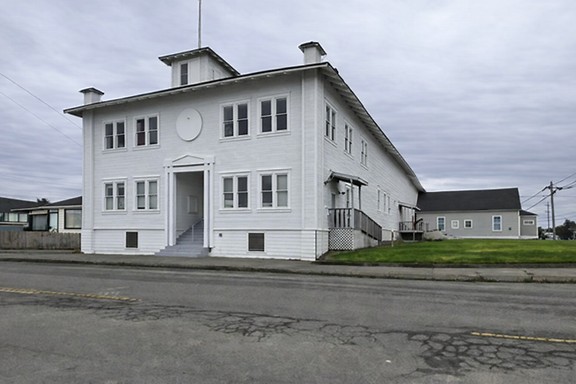
Some buildings do not just serve the town. They absorb it.
The building at 210 North Corry Street is one of those places. Many Fort Bragg people remember it first as the Eagles Hall, and that alone would make it important. For years, it was where receptions, reunions, bingo nights, flea markets, dances, plays, concerts, lessons, beer tastings, and community events all found a home.
It was one of those buildings that kept showing up in people's lives at different ages for different reasons, which is usually a good sign that the place mattered more than its plain exterior might suggest.
Location
Eagles Hall stands at 210 North Corry Street, slightly outside the main downtown storefront corridor but still close enough to be part of Fort Bragg's civic and social life.
Its location fits its purpose. This was not a shop built around window displays or casual foot traffic. It was a hall — a destination building where people came for meetings, dances, ceremonies, performances, dinners, fundraisers, and gatherings large enough to need a real room.
History
The documented history goes much deeper than the Eagles years. Local history ties the building to 1914, when Fort Bragg's Finnish socialist community built it as Toveri Tupa, meaning Comrades' Hall. It was constructed with volunteer labor and "comrade loans," and was intended as a gathering place for drama, music, lectures, parties, and civic life.
That early Finnish chapter connects the building directly to Fort Bragg's immigrant, labor, and community history. This was not just a hall for entertainment. It was part of a larger world of organizing, culture, mutual support, and public life among Fort Bragg's Finnish community.
Later, the building served as the International Workers Order / Redwood Lodge No. 3893, then as the Fort Bragg Labor Temple. In 1960, it became the Eagles Hall. Each chapter added another layer, but the basic purpose stayed remarkably steady: people gathering under one roof.
The comments make it clear how thoroughly that larger history became lived memory. People remembered roller skating there on Saturdays in the 1950s, dances in the 1960s and 1970s, Cat Mother playing there, local bands, touring acts, wedding receptions, reunions, theater productions, ballet and jazz lessons, tap lessons, bingo, beer tastings, AA meetings, and the bar and snooker table in the back.
Others remembered it simply as the old Finnish hall, which says a lot about how long that first identity lingered.
The Building Today
The building itself still feels right for its purpose. It is broad, sturdy, symmetrical, and practical, with the look of a public hall meant for crowds rather than privacy.
Property information from its 2022 sale described the building as roughly 6,700 square feet and emphasized its long use for cultural events, concerts, weddings, and graduations. After the Eagles chapter faded, the building was sold in 2022 to Efstathios and Miranda Pappas, with hopes for repairs and a return to some form of hall use.
That matters, because it means the building was not simply treated as an old structure to be discarded. It was recognized as a place worth keeping alive.
Why It Matters
210 North Corry Street matters because it holds more than one Fort Bragg era at once.
It was Toveri Tupa. It was the Labor Temple. It was the Eagles Hall. It was also a skating rink, dance hall, performance space, reunion hall, wedding reception site, beer tasting room, lesson space, bingo hall, and gathering place.
The comments show how much life passed through this building. People remembered family members involved in its construction, weddings held there, Paul Bunyan events, Belle of the Redwoods crowning, old-fashioned dress reviews, Firemen's Balls, high school dances, reunions, Quinceañeras, and the feeling that Fort Bragg lost something when large public gatherings there became less common.
Buildings like this do not just host events. They carry generations of them.
Community Memories
Community memories connect Eagles Hall / Toveri Tupa to Finnish families, volunteer construction, Arvid as architect in local memory, roller skating, dances, Cat Mother, the Green Brothers, The Living Children, wedding receptions, Firemen's Balls, Paul Bunyan events, Belle of the Redwoods, old-fashioned dress reviews, bingo, ballet and jazz classes, AA meetings, beer tastings, reunions, theater, concerts, upstairs carvings and dates, palm trees, and the sadness many felt when public use became more limited.
Those memories show a building that people knew not just from one event, but from whole stages of life.
Timeline
1914 — Built by Fort Bragg's Finnish socialist community as Toveri Tupa, or Comrades' Hall.
Early 20th Century — Used for drama, music, lectures, parties, meetings, and civic life.
Later Years — Serves as International Workers Order / Redwood Lodge No. 3893.
Labor Temple Era — Becomes the Fort Bragg Labor Temple.
1950s — Remembered for Saturday roller skating and community use.
1960 — Becomes Eagles Hall.
1960s–1970s — Remembered for dances, bands, Firemen's Balls, receptions, and community gatherings.
Later Years — Used for weddings, reunions, bingo, flea markets, lessons, meetings, performances, and beer tastings.
2022 — Building sold to Efstathios and Miranda Pappas, with hopes for repairs and continued hall use.
Present — Still remembered as one of Fort Bragg's most important community hall buildings.
Sources & Original Research
This article blends verifiable historical records with personal recollections shared by longtime Fort Bragg residents. Much of this information comes from community memory and is not available in any published source.
Sources: User's original post text for 210 N. Corry St. / Eagles Hall; user-supplied comment thread and memories; Anderson Valley Advertiser, "Saving Finnish Lodge"; Fort Bragg History / "From Finland to Fort Bragg" mural history; Anderson Valley Advertiser, "New Fort Bragg Mural: From Finland To Fort Bragg"; Trulia; MendoFever / Mendo Voice; comment-thread contributors Dick Whetstone, Nancy Fereira, Donna Winters, Terri Maki-Swartz, Rus Jewett, Joe Wagner, Eric Lyte, Kelly Hilliard, Sandra Liljeberg, Bob Kinney, Diana Sallinen, Yvonne Crytzer Brown, Darilyn Fenech, Mary Souza, Jary Stavely, Heather Capps, Rod Tennison, Jo Ann Grant, Cathy Parnell, Cb Schmidt, Vianna Robbins, Sandi Zap, Jason Middleton Tupper, Carol Eshom, Michael Chapman, Carolyn Gray, Jim Nailor, Scott Taubold, Jay McMartin-Rosenquist, Tammy Lowe, Larry Nelson, Tina Krenov, Laurie Elaine Koski, Anna Roeth, Patricia A. Williams, Carrie Dattalo, Adriane Nicolaisen, Stathi Pappas, Galen-pierre Barrow, Patty Reed Barrow, Keith Patterson, and Tom Gossard.
