Footlighters (formerly Runeberg Hall)
248 E. Laurel St. — From Runeberg Hall and community dances to Footlighters Theater, melodramas, Can-Can dancers and a remembered appearance in Humanoids from the Deep, this building was part of Fort Bragg's entertainment and community life for generations.
Last updated: September 27, 2026
Overview
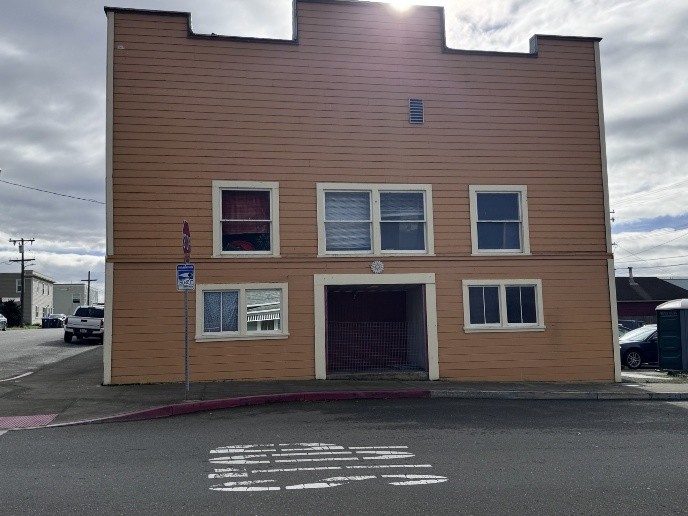
Footlighters, formerly Runeberg Hall, stands at 248 E. Laurel Street in Fort Bragg.
The two-story wood-frame building, with its distinctive stepped parapet and large ground-floor opening, was a longtime gathering place for dances, fundraisers, music and live theater.
Its best-remembered chapter was as Footlighters Theater, where local performers entertained residents and visitors with melodramas, musical productions, Can-Can dancing and plenty of audience participation.
For generations of Fort Bragg families, the building was more than a theater. It was a place to perform, volunteer, socialize and enjoy entertainment created by their own community.
Location
The building stands at 248 E. Laurel Street in a residential neighborhood east of downtown Fort Bragg.
Unlike the commercial storefronts along Main and Franklin streets, Runeberg Hall served as a neighborhood gathering place for entertainment, celebrations and community events.
Its substantial ground-floor opening and spacious interior accommodated the practical needs of a community hall and, later, a working theater.
History
Before becoming Footlighters Theater, the building was known as Runeberg Hall, a community gathering place associated with dances, meetings, music and fundraisers.
One remembered event took place in 1963, when residents attended a dance fundraiser for a proposed new swimming pool. The entertainment was provided by Bussy and the Boys.
The building later became best known as Footlighters Theater, one of Fort Bragg's most memorable community entertainment venues.
Footlighters specialized in lively, participatory theater. Melodramas featured villains to boo, heroes to cheer and plenty of opportunities for the audience to join the fun.
Musical productions, Christmas shows and Can-Can performances added to the theater's appeal. Local residents acted, danced, played instruments, built sets and worked behind the scenes.
Pal Lima became one of the theater's most fondly remembered performers, known for her animated performances and lively personality.
Henry and Jo Williams also contributed to the theater's musical tradition, with Jo playing piano and Henry playing banjo.
The Can-Can performances became another familiar part of Footlighters' identity. One recollection describes a life-size Can-Can dancer displayed on the side of the building, based on an image used for the theater's postcards.
The building's former red exterior also became closely associated with the Footlighters years.
A scene from the 1980 horror film Humanoids from the Deep is remembered as having been filmed at the theater, adding an unusual connection to Fort Bragg's movie history.
In later years, the property became associated with Mendocino Coast Television and Mendocino Coast Community Education Television.
A dispute over the transfer of the property led to lengthy legal proceedings. A 2016 Mendocino Superior Court decision addressed the transfer and required the building to be returned to Footlighters, along with monetary damages.
The property subsequently went to a sheriff's auction in March 2021. Published reporting identified retired electrician Glenn Neutren as the buyer, with a reported purchase price of $210,000.
Although Footlighters no longer operates there, the building remains closely associated with Fort Bragg's community theater tradition. Its present occupancy and use have not been independently confirmed.
Community Memories
Residents remember Footlighters as a place where local performers and audiences shared the fun of live theater.
Pal Lima is remembered with particular affection. Family members recall spending countless hours watching her perform, while others remember appearing onstage alongside her.
Henry and Jo Williams are remembered for their years of musical contributions, with piano and banjo accompanying the theater's productions.
One resident remembers playing piano for Footlighters for an evening as a child. Others recall performing onstage, watching shows with their families and becoming involved in theater at an early age.
The 1963 swimming pool fundraiser remains another memorable chapter, with recollections of dancing to Bussy and the Boys.
Several residents remember spending considerable time at Footlighters during childhood. One even recalls using the east side of the building as a practice wall for hitting tennis balls.
The theater's remembered connection to Humanoids from the Deep adds another unusual detail to its history.
A former Footlighters participant recalls being involved from 2011 through 2015, remembering those years as a time of fun and friendship.
Others express how much they miss the old theater while appreciating the continuation of local performances, including Gloriana Musical Theatre's activities at the Boatyard.
Together, these memories capture a place where generations of Fort Bragg residents were not simply spectators. They helped create the entertainment.
Timeline
Early History — The building is known as Runeberg Hall, serving as a neighborhood gathering place for dances, meetings, music and community events.
1963 — A dance fundraiser for a new swimming pool features Bussy and the Boys.
Later Decades — Footlighters Theater becomes known for melodramas, musical productions, Christmas shows, Can-Can dancers and audience participation.
Footlighters Era — Pal Lima, Henry and Jo Williams, local performers, musicians and volunteers become closely associated with the theater.
1980 — Humanoids from the Deep is released, with a scene remembered as having been filmed at Footlighters.
2006–2007 — The property becomes involved in a disputed transfer to Mendocino Coast Community Education Television.
2011–2015 — Community recollections confirm continued participation in Footlighters productions during these years.
2016 — A Mendocino Superior Court decision addresses the disputed property transfer.
2021 — The building goes to a sheriff's auction and is reported sold for $210,000.
Sources & Original Research
This article blends verifiable historical records with personal recollections shared by longtime Fort Bragg residents. Much of this information comes from community memory and is not available in any published source.
This article combines published reporting, court records and firsthand recollections shared by longtime Fort Bragg residents. Much of the theater's performance history and the memories of individual participants come from community discussions rather than published historical records.
Original Facebook posts and community comments: John Schnaubelt, Sarah Ginskey, Karen Horne, Darilyn Fenech, Lynn Prather, Kathy Oliver, David John Thompson, Rus Jewett, Michelle Braga, Julie Russell and Tammy Lowe.
Additional community research includes recollections of Runeberg Hall, Footlighters performances, Pal Lima, Henry and Jo Williams, Bussy and the Boys, Can-Can productions, Christmas shows, set-building, the theater's former red exterior and its connection to Humanoids from the Deep.
Published references: The Mendocino Voice, March 31, 2021, reporting on the sheriff's auction and property dispute; subsequent reporting on the auction result; Mendocino Superior Court Statement of Decision, March 24, 2016, concerning the disputed transfer of 248 E. Laurel Street.
Original research: Gee Bee's Buildings and Businesses in Fort Bragg, California — with History.
