The Ford House Visitor Center and Museum
45035 Main Street, Mendocino — Built in 1854 for Jerome B. Ford, the last surviving Mendocino Lumber Company house on Main Street, now a visitor center and museum.
Last updated: August 10, 2026
Some Mendocino buildings are not just old. They are the starting point for the whole story.
Overview
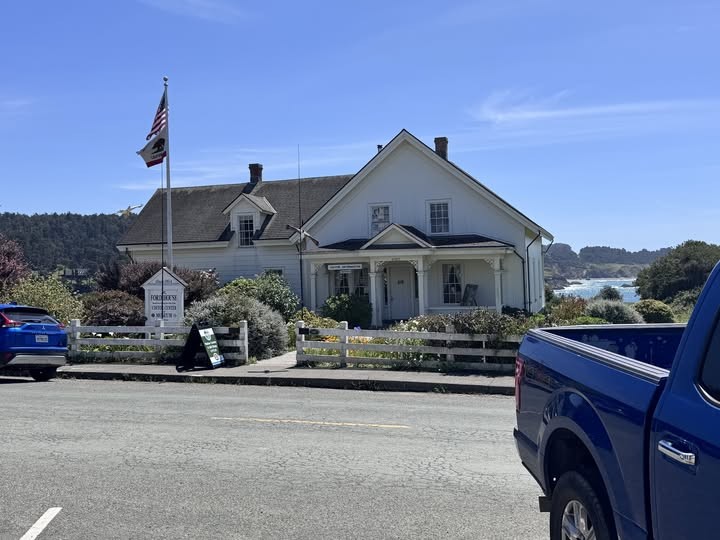
The Ford House stands on Main Street with the ocean behind it, looking almost too calm for the amount of history it carries. Built in 1854, it is one of the key surviving buildings tied to the beginning of Mendocino as a lumber town.
Jerome B. Ford had the house built for himself and his bride, Martha. Ford was superintendent of Mendocino's first sawmill and one of the men closely associated with the development of the settlement that became Mendocino.
Today the house serves as the Ford House Visitor Center and Museum, helping visitors understand both the village and the headlands surrounding it.
Location
The Ford House sits at 45035 Main Street in Mendocino, overlooking Mendocino Bay, the headlands and the mouth of Big River.
History
Jerome B. Ford and William Kasten arrived on the Mendocino Coast in 1852 while investigating the great redwood forests surrounding Big River. The sawmill that followed became the economic center of the young settlement. Lumber, shipping, workers, houses, stores and streets developed around it, turning the isolated coastal location into the village of Mendocino.
The Ford House was built only a few years later. Its location overlooking Mendocino Bay placed the Ford family close to the mill and within sight of the industrial activity along Big River. The history of the area, of course, reaches much farther back. Indigenous Pomo people lived around Big River long before the arrival of the lumber industry and the creation of the town.
The Ford House continued its connection with Mendocino's lumber industry long after Jerome Ford's time. In the early 1900s, the house became home to John S. Ross, superintendent of the Mendocino Lumber Company. Ross began serving as superintendent in 1902 and remained connected with management of the lumber company through 1924.
Historical accounts identify the Ford House during this period as the residence of the mill superintendent, making it more than simply a surviving home from the 1850s. The same building remained closely tied to the company that had shaped Mendocino from its beginning.
Growing Up in the Ford House
Family memories supplied with the original posts give the house another personal layer. The son and daughter of John S. Ross grew up in the Ford House while their father ran the Mendocino Lumber Company.
The family remembers that the children were not born in the Ford House. Both were born in the same house on their grandparents' property north of Fort Bragg, although surviving birth records identify the birthplace differently — one as Inglenook and the other as Cleone. Afterward, the Ford House became their Mendocino home.
They lived here through their school years. The son graduated from high school in 1919, and his sister graduated in 1921, before both eventually left Mendocino for college. Historical records provide another glimpse of the family. In 1920, the superintendent's son introduced his friend Miles Paoli to wireless radio technology, helping spark an interest that became Paoli's lifelong career in radio and electronics.
The Ford House, in other words, was not simply company housing or an executive residence. It was a family home.
A Social Center Overlooking the Bay
The grounds around the Ford House once had their own busy social life. During the early 1900s, a clay tennis court stood behind the residence. Historical accounts describe Saturday-afternoon matches where townspeople gathered to play, watch, visit and enjoy the view toward Mendocino Bay.
The Ross household was also part of Mendocino's community life. Historical newspaper material records gatherings at the home during the years the family lived there. The area later became familiar to generations of residents and visitors for another kind of gathering when the Mendocino Music Festival erected its large seasonal performance tent nearby.
It is another reminder that the quiet museum grounds of today were once the backyard of an active Mendocino household.
The Building Today
Today the Ford House serves as the visitor center for Mendocino Headlands State Park and as a museum devoted to the area's natural and cultural history. One of its best-known exhibits is a detailed scale model depicting Mendocino as it appeared around 1890.
Visitors can also learn about the lumber era, the development of the village, the surrounding headlands, wildlife and the annual migration of gray whales. Its location makes the Ford House an especially fitting place to tell that story. Step outside the front door and much of the landscape that shaped Mendocino is still visible — Main Street on one side and the ocean, headlands and Big River on the other.
Why It Matters
The Ford House connects several generations of Mendocino history under one roof. Jerome and Martha Ford connect it with the beginnings of the lumber settlement in the 1850s. John S. Ross and his family connect it with the Mendocino Lumber Company during the early twentieth century. The memories of his children growing up here — along with their descendants returning for the house's 150th anniversary in 2004 — connect that history directly to families living today.
And now, as a visitor center and museum, the house has another job: preserving those stories and passing them along. More than 170 years after it was built, the Ford House is still doing what it has always done remarkably well. It is watching Mendocino history happen right outside its windows.
Community Memories
That family connection continued long after the Ross family had moved away. In 2004, during the Ford House's sesquicentennial — its 150th anniversary — members of the Ross family returned to the house. A family photograph shared with the original post shows siblings, spouses and cousins gathered there for the celebration.
For descendants of people who had once lived inside these walls, the anniversary was more than a historic-building celebration. It was also a return to a family home from an earlier generation. That is one of the things that makes the Ford House different from a building whose story survives only in records and photographs. People living today still carry direct family connections to it.
Timeline
1852 — Jerome B. Ford and William Kasten arrive on the Mendocino Coast.
1854 — The Ford House is built for Jerome B. Ford and his bride, Martha.
1902 — John S. Ross becomes superintendent of the Mendocino Lumber Company and lives in the house with his family.
1919 and 1921 — The Ross son and daughter graduate from high school while living in the Ford House.
1920 — Jack Ross introduces Miles Paoli to wireless radio technology.
1924 — Ross's connection with the lumber company management ends.
2004 — The Ford House marks its 150th anniversary; Ross family descendants return for the celebration.
Today — The house serves as the Ford House Visitor Center and Museum for Mendocino Headlands State Park.
Sources & Original Research: This history blends verifiable published records with the original posts and community memories supplied for the Buildings and Businesses in Mendocino project. Sources include California State Parks, Mendocino Headlands State Park and Ford House historical information; MendoParks / Mendocino Area Parks Association, Ford House Visitor Center and Museum information; and the Kelley House Museum, including historical material concerning Jerome B. Ford, John S. Ross, the Mendocino Lumber Company, the Ford House tennis court, the Ross household, Jack Ross and Miles Paoli, and early Mendocino history. Original post text, both community replies, and family photograph information provided by Gee Bee. Community contributor whose family history helped substantially expand this article: Chuck Ross.
Sources & Original Research
This article blends verifiable historical records with personal recollections shared by longtime Fort Bragg residents. Much of this information comes from community memory and is not available in any published source.
