Grace Community Church
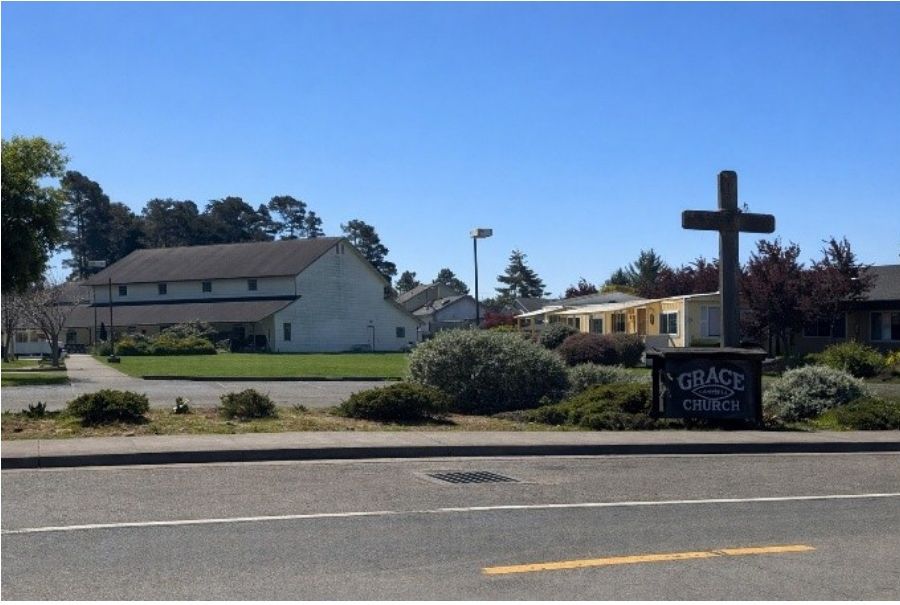
1450 E. Oak St. — A church campus on East Oak where sanctuary, lawn, cross, gym, and community memory all sit together outside the downtown storefront rhythm.
Last updated: July 22, 2026
Overview
Some Fort Bragg places are not remembered by a display window or a sign over the sidewalk. They are remembered by who gathered there.
Grace Community Church is one of those places.
Located on East Oak Street, away from the tighter commercial blocks downtown, the property has the feeling of a small campus rather than a single church building. Its broad lawn, large cross, long low structures, parking areas, sanctuary, and gymnasium create a place intended for much more than Sunday worship.
Churches like this become gathering places for services, Bible studies, youth activities, dinners, meetings, weddings, memorials, holiday programs, outreach, and the ordinary community life that develops over many years.
Current church directories place Grace Community Church at 1450 E. Oak Street and connect the congregation with the Southern Baptist tradition.
History
Local memory reaches back to the years when the congregation was known as Grace Baptist Church.
Church names sometimes change while the people, traditions, and memories remain connected. Some longtime residents still identify the congregation by its earlier Baptist name, even though it is now generally listed as Grace Community Church.
One community memory asked whether the church had once met on McPherson Street. That possible earlier location has not been fully documented, but the recollection suggests that the congregation's history may extend beyond the present East Oak campus.
Churches often begin in borrowed rooms, homes, converted buildings, or smaller meeting spaces before moving to a permanent property. Even when an earlier address cannot yet be confirmed, those memories can point toward chapters worth preserving and researching further.
Grace Baptist Church
The earlier Grace Baptist name aligns with the congregation's documented connection to the Southern Baptist Convention.
For many local families, the older name may still be the one that feels most familiar. It represents a period when Fort Bragg was deeply shaped by the lumber mill, fishing, logging, railroad work, and the churches that served as important social and spiritual anchors.
Grace Baptist Church would have been part of that working-town rhythm.
Families attended services, children went to Sunday school, volunteers prepared meals, and people turned to the church during celebrations, illness, grief, financial difficulty, and other major moments in life.
Pastor Glenn Biggs
One specific community memory identified Glenn Biggs as pastor from 1961 through 1975.
Those years give the church story a valuable human timeline.
Pastoral service is often remembered less through official records than through the families who attended, the marriages performed, the children baptized, the funerals conducted, and the sermons heard week after week.
The years from 1961 to 1975 were also an important period in Fort Bragg's history. The lumber mill remained central to the local economy, logging and fishing supported many households, and churches played a major role in the social life of the town.
A pastor serving for approximately 14 years would have known generations of families and likely witnessed many changes within both the congregation and Fort Bragg itself.
The Church Campus
The East Oak property differs from the churches built into Fort Bragg's older downtown street pattern.
Instead of standing close to the sidewalk between neighboring buildings, Grace Community Church sits back from the road with room around it. The lawn, parking, sanctuary, cross, gymnasium, and additional spaces give it a more open, practical layout.
That campus design allows several activities to happen at once.
A worship service can take place in one area while children gather in another. The gym can host recreation or a community event while smaller rooms are used for meetings, study groups, or counseling.
The setting also gives the church visibility without making it feel commercial. The large cross and open grounds identify the property clearly while separating it from the retail and office buildings found closer to downtown.
The Gymnasium
The gymnasium is one of the most frequently remembered parts of the church property.
A church gym is rarely used for only one purpose.
It can become a basketball court, youth room, banquet hall, holiday gathering place, classroom, emergency meeting space, or location for community meals.
People who may not remember the details of a particular service often remember playing basketball, attending a potluck, helping with a fundraiser, watching children perform, or gathering with friends inside the gym.
Those memories matter because they show how the church functioned beyond formal worship.
The gym helped make Grace a place where children and teenagers could spend time, families could gather informally, and church members could create activities that connected faith with everyday community life.
Worship and Belonging
One recent response described Grace Community Church as a wonderful place to worship Jesus Christ and called it a "home church away from home."
That phrase captures something important about congregations in coastal towns.
Fort Bragg has always included people who arrived for work, family, retirement, travel, fishing, military service, seasonal employment, or a temporary stay and then found reasons to remain connected.
A church can give someone a familiar place even when they are far from their original home congregation.
For longtime members, the building may represent decades of continuity. For visitors and newer residents, it can provide an immediate sense of welcome and belonging.
A church becomes meaningful not only because people attend every week, but because it can feel like home when they need one.
Community Outreach
Grace Community Church has also been remembered for efforts to help people facing difficult circumstances.
One community recollection mentioned that homeless individuals were once permitted to park on the property.
Allowing people to stay in vehicles can be a practical form of help in a town where housing is limited and many people struggle to find safe places to sleep.
That kind of outreach is rarely simple.
Churches attempting to help people must balance compassion with safety, sanitation, property care, neighborhood concerns, and the needs of the congregation. Good intentions can lead to difficult situations, especially when a church is trying to respond to problems larger than any single organization can solve.
That experience belongs in the history because it shows Grace as a working community institution rather than a building used only for scheduled services.
The church was confronted with real local needs and tried to respond.
A Place for Families
Church buildings often hold generations of family history.
Children attend Sunday school, grow up in youth groups, marry in the sanctuary, bring their own children back, and later gather for memorial services honoring parents and grandparents.
Even families who eventually move away may continue to think of a particular church as part of their Fort Bragg story.
Grace Community Church has served as that kind of place.
Its history is not only found in denominational listings or pastoral dates. It is held in remembered voices, familiar hymns, folding tables, gym activities, holiday services, church dinners, volunteer work, and the people who greeted one another at the door.
Changes Through the Years
Like many congregations, Grace has likely changed in membership, leadership, worship style, programs, and community role over time.
The earlier Grace Baptist identity became Grace Community Church. Pastors changed. Families arrived and moved away. Children grew up. Community needs shifted.
The building and campus also would have required regular upkeep, repair, remodeling, and adaptation as programs changed.
Those transitions are part of what allows a church to continue.
A congregation that lasts for decades cannot remain frozen in one period. It carries its earlier identity forward while finding ways to serve the people who gather there now.
Community Memory
The comments connected with Grace Community Church are modest, but they reveal several distinct parts of its story.
One person remembered the earlier Grace Baptist name and a possible McPherson Street chapter. Another supplied the pastoral years of Glenn Biggs. The gym was remembered as an important part of the campus.
Other memories touched on outreach to homeless residents and the complications that can come with trying to help.
A more recent response simply expressed gratitude, while another described Grace as a wonderful place to worship and a home church away from home.
Together, those comments show the different ways people remember a church.
Some remember names and dates. Some remember buildings and programs. Some remember difficult community work. Others remember how the place made them feel.
Why It Matters
Grace Community Church represents a different kind of Fort Bragg building history.
It is not a storefront, hotel, restaurant, auto shop, or industrial building. Its importance comes from gathering people rather than selling products or producing goods.
The East Oak campus has provided room for worship, teaching, recreation, meals, outreach, friendship, and support.
Its story includes the earlier Grace Baptist Church name, Pastor Glenn Biggs's years of service, the gymnasium, generations of families, efforts to respond to homelessness, and people who still describe it as a spiritual home.
Some buildings are remembered for what was made or sold inside them.
Grace Community Church is remembered for the people who kept showing up.
Sources & Original Research
This article blends verifiable historical records with personal recollections shared by longtime Fort Bragg residents. Much of this information comes from community memory and is not available in any published source.
Sources: Original post text provided by Gee Bee; community discussion and contributor memories; Southern Baptist Convention Churches Directory listing for Fort Bragg Grace Community Church; PsalmLog listing for Grace Community Church; Grace Community Church social-media listing. Contributors: Ann Richmond-Di Luciano, Joe Wagner, Heather Capps, Anna Roeth, Steve Schneider, and Christee Coleman.
