The Guest House
343 N. Main St. — A redwood company house built in 1892 by the Fort Bragg Redwood Company, now one of Fort Bragg's most beloved history museums.
Last updated: June 6, 2026
Overview
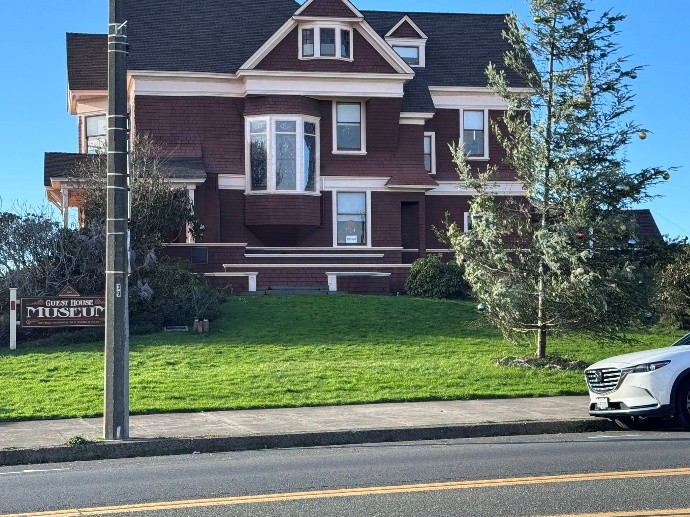
Some Fort Bragg buildings do not just sit in town. They seem to hold the town for safekeeping.
The Guest House at 343 North Main Street is one of those places. Built in 1892 by the Fort Bragg Redwood Company, this redwood house was never meant to be ordinary. It was a company-era statement piece, built from the material that shaped the town and placed where it could be seen.
Long before it became a museum, it stood as a reminder of timber wealth, company power, visiting executives, and the early redwood industry that helped build Fort Bragg.
Location
The Guest House stands at 343 North Main Street, near the center of Fort Bragg's downtown corridor. Its Main Street location gives it a public presence that fits both its original company role and its later museum life.
This was not a hidden residence tucked away on a side street. It was a visible building connected to the town's commercial, civic, and industrial story. From its location, the Guest House remains close to the old business district, the railroad-era downtown, and the larger story of the mill town that grew around the redwood industry.
History
The Guest House was built in 1892 by the Fort Bragg Redwood Company. Later remembered as the company house, it served as part of the social and business world surrounding the redwood industry. Buildings like this were not simply homes. They reflected the power and reach of the lumber companies that shaped Fort Bragg's early development.
Over time, the building's role changed, but its importance never really faded. Instead of serving the company, it eventually became a place for telling the town's story. Today, the Guest House Museum is one of Fort Bragg's most recognizable historic buildings, preserving photographs, artifacts, stories, and reminders of the lumber, railroad, shipping, fishing, and family history that shaped the community.
The comments added several important pieces of lived memory. People remembered visiting the museum and seeing old shipwreck photographs, tracing the coastline through wrecks, anchorages, and logging-era hazards that made the Mendocino Coast both productive and dangerous. Others remembered touring the house years later and being struck by how much history still lived inside it.
One of the strongest memories involved the museum's early development. The first director helped put the museum together and served from 1985 to 1991, with an annual history award later given in his name. That kind of behind-the-scenes work matters. Buildings like this do not become museums by accident. They become museums because people decide the town's story is worth saving.
The Building Today
Today, The Guest House continues as a museum and local history landmark. It is a place where Fort Bragg can look back at itself through photographs, objects, exhibits, and community memory.
The building itself remains one of the most recognizable structures on Main Street. Its redwood construction, historic form, and prominent location make it a visual anchor, while its museum role gives it a deeper purpose. It no longer represents company power in the same way it once did. Now it represents preservation.
Why It Matters
The Guest House matters because it helps Fort Bragg remember itself.
It began as a company building tied to timber wealth and the early redwood industry. It later became a community history museum, preserving stories from the same town that the lumber companies helped shape. That transformation gives the building a powerful second life.
The comments show that people connect to the building in many different ways. Some remember museum visits. Some remember shipwreck photos. Some remember the noon whistle. Some remember the building as a boutique in the 1970s. Others remember Christmas decorations on the lawn — wooden Mother Goose figures, nursery-rhyme houses, shiny lollipops, and the kind of holiday display that could live in a child's imagination for decades.
That is what makes The Guest House special. It is not only an old building. It is a keeper of memory, both official and personal.
Community Memories
Community memories add warmth and detail to the Guest House story. People remembered visiting the museum, learning local history, seeing shipwreck photographs, touring the house, and loving the building itself.
One memory recalled the first museum director, who helped assemble the museum and later had an annual history award named in his honor. Another remembered the Christmas displays that once filled the lawn with Mother Goose figures and nursery-rhyme houses. Others recalled the noon whistle, the building's boutique chapter, and the simple pleasure of visiting a place that still feels connected to Fort Bragg's older story.
Those memories show that the Guest House has never been only a preserved object. It has remained part of the town's living memory.
Timeline
1892 — Built by the Fort Bragg Redwood Company.
Early Company Era — Used as part of the company-town world connected to timber, visiting executives, and Fort Bragg's redwood economy.
1970s — Remembered by community memory as having a boutique chapter.
1985–1991 — Early museum leadership remembered through the first director's work and later annual history award.
Museum Era — Becomes the Guest House Museum, preserving Fort Bragg photographs, artifacts, shipwreck history, lumber history, and community stories.
Present — Continues as one of Fort Bragg's most recognizable historic buildings and local history museums.
Sources & Original Research
This article blends verifiable historical records with personal recollections shared by longtime Fort Bragg residents. Much of this information comes from community memory and is not available in any published source.
Sources: Original post text supplied by Gee Bee; comment thread supplied by Gee Bee including contributor memories from Beverly Freitas, Sarah Quentin, Pilar Gray, Vanette St John, Steve Av, Heather Capps, Denise Wessels, Lorene Anglesburg DelBucchia, Corvin Mango, Debbi Pisani, Debbie Newman, and Kim Fisher; Guest House Museum historical information; Fort Bragg-Mendocino Coast Historical Society materials; Local Fort Bragg history references.
