John Dougherty House
571 Ukiah Street, Mendocino — An 1867 saltbox residence built for pioneer John Dougherty, later a bed-and-breakfast with a converted water tower.
Last updated: August 11, 2026
Some Mendocino houses look quiet from the street, but once the name is attached, the whole early village starts to come into view.
Overview
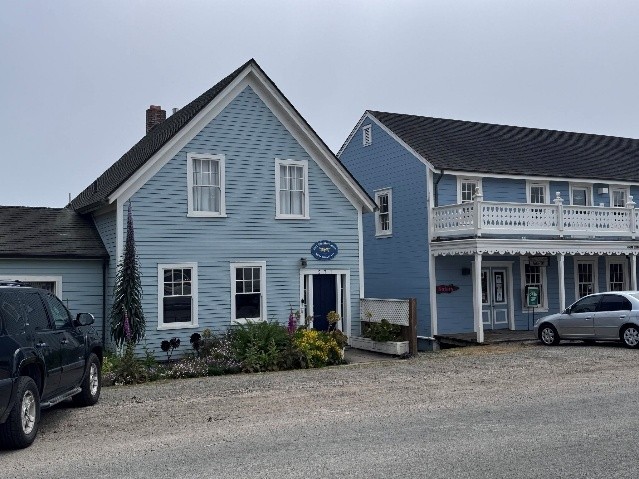
The John Dougherty House at 571 Ukiah Street is one of those buildings. Dating to about 1867, the house is among Mendocino's early surviving residences and later became a bed-and-breakfast inn. Its history reaches beyond lodging, back to pioneer John Dougherty, his family, the Big River logging country, and even a creek that still carries the Dougherty name.
The Kelley House Museum provides one especially solid connection between the family and the building: in 1888, John Dougherty's daughter Bessie was married inside the house on Ukiah Street.
Location
The John Dougherty House stands at 571 Ukiah Street in Mendocino, a short distance uphill from Main Street and the Mendocino Headlands.
Historic photographs preserved by the Kelley House Museum show the house as part of the established village landscape by the early twentieth century. In an elevated photograph dated approximately 1909–1912, the roof of the John Dougherty House can be seen along with a small water tank in its backyard. Another Kelley House photograph from the early twentieth century also identifies the Dougherty House among the buildings visible from Ukiah Street.
History
John Dougherty belonged to the first generation of workers who arrived during Mendocino's early lumber era. A Big River historical chronology records that Dougherty arrived on the Mendocino Coast in 1855. He first worked at the mill and later in the woods for Daniel Milliken. Eventually he moved inland along the South Fork of Big River.
That move left his name on the landscape. The same historical record identifies the South Fork tributary known as Dougherty Creek as taking its name from John Dougherty after he lived in that area. A Mendocino County genealogical index based on contemporary newspaper records reports that John Dougherty died in November 1911 at age 88, describing him as a native of Ireland who had come to the coast in 1855.
So the man whose name remains attached to this Mendocino house was also connected directly to the logging and settlement history of the Big River watershed.
Published lodging histories consistently date the John Dougherty House to approximately 1867. A Los Angeles Times travel feature described it as an 1867 structure, while historic-inn directories likewise identify the property as dating from that year. The building is generally described as a saltbox-style house, with the steep roof and relatively restrained exterior characteristic of many of Mendocino's nineteenth-century buildings.
One of the best-documented family events connected with the house occurred on November 6, 1888. According to research preserved by the Kelley House Museum, Bessie Dougherty, the only child of John and the late Elizabeth Dougherty, married music professor Charles Millard in a quiet ceremony at the John Dougherty House on Ukiah Street. The contemporary Mendocino Beacon described Bessie as a well-known and respected daughter of Mendocino. That small newspaper item is important because it ties the Dougherty family unmistakably to this particular house rather than simply to the broader Mendocino area. The building was not merely named after a pioneer at some later date. It was remembered in the nineteenth-century record as the John Dougherty House itself.
The Water Tower
The water tower became one of the property's distinctive features. Mendocino's water towers were originally practical necessities. Before modern municipal water systems, homes and businesses commonly used windmills or pumps to lift water into elevated wooden tanks, allowing gravity to provide pressure.
At the Dougherty property, the tower eventually found an entirely different purpose. During the building's bed-and-breakfast era, the water tower was converted into guest accommodations. Lodging descriptions promoted the tower room as one of the property's unusual places to stay, while the Kelley House Museum includes the John Dougherty House among Mendocino inns where historic water towers have been adapted for lodging.
From Residence to Inn
Like many historic Mendocino homes, the Dougherty House eventually shifted from a private residence to visitor lodging. By the late twentieth and early twenty-first centuries it was operating as the John Dougherty House Bed and Breakfast, commonly shortened to JD House.
Historic lodging directories list the property at 571 Ukiah Street with approximately eight guest accommodations. A 2001 Los Angeles Times account described the property as an eight-room bed-and-breakfast centered around the 1867 house and an extensive English-style garden. Later travel listings connected JD House with the group of Mendocino lodging properties that also included the Blue Door Inn.
Through that transformation, a house built during Mendocino's lumber era survived by finding a completely different role in the village's tourism economy.
The Building Today
The house's presence in early photographs gives the property another layer of documented history. In the Kelley House Museum's elevated view of central Mendocino from approximately 1909–1912, the Dougherty House roof and backyard water tank are plainly identified.
Those photographs place the house within a landscape filled with other pieces of old Mendocino: the Odd Fellows building, the Heeser House, hotel buildings, water towers, windmills, livery facilities, and commercial structures. Seen in that setting, the Dougherty House was not an isolated residence. It belonged to a compact working village in which homes, hotels, shops, lumber workers, horses, water towers, and businesses all existed within a few blocks of one another.
Why It Matters
The John Dougherty House connects several different pieces of Mendocino history in one small property. It begins with a man who arrived during the village's first lumber years, worked in the woods and mills, and eventually left his name on a Big River tributary. It continues with a family home where a daughter was married in 1888.
The house and its water tank then appear in photographs of the early village, surrounded by hotels, halls, windmills, water towers, and businesses that made up everyday Mendocino life. And finally, like so many old Mendocino buildings, the house found a new purpose. What began as a nineteenth-century family residence eventually became a place where visitors could stay while experiencing the village that grew up around it. More than 150 years after it was built, the John Dougherty House still carries the name of one of Mendocino's early residents — and a little piece of Big River history along with it.
Community Memories
No individual community comments were included with the material provided for this version of the post. That leaves plenty of room for additional history. Memories of staying at the John Dougherty House, people who worked there during its inn years, earlier owners or residents, changes to the garden and water tower, or stories handed down about the Dougherty family could help fill in the long period between the nineteenth-century residence and the modern lodging business.
Timeline
1855 — John Dougherty arrives on the Mendocino Coast and works in the lumber industry.
About 1867 — The house now known as the John Dougherty House is built on Ukiah Street.
Later nineteenth century — Dougherty works in the Big River country and lives along the South Fork; Dougherty Creek takes his name.
November 6, 1888 — Bessie Dougherty marries Charles Millard in a ceremony at the John Dougherty House.
1909–1912 — A historic photograph shows the roof of the Dougherty House and its backyard water tank.
November 1911 — John Dougherty dies at approximately 88 years old.
Later twentieth century — The historic residence is adapted for use as a bed-and-breakfast inn.
2001 — The Los Angeles Times describes the John Dougherty House as an eight-room bed-and-breakfast centered on the 1867 residence.
Later years — The property becomes widely known as JD House, with its historic water tower incorporated into guest accommodations.
Sources & Original Research: This article blends verifiable historical information with the original post provided for the Buildings and Businesses in Mendocino, Ca. with history project. Historical information concerning the 1888 Dougherty-Millard wedding, early photographs of the John Dougherty House, and its backyard water tank comes from the Kelley House Museum. Information on John Dougherty's arrival on the Mendocino Coast in 1855, his lumber work, his later residence along the South Fork of Big River, and the naming of Dougherty Creek comes from the Big River historical chronology preserved through the Klamath Resource Information System. John Dougherty's 1911 death information is supported by Mendocino County genealogical material compiled from contemporary newspaper records. The approximately 1867 construction date, later bed-and-breakfast use, eight-room configuration, garden, and water-tower accommodations are supported by historical inn directories, published lodging accounts, and a Los Angeles Times travel feature. No contributor names were included because no individual community comments accompanied the supplied post material.
Sources & Original Research
This article blends verifiable historical records with personal recollections shared by longtime Fort Bragg residents. Much of this information comes from community memory and is not available in any published source.
