Landmark Grocery
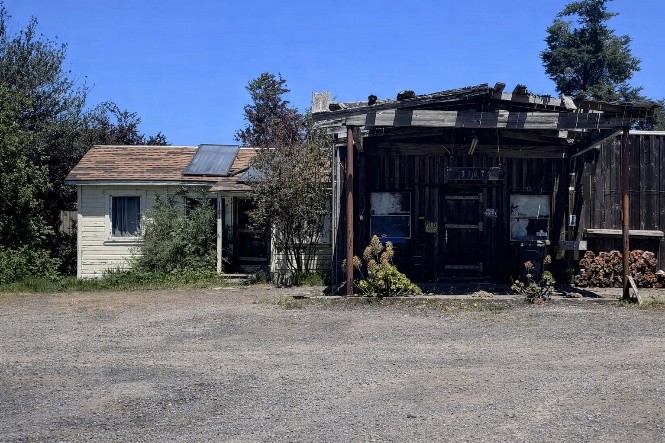
31070 Highway 20 — A weathered Highway 20 country store that was the snack stop, gas stop, candy stop, and the familiar sign that meant home was close.
Last updated: July 23, 2026
31070 Highway 20 — A roadside Highway 20 market remembered for gas, snacks, penny candy, cold beer, mushroom buying, slanted floors, and the feeling that Fort Bragg was finally close.
Overview
Some places do not need a sign anymore. Everybody still knows what they were.
The former Landmark Grocery building is one of those places. Sitting along Highway 20 east of Fort Bragg, it still has the unmistakable look of an old roadside country store: a low storefront, room to pull off the highway, and the mixed store-and-home character of a business built for travelers and nearby residents.
Public business listings continued to identify the property by its old name after the store closed, and a later real estate listing described it as the "former beloved Landmark Grocery." That simple phrase says a great deal about how firmly the store remained in local memory.
For generations of Fort Bragg residents, Landmark was more than a grocery store. It was a gas stop, candy stop, neighborhood gathering place, childhood destination, and the familiar roadside marker that meant home was getting close.
History
Landmark Grocery had a long life under several owners and operators.
One family recollection places William "Harry" Wainwright at the store before his death in 1951. Later memories connect the business with Gene and AnnaLu Parrish during the 1960s. One former employee recalled beginning her first job there in 1965, selling groceries and pumping gasoline.
Community recollections also place Matt and Beulah Thompson at Landmark during the 1960s and 1970s. A newer memory identifies the business as having operated as a Shell station during at least part of its history.
The person remembered most often from the store's later years is Diane Rugh. State records identify Diane as the property owner by 2002, but local memories show that her importance to Landmark went far beyond property ownership. She was remembered behind the counter filling small bags with candy, visiting with neighbors, handing out homemade Chex mix at Christmas, and treating local children with warmth and familiarity.
Under her care, Landmark became the kind of small store where people stopped not only because they needed something, but because they knew the person working inside.
The Store
Landmark Grocery served the practical needs of people traveling Highway 20 and those living nearby. State Water Board records confirm that the property operated as both a grocery store and a gasoline and diesel station.
People stopped to fill their tanks before driving inland, top off on the way back to the coast, buy food and drinks, or make one final stop before arriving home.
For children growing up along Highway 20, Landmark could feel like a destination of its own. A few coins might buy penny candy, Bazooka bubble gum, a soda, or some other small treat. Nearby children walked to the store, and some got off the school bus there.
The building itself became part of the experience. People remember the wooden floors, a noticeably slanted floor that could send round objects rolling across the room, the screen door, shelves and walls crowded with interesting items, and a collection of old objects and memorabilia that gave the place its distinctive personality.
Some later visitors remembered the store as dark, cluttered, and a little rough around the edges. That weathered atmosphere was part of its character. Landmark was not polished or carefully staged. It looked and felt like a country store that had accumulated years of use, objects, stories, and local life.
Candy, Cold Beer, and Single Cigarettes
The memories of what Landmark sold are as varied as the people who stopped there.
People recall milk, eggs, soda, candy, snacks, burritos, cold drinks, and what some described as the coldest beer in town. The store also sold single cigarettes, remembered by more than one customer as costing a quarter.
There were practical stops before dirt-bike rides, quick purchases on the way over the hill, and supplies for the trip home. Fishermen remembered stopping to buy ice for salmon catches, while others sold mushrooms at the store during the season.
Landmark was also remembered for its humor. A "wall of shame" reportedly listed unpaid charge accounts, and another sign promised, "No credit today; I'll give you credit tomorrow."
Those details capture the personality of an independent rural store where business, teasing, trust, and neighborhood familiarity all mixed together.
Mushrooms and Local Trade
Landmark Grocery also played a role in the seasonal mushroom economy.
People remember mushrooms being brought to and sold through the store, giving local pickers a familiar roadside buying point. This was another example of the way Landmark adapted to the needs of the surrounding community.
It was not simply a place stocked with products delivered from elsewhere. It was connected to the local economy, nearby families, fishermen, mushroom pickers, travelers, and people who relied on Highway 20 every day.
One especially unusual memory involves an autographed photograph of Bette Davis displayed inside, reportedly connected to her time filming in the Fort Bragg area. Whether customers stopped for gas, candy, beer, or groceries, the store always seemed to have something unexpected to look at.
Gas Station and Environmental History
The fuel tanks at Landmark were removed in 2001. During the removal, petroleum contamination was discovered, leading to environmental investigation and monitoring under the California North Coast Regional Water Quality Control Board.
In 2002, Diane Rugh was identified in state records as the property owner submitting a workplan for the site. The environmental case remained in official records for years after the store itself had closed.
That chapter is less sentimental than the candy-counter memories, but it is part of the building's documented history as a longtime gasoline and diesel station.
A Neighborhood Place
Landmark was closely tied to the people living along this stretch of Highway 20. Families lived across the road and down nearby lanes. Children walked over from neighboring homes, and generations of local residents grew up seeing the store as part of the landscape.
Some people rarely or never shopped there but still remember when the doors were open and the station was operating. Others remember relatives working there, grandparents living nearby, or years of stopping at the same familiar building.
That neighborhood connection helps explain why the building still generates such strong reactions. Seeing it closed and weathered is difficult for people who remember it full of customers, candy, conversation, collectibles, fuel pumps, and everyday activity.
Why It Matters
What stands out most is how often people describe Landmark Grocery as a marker of arrival.
Coming toward Fort Bragg from inland, passing Landmark meant home was close. Heading east, it was the last convenient place to stop for gasoline, snacks, drinks, ice, or a quick conversation before continuing over the hill.
Even after the business closed, the location remained a landmark in the truest sense of the word. Directions could still be given as "just past Landmark Grocery," because everybody knew exactly where that meant.
Landmark Grocery was never grand, polished, or fancy. It was something more valuable to the people who depended on it: useful, familiar, personal, and woven into the rhythm of everyday life.
The store may be gone, but the place is still Landmark.
Sources & Original Research
This article blends verifiable historical records with personal recollections shared by longtime Fort Bragg residents. Much of this information comes from community memory and is not available in any published source.
Sources: Original post text and comment threads provided by Gee Bee, including contributor memories from Mendo Love, Andrew Leonard, Stacey Bradley, Lydia Arnold, Eric Carmichael, Keith Olson, Lisa D Walker, Kim Taylor, Jennie Alice Lillard, Tammy Lowe, Clancey Kennedy, Cordy Cordelia K Fortier, Kelly Hilliard, Kristina Carbone-Smith, Melinda Gratteau, Linda Morales, Julie Parker, Navin Johnson, Jenny Powell, Dave DeSilva, Derek Sipila, Sherry Simms, Michele Bass, Marie Meyer, Mark Taylor, Richard Pops Venturi, Poncho Villa, Dawn Amber, Tonya Killion, Stephanie Rambolt, Aaron Vargas, Heather Capps, David Zwald, Bluthardt Dustin, Sean Derr, Jeremy Westcott, Joan Makela, Jassen Clawson, Randy Hillbilly, Fredrick Smith, Steve Davis, Leland Geoble, Maryann Hansen, Sandra Liljeberg, Anne Albert Rodriguez-Patton, Cheryl McKinney, Diane Jackson-Dallas, Mariana Corona, Nick Arreguin, Lucinda Venegas, Stephanie Scherbarth, Aaron Scherbarth, Jeanne A Pepper, Pierre Ardans, Bill Brazill, Dean Clark, Michael Duffy, Summer Deitz, Judith Smith, Wayne Schrum, Ron Smoley, Johnny Hayward, and Kim Keen Gunaratne; MerchantCircle listing for Landmark Grocery at 31070 Highway 20; California North Coast Regional Water Quality Control Board Executive Officer's Report, April 2022, Former Landmark Grocery, 31070 Highway 20; Redfin and BAREIS listing history for 31070 Highway 20; Smoke Signals, Summer 2014, Diane Crossman Rugh biographical notice.
