Larry Spring Museum of Common Sense Physics
225 E. Redwood Ave., Fort Bragg, CA 95437 — From early television and antenna service to Larry Spring’s homemade physics models, this storefront preserves a local story of repair, invention and curiosity.
Last updated: September 29, 2026
Overview
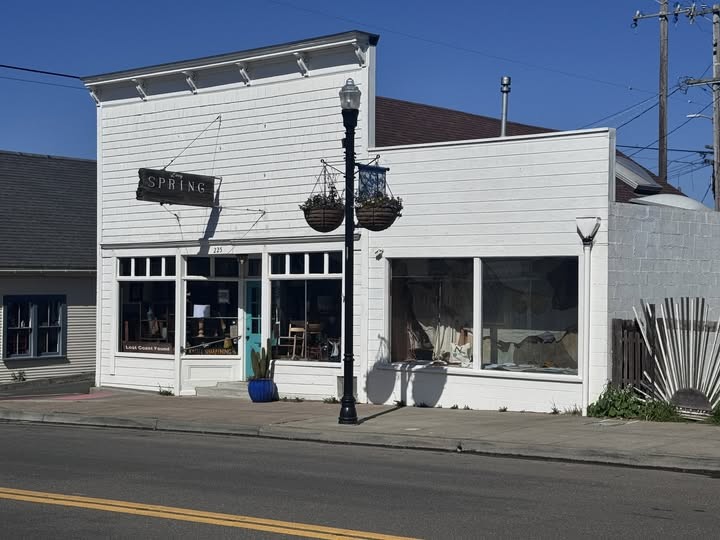
The Larry Spring Museum of Common Sense Physics at 225 E. Redwood Avenue preserves the work and ideas of Larry Spring, a Fort Bragg television repairman, inventor and independent thinker.
What began as a television and antenna business eventually became a collection of homemade models, experiments and demonstrations reflecting Larry’s unconventional approach to understanding the physical world.
Location
The building stands on East Redwood Avenue in Fort Bragg’s older commercial district.
Its simple storefront served first as Larry’s working television business and later as the home of his unusual collection of experiments and models.
History
After World War II, Larry Spring established a television and antenna sales and service business on East Redwood Avenue.
As television arrived on the Mendocino Coast, Larry sold and repaired sets, installed antennas and made house calls. Residents remember his service van as a mobile workshop carrying the equipment he needed for repairs.
A resident also recalled Larry introducing local families to a large V-shaped rhombic antenna used to improve television reception along the coast.
After retiring from the television business, Larry transformed the space into the Larry Spring School of Common Sense Physics.
He filled it with handmade models and demonstrations representing his ideas about electricity, magnetism, light and the physical world. His approach was highly individual, combining mechanical experimentation with a lifelong desire to understand and explain how things worked.
Among the objects people remember was an enormous two-man chainsaw once displayed in the storefront window. The saw survives as part of the museum collection.
Community recollection also places surveyor David Paoli’s office in the building for a period during the 2000s.
The Building Today
Today, the Larry Spring Museum of Common Sense Physics continues to preserve Larry’s models, inventions and demonstrations, keeping his unusual body of work accessible to the public.
Community Memories
People who knew Larry remember the person as much as the inventor.
One family who lived near him remembers Larry regularly giving them honey, a small detail that adds another side to the man behind the museum.
For others, Larry and his unusual storefront became part of the character of East Redwood Avenue and a piece of Fort Bragg they never forgot.
Why It Matters
225 E. Redwood Avenue connects the arrival of television on the Mendocino Coast with the life and work of one of Fort Bragg’s more unusual local figures.
Larry’s practical work repairing televisions eventually gave way to his experiments and independent ideas about physics.
The museum preserves that transition from repairman to experimenter, along with the curiosity and individuality that made Larry Spring memorable.
Sources & Original Research
This article blends verifiable historical records with personal recollections shared by longtime Fort Bragg residents. Much of this information comes from community memory and is not available in any published source.
This article combines published information about Larry Spring and the museum with community recollections from the original Buildings and Businesses in Fort Bragg discussions.
Sources include information from the Larry Spring Museum of Common Sense Physics; published material concerning Larry Spring and his television and antenna work; the original Buildings and Businesses in Fort Bragg posts; and community recollections concerning Larry’s house calls, service van, rhombic antenna, honey, the large chainsaw and the remembered surveyor-office use of the building.
The surveyor-office history is presented as a community recollection.
Original research and community history compiled for Buildings and Businesses in Fort Bragg, California — with History.
