Mendocino Presbyterian Church
44831 Main Street, Mendocino — An 1867-1868 redwood Gothic church above Mendocino Bay, California Historical Landmark No. 714.
Last updated: August 16, 2026
That tall white steeple has been part of Mendocino's skyline for so long that it almost feels less like a building and more like a compass point.
Overview
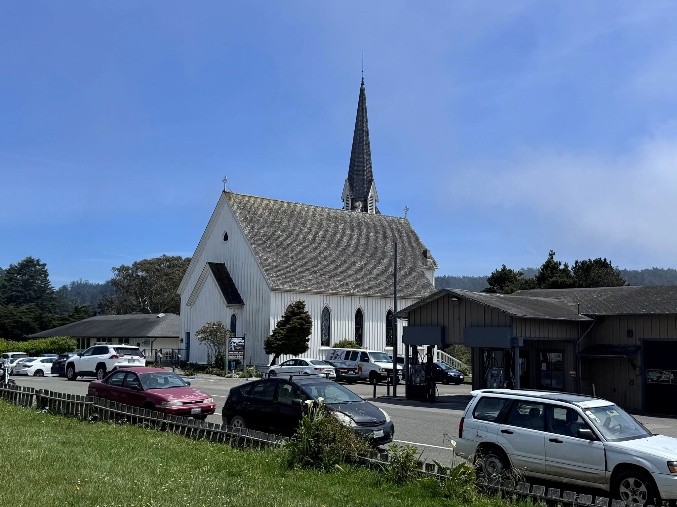
The Mendocino Presbyterian Church is one of the great landmark buildings of Mendocino Village, standing near the headlands at 44831 Main Street and overlooking Mendocino Bay.
The congregation dates to 1859, while the present sanctuary was built in 1867-1868 from locally milled redwood. More than 150 years later, it remains an active church and one of California's oldest Protestant churches in continuous use. California recognizes it as Historical Landmark No. 714.
Its steep roof, tall white steeple, Gothic windows and prominent position above the bay have made the church one of the most recognizable silhouettes in Mendocino.
Location
The church stands at 44831 Main Street, close to the southern edge of the village and the Mendocino Headlands.
There is an interesting reason the building can appear oddly oriented toward today's Main Street. When it was constructed, its main entrance faced the old Coast Road coming up from the Big River flats, then one of the principal approaches into Mendocino. That road later disappeared, but the church remained where it had been built.
For people who once lived on the Big River flats, the church was not simply a distant landmark. One community memory recalls walking up from the flats with family to attend services during the years from 1945 through 1955.
History
Presbyterian worship in Mendocino began before the present church was built. In 1858, Jerome B. Ford and William Heeser were chosen to collect subscriptions for Mendocino's first Presbyterian church building, a small structure at the northeast corner of Lansing and Ukiah Streets.
The congregation was formally organized in 1859 with eight charter members. As Mendocino grew, that first church quickly became too small.
Construction of the present sanctuary began October 7, 1867.
Architects S.C. Bugbee and Son of San Francisco designed the English Gothic building, and contractor Albert Maxwell constructed it from native redwood milled in Mendocino. Jerome B. Ford donated the land and half of the approximately $10,000 construction cost.
The completed church was dedicated July 5, 1868. The dedication sermon was given by the Reverend Dr. Laurentine Hamilton of the First Presbyterian Church of Oakland.
The building itself contains some wonderful reminders of Mendocino's maritime beginnings. The sanctuary ceiling was constructed to resemble the inverted hull of a ship, an especially fitting detail in a lumber and shipping town whose fortunes depended heavily on vessels coming and going from the coast. The steeple rises approximately 78 feet above the building.
In 1870, Jerome B. Ford purchased a roughly 1,000-pound Meneely bell made in West Troy, New York. It was shipped around Cape Horn to Mendocino, and the historic bell continues to be rung for Sunday services.
The church later became part of Mendocino's surprisingly rich motion-picture history.
Warner Bros. used the Mendocino Presbyterian Church as one of the Mendocino locations for Johnny Belinda, filmed on the Mendocino Coast in 1947 and released in 1948. The movie starred Jane Wyman, Lew Ayres, Charles Bickford and Agnes Moorehead, and Wyman won the Academy Award for Best Actress.
One community reply preserved with this history specifically identifies a church interior image as a still from Johnny Belinda, adding another connection between the familiar sanctuary and the movie.
The church marked its congregation's centennial in 1959. That same year it was designated California Historical Landmark No. 714.
The Building Today
The building has changed carefully over the generations. Pews and interior spaces have been rearranged, rooms altered, and memorial stained-glass windows were added by local artist Leone McNeil Zimmer during the late 1970s and 1980s. A large memorial window designed by Zimmer was dedicated in 1990.
Yet from outside, the essential picture remains remarkably familiar: white walls, Gothic lines and that unmistakable steeple rising above Mendocino.
Why It Matters
Perhaps the shortest community reply says as much about the building as any long history could.
"My church."
For generations of Mendocino families, that is exactly what this landmark has been.
Community Memories
One memory recalls walking up from the Big River flats with family to attend services between 1945 and 1955. Another reply identifies a familiar church interior photograph as a still from Johnny Belinda. And one reply needed only two words to sum up a lifetime of Sundays.
Timeline
1858 - Jerome B. Ford and William Heeser collect subscriptions for Mendocino's first Presbyterian church building.
1859 - The congregation is formally organized with eight charter members.
October 7, 1867 - Construction begins on the present sanctuary.
July 5, 1868 - The church is dedicated.
1870 - A roughly 1,000-pound Meneely bell arrives around Cape Horn.
1947-1948 - Warner Bros. films Johnny Belinda on the Mendocino Coast using the church as a location.
1959 - The congregation's centennial; the church is designated California Historical Landmark No. 714.
Late 1970s-1980s - Memorial stained-glass windows are added by Leone McNeil Zimmer.
1990 - A large Zimmer memorial window is dedicated.
Sources & Original Research: This history blends verifiable historical records with the original Buildings and Businesses in Mendocino post and community memories. Sources include the Mendocino Presbyterian Church historical archive; Kelley House Museum's "Mendocino Presbyterian Church - Then and Now"; California Office of Historic Preservation records for California Historical Landmark No. 714; Mendocino Coast Chamber of Commerce motion-picture location records; original post text and research provided by Gee Bee; and community replies provided by India Gingell, Chuck Ross and Lucas Macmath.
Sources & Original Research
This article blends verifiable historical records with personal recollections shared by longtime Fort Bragg residents. Much of this information comes from community memory and is not available in any published source.
