Milano Hotel & Bar
300 E. Oak St. — A longstanding neighborhood bar rooted in Fort Bragg's Italian community, lumber industry, and generations of family memories.
Last updated: September 30, 2026
300 E. Oak St., Fort Bragg, CA 95437 — A longstanding neighborhood establishment with roots in Fort Bragg's Italian community and lumber industry.
Overview
Milano Hotel & Bar is one of Fort Bragg's longstanding neighborhood establishments, with roots in the town's Italian community and lumber industry.
Originally opened by the Milano family and reportedly purchased by the Pasetti family during the 1930s, it became a familiar gathering place for generations of mill workers, loggers and local families.
With its downstairs bar, former upstairs accommodations and history of homemade Italian cooking, Milano represents a time when neighborhood establishments provided more than food and drinks. They were places where people gathered after work, maintained friendships and became part of one another's lives.
Location
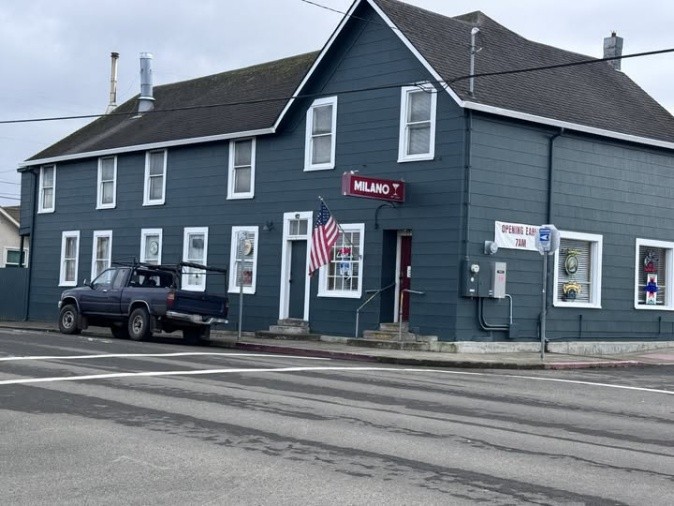
Milano occupies a two-story corner building at 300 E. Oak Street, within one of Fort Bragg's older residential neighborhoods.
Its practical design reflects the mixed-use buildings common in early lumber towns, with a commercial establishment downstairs and rooms upstairs.
Situated in an area remembered for its Italian families and working-class residents, Milano was conveniently located for the people who made it part of their daily routines.
History
### The Milano Family
According to a Milano family recollection, the family originally established the business before selling it to the Pasetti family during the 1930s.
The structure appears to date to the early 1900s, although its exact construction date remains unconfirmed.
Residents remember that the upstairs rooms were once rented to single loggers. The combination of lodging and a neighborhood bar suited Fort Bragg's early lumber-town economy, providing accommodations and a gathering place near the town's working neighborhoods.
### The Pasetti Family
Mary Pasetti became one of Milano's most memorable owners, particularly among the mill workers, loggers and families who frequented the establishment.
Her homemade Italian cooking was a distinguishing feature. Children remember Mary serving them spaghetti in the dining room, while regular customers recall meals prepared for the town's working population.
The kitchen remained an active part of the business. One former propane delivery worker remembers Ernie and his crew canning albacore there.
Milano's employees also became familiar figures in the community. Stan Campbell bartended intermittently from the 1960s through the early 1980s, while Spike McNabb was another longtime employee.
Following Mary's death, family recollections indicate that ownership passed to her son James, commonly known as Jim, who had reportedly worked as a supervisor at the local mill.
Later family involvement included Jim's wife, daughter Kathy and son Mark. Kathy managed the establishment during part of this period.
Several family members reportedly died within a relatively short time. According to one family account, Mark eventually left the property to a close friend who became its subsequent owner.
The precise dates and sequence of these later ownership transfers have not been independently established.
### Prohibition and the Upstairs Rooms
Milano's older history includes stories that have survived through generations of customers.
One resident remembers a trap door behind the bar, reportedly associated with Prohibition. Although its existence is part of community recollection, its original purpose and possible Prohibition connection remain unverified.
The former upstairs accommodations have inspired another local legend. A former employee reportedly described unexplained activity on the second floor, contributing to stories that the old building might be haunted.
### Changing Generations
During Fort Bragg's lumber-industry years, Milano was particularly associated with mill workers and longtime neighborhood regulars.
As the town's economy and population changed, the establishment gradually attracted a younger and more varied clientele.
Its character evolved without completely losing the familiar atmosphere remembered by earlier generations.
The Building Today
Milano continues operating as a neighborhood bar at 300 E. Oak Street.
Public business-registry information identifies Milano Hotel & Bar, LLC at the address, with a reported California business filing in 2020.
The building retains its recognizable corner appearance and historic mixed-use character. Although its upstairs accommodations belong primarily to its earlier history, the structure remains closely associated with Fort Bragg's traditional neighborhood-bar culture.
Community Memories
For many residents, Milano was a regular part of family life. Some remember fathers and uncles who gathered there for years, while others recall Sunday breakfast potlucks, favorite bartenders and friendships formed around the bar.
One particularly personal memory concerns a father who spent part of his final day at Milano before returning home and passing away in his sleep in 2009.
The establishment also became a setting for important celebrations. One couple married on the back patio in 2004.
Another memorable occasion was Gee Bee's surprise 60th birthday party. Having visited Milano only a handful of times during his decades in the area, he walked in to find a surprised coworker asking whether he was lost. He still has a drink token from the celebration.
Milano also figures in a memorable Paul Bunyan Days story. A police scanner report described armed men running from the establishment and shooting. What initially sounded like a serious emergency turned out to involve the Kangaroo Court sheriffs and their festival antics.
Other residents remember walking past Milano almost daily, visiting with relatives or discovering the establishment years after becoming familiar with Fort Bragg. Some longtime visitors now make it a regular stop whenever they return to town.
These recollections illustrate how a neighborhood bar can become the setting for everyday routines, family milestones and stories that survive long after the events themselves.
Why It Matters
Milano Hotel & Bar preserves a significant part of Fort Bragg's Italian heritage, lumber-industry history and neighborhood social life.
Its early combination of a bar, kitchen and upstairs lodging reflects the practical needs of a working lumber town. The Milano and Pasetti families helped establish a tradition of hospitality that extended across generations.
The building's history also illustrates the importance of neighborhood establishments as informal gathering places. They connected coworkers, families and friends while providing continuity through changes in the local economy.
Milano remains a recognizable link between Fort Bragg's working-town past and its present community.
Sources & Original Research
This article blends verifiable historical records with personal recollections shared by longtime Fort Bragg residents. Much of this information comes from community memory and is not available in any published source.
Original Facebook posts, photographs and combined community discussions provided by Gee Bee.
Milano family history and ownership recollections provided by Nancy Lou Milano.
Community contributions from Nancy Ferreira, Karen Horne, Eric Carmichael, David Wright, Larry McCart, Sandra Liljeberg, Yvonne Crytzer Brown, India Gingell, Mark Letner, Deborah Porter-Hartle, Benay Nielson, Darilyn Fenech, Darlene Stephenson, Sandi Zap, Annamarie Trager, Michael Duffy, Gary Welsh, Diane Usherwood Cummins, Shannon Madrigal, Heather Capps, Terrilynn Harrison, Lynn Menicucci, Chuck Ross, Roy McCoy, Joe Million, LePriel White, Daniel Leo Galli and other contributors.
Visit Fort Bragg — Milano's business listing.
Milano Hotel & Bar — public business and Facebook information.
California Secretary of State business information, as reflected in public business-registry listings for Milano Hotel & Bar, LLC.
Public property information for 300 E. Oak Street.
The original construction date, early ownership history, later family transfers and stories concerning Prohibition and the second-floor ghost require additional historical documentation.
