Noyo Gas Stop
1004 S. Main St. — A practical Highway 1 gas stop near the north end of the Noyo Bridge, on a corner remembered for a 1960s Chevron station with service bays, Kemgas fuel tanks, and a South Main stretch once lined with markets, motels, used-car lots, and roadside shops.
Last updated: July 16, 2026
Overview
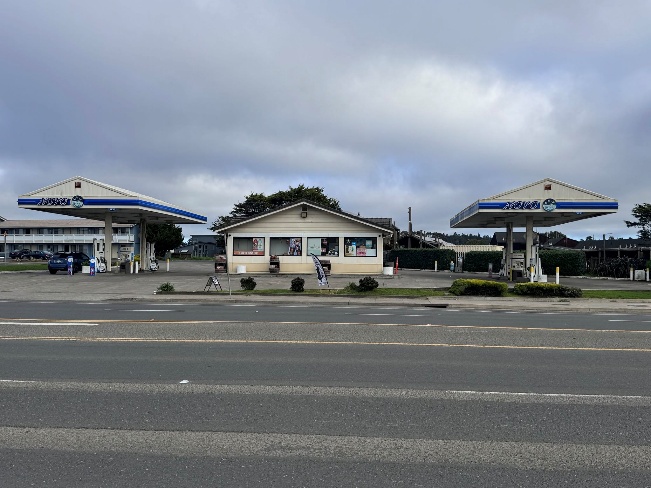
This spot is pure Highway 1 practicality. Most people do not come here to admire the building. They stop because they need gas, coffee, a snack, or just enough fuel to make it to wherever they are going next.
Today the corner at 1004 South Main Street is Noyo Gas Stop, a busy roadside station near the north end of the Noyo Bridge. It sits in one of Fort Bragg's most heavily traveled areas, where local traffic, harbor traffic, logging trucks, tourists, fishermen, and people heading up or down the coast all pass through.
Location
1004 S. Main Street sits along Highway 1 near the north end of the Noyo Bridge, on the stretch where South Main drops toward Noyo Harbor.
This is one of the most heavily traveled corridors in Fort Bragg, historically lined with gas stations, motels, markets, and repair shops serving drivers approaching or leaving the bridge.
History
At first, some people remembered Brown's Ranch Market being on this exact corner, but community comments helped sort out several nearby places that have become blended together over the years.
Brown's Ranch Market was remembered nearby, but not necessarily on the present Noyo Gas Stop parcel. One recollection placed Brown's farther north, around the area later occupied by the Super 8 Motel and Mountain Mike's Pizza. Another memory placed an earlier Brown's Market in a small red building near the north side of what later became the Safeway parking lot, with penny candy and the kind of small neighborhood-market feeling that people still remember decades later.
The present gas-station site has its own separate history. During the 1960s, this corner was remembered as a Chevron station with two service bays and automotive lifts. Fred Baron was associated with the station, and the place operated in the days when gas stations did more than sell fuel — cars pulled into the bays for repairs, oil changes, tires, and everyday mechanical work.
Kemgas was also remembered as having a bulk fuel tank near the bridge in the early 1970s. That fit the industrial and transportation character of the area, where fuel storage, delivery trucks, automotive services, and harbor traffic naturally gathered close to Highway 1.
Another nearby station, Force's Chevron, was remembered on the north end of the Noyo Bridge. The shifting station names and locations can be confusing because several gas businesses operated close together over the years.
The Building Today
Today, Noyo Gas Stop continues the corner's long connection to vehicles and Highway 1. The old service bays, fuel tanks, nearby markets, car lots, barns, motels, and roadside shops have mostly disappeared or changed beyond recognition, but the purpose of the location remains familiar.
People still pull in because they need something before crossing the bridge or continuing along the coast.
Why It Matters
The sign may say Noyo Gas Stop now, but this whole stretch carries memories of Chevron, Kemgas, Brown's Ranch Market, Cannon's Used Cars, small shops, fresh fish, crab cookers, stained glass, old motels, buses, barns, and a South Main landscape that was once far more open than it is today.
The corner shows how a single Fort Bragg parcel can hold decades of change while still doing essentially the same job — serving people passing through on Highway 1.
Community Memories
One longtime memory placed Brown's Ranch Market near a large barn that became almost as memorable as the store itself. People remembered friends living in buses and trucks nearby, gathering there during the off-season, and turning the property into a lively social spot — with parties, a large wood-fired hot tub, and even a sailboat being built inside the barn by Gil Roden. Nina was also remembered as having a stained-glass shop in the area.
Another person remembered a group of small storefronts near Brown's, including a sign shop run by people his mother called hippies and a fresh-fish market where local fishermen sold their catch. Crabs were cooked behind the shop in a large brick-and-stainless-steel cooker, while crab pots and household belongings were stored in the barn. The family lived in a small shack behind the businesses from about 1970 to 1972. North of that area, between the market and the old A&W, was Cannon's Used Cars.
One local recollection described a time when the land south of the present bridge was still mostly cow pasture. Highway 1 did not follow the route people know today — traffic went down through Noyo Harbor and crossed the river on an older bridge at the bottom of the hill. Much of the commercial development south of the current bridge had not yet appeared.
There were also memories of an auto court or motel in the general area during the 1950s. Some placed that farther south near the later Harbor Lite property, while Bull's Motel was remembered in the area that became part of the Safeway development. The motel rooms reportedly had small individual carports — another reminder of the early automobile-tourism era when South Main was filling with places designed around travelers and their cars.
Gee Bee remembers Brown's being in the broader South Main area when he arrived in Fort Bragg in 1986. He bought sandbags there before trying rock fishing for the first time. Half a sandbag was cheaper than lead, worked well in the rough coastal rocks, and did not leave more lead behind along the shore. It may be his only personal memory of Brown's, but it is exactly the kind of ordinary detail that keeps an old business alive.
Timeline
Before the modern bridge — Land south of the present bridge remembered as mostly cow pasture; Highway 1 traffic dropped down through Noyo Harbor and crossed on an older bridge at the bottom of the hill.
1950s — Auto courts and small motels remembered in the general South Main area, including Bull's Motel with small individual carports near what later became the Safeway development.
1960s — The present corner operated as a Chevron station with two service bays and automotive lifts, associated with Fred Baron.
Early 1970s — Kemgas remembered as having a bulk fuel tank near the bridge; nearby storefronts included a sign shop and a fresh-fish market with a brick-and-stainless-steel crab cooker; one family lived in a small shack behind the businesses from about 1970 to 1972.
1986 — Gee Bee arrives in Fort Bragg and remembers Brown's still in the broader South Main area, where he bought sandbags for rock fishing.
Today — The corner operates as Noyo Gas Stop, a busy Highway 1 roadside station near the north end of the Noyo Bridge.
Sources & Original Research
This article blends verifiable historical records with personal recollections shared by longtime Fort Bragg residents. Much of this information comes from community memory and is not available in any published source.
Sources: Original post text and photograph provided by Gee Bee; community memories provided by Clancey Kennedy, Gee Bee, Sandra Liljeberg, Richard Shafer, Tammy Lowe, Kelly Hilliard, Wendy Loomis, Dick Whetstone, Joe Wagner, Kyla Demetrio, Lucinda Mae Forrest Venegas, Darilyn Fenech, Heather Capps, Jo-Ann Allison, Ray Farrer, Russell Terrell, Bill Brazill, Loretta Joan Driggers, Richard Jacobsen, and Lu Rik.
