Redwood Investments
319 N. Main St., Fort Bragg, CA 95437 — Built in 1904 as the Bank of Fort Bragg, this landmark brick building survived the devastating 1906 earthquake and served generations of banking customers. From Coast National Bank and Crocker Bank to Redwood Investments and professional offices, 319 N. Main Street remains one of downtown Fort Bragg's most significant surviving early commercial buildings.
Last updated: October 20, 2026
Overview
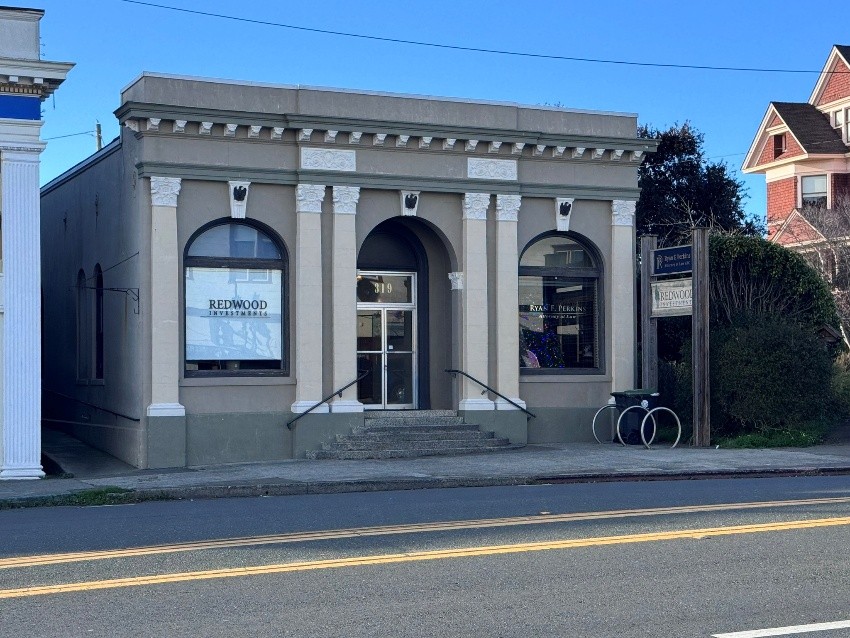
Redwood Investments at 319 N. Main Street occupies the historic Bank of Fort Bragg building, constructed in 1904 and among the few brick commercial structures to survive the 1906 earthquake.
Its symmetrical facade, arched window openings, and prominent central entrance reflect an era when bank architecture emphasized stability, security, and public confidence.
The building narrowly escaped destruction during the earthquake. Historical accounts describe heavy timbers from the mill being used to brace the damaged structure before repairs allowed banking operations to resume.
Over the following decades, the property housed Coast National Bank and Crocker Bank before transitioning to professional offices, including Redwood Investments and legal services.
Location
319 N. Main Street stands in Fort Bragg's historic downtown commercial district, where banks, merchants, hotels, and other businesses served the growing lumber and coastal communities.
Its substantial brick construction and formal architectural details distinguish it from many surrounding storefronts.
The building was part of a larger downtown banking district that included the Bank of Italy, later Bank of America, at the southwest corner of Main and Laurel Streets.
History
The Bank of Fort Bragg — 1904
Constructed in 1904, the Bank of Fort Bragg building represented a significant investment in the growing community.
Fort Bragg's timber industry supported expanding commerce, employment, and residential development, creating demand for established financial institutions.
The bank's brick construction and classical styling communicated permanence at a time when many neighboring commercial buildings were made of wood.
Surviving the 1906 Earthquake
The April 18, 1906 earthquake devastated Fort Bragg's downtown, destroying or seriously damaging numerous commercial structures.
The Bank of Fort Bragg building was among the few brick buildings that remained standing.
Historical accounts describe how heavy timbers from the mill were used to brace the weakened structure. Following reinforcement and repairs, the building returned to banking use.
Later building histories identify rebuilding work in 1914 and remodeling in 2005, although the extent of those alterations is not established in the available information.
Its survival preserves an important architectural connection to Fort Bragg before the earthquake.
Coast National Bank
In later decades, the building became associated with Coast National Bank.
Historical banking references identify Coast National Bank in Fort Bragg under a national charter dating to 1933.
Longtime residents remember the bank's tellers, officers, and familiar customers. One recalled a mother working there as a teller after graduating from Fort Bragg High School, while another remembered opening a first bank account at the location.
These recollections illustrate the personal relationships that characterized local banking during much of the twentieth century.
The Crocker Bank Years
By the early 1970s, community memories place Crocker Bank at 319 N. Main Street.
One resident described its occupancy as relatively brief and remembered Mr. Albertson as a bank manager or officer.
Others recalled visiting Crocker Bank during childhood.
The precise dates of the transition from Coast National Bank to Crocker Bank have not been established, but both institutions remain closely associated with the building's history.
The Old Bank Vault
One particularly memorable feature is an old walk-in safe reportedly preserved in the rear of the building.
A resident who had seen it described a large, heavy door and recalled that the former safe was being used as a storage room.
Although its current condition has not been confirmed, the remembered vault provides a physical connection to the building's original banking purpose.
Transition to Professional Offices
Following its banking years, the building was adapted for professional and business offices.
Redwood Investments was associated with the address by 2006. Other occupants have included legal offices, with Ryan F. Perkins, Attorney at Law, identified at the property.
Community recollections also connect the building with title-related services.
Despite changes in occupancy, its original architectural character remains recognizable, allowing the former bank to continue contributing to downtown commercial life.
Community Memories
For generations of Fort Bragg residents, 319 N. Main Street was simply remembered as the bank.
Some recalled Coast National Bank, while others remembered Crocker Bank during the early 1970s.
Memories include a mother working as a teller after high school, Mr. Albertson serving as a bank officer, and a resident opening a first bank account there.
Another contributor remembered the old walk-in safe in the rear, complete with its heavy door, being used for storage.
Residents also recalled the later transition to lawyers' offices and title-related businesses, with some remembering those professional services occupying the building for many years.
The building's survival of the 1906 earthquake remains another important part of local memory. Its continued presence offers a tangible reminder of the downtown that existed before much of Fort Bragg was rebuilt.
Why It Matters
319 N. Main Street is one of Fort Bragg's most important surviving connections to its pre-1906 downtown.
Built in 1904, the structure endured a devastating earthquake, underwent reinforcement and later alterations, and continued serving the community through successive generations of banking and professional activity.
Its history traces the evolution of local banking from the Bank of Fort Bragg through Coast National Bank and Crocker Bank, while its later office use demonstrates the adaptability of historic commercial buildings.
The classical facade, brick construction, and remembered vault preserve reminders of its original purpose.
More than 120 years after construction, the former Bank of Fort Bragg remains a working part of downtown and a lasting symbol of the community's resilience, rebuilding, and commercial heritage.
Timeline
No separate timeline is documented in the existing text.
For more local history, photographs, and archived articles, explore the complete Fort Bragg History collection.
See the full archive: www.infortbragg.com
Sources & Original Research
This article blends verifiable historical records with personal recollections shared by longtime Fort Bragg residents. Much of this information comes from community memory and is not available in any published source.
Original Buildings and Businesses in Fort Bragg, California — With History posts and community recollections.
Community contributions: Linda Stanton, Nancy Fereira, Rus Jewett, Sandra Liljeberg, Steven Taylor, Teresa Warmke, Mark Taylor, Kyla Demetrio, Donna Winters, Heather Capps, Tina Krenov, and Loretta Joan Driggers.
Fort Bragg History — The 1906 Earthquake; 1906 Earthquake Photos and Comparisons.
Kelley House Museum — A Whole Lot of Shaking.
Historical banking references identifying Coast National Bank in Fort Bragg and its 1933 national charter.
Previously compiled building history identifying 1904 construction, 1914 rebuilding, and 2005 remodeling.
Original Fort Bragg historical research and community archive, InFortBragg.com.
