Sew and Sew
890 N Franklin St — A long warehouse building that went from pea packing plant to co-op feed store to Overboard film location to today’s maker spaces.
Last updated: June 24, 2026
Overview
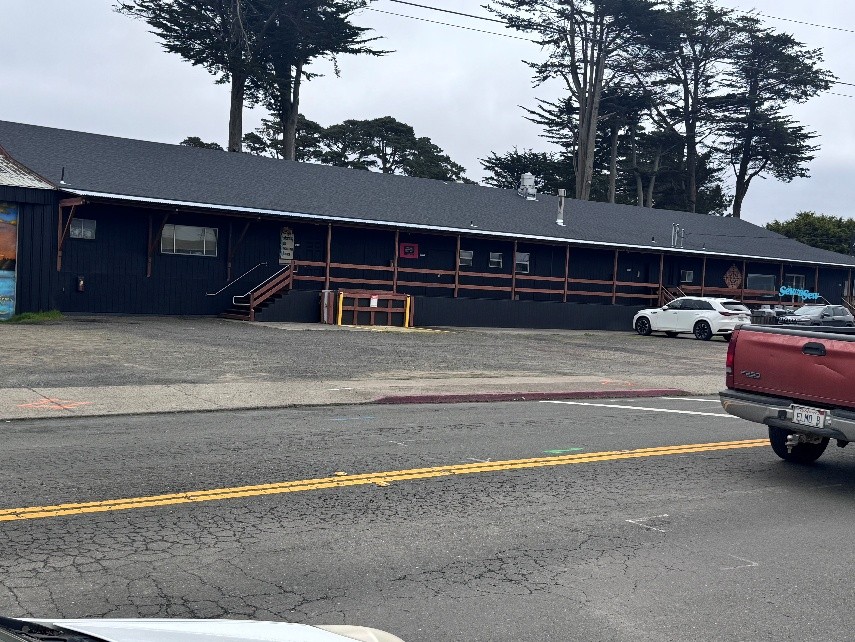
Sew and Sew
The long building at 890 North Franklin Street is one of those Fort Bragg properties that makes more sense the longer it is studied. It was never really about one single storefront identity. It was built for work.
The building has a long footprint, loading access, multiple bays, and the practical layout of a property tied to the railroad-and-warehouse side of town rather than a polished downtown retail block. That working character still survives today.
Current records show the property as a warehouse/commercial site, and recent listings describe 890--900 North Franklin as a multi-unit property with retail, kitchen, office, and performance uses. That fits the building perfectly. It has always been a place with many lives under one roof.
Location
The building stands at 890 North Franklin Street, on the north side of Fort Bragg's old working commercial district.
This part of Franklin Street has a different feeling from Main Street storefronts. It connects more closely to the railroad, shipping, warehouse, and industrial history of town. That location helps explain why the building looks the way it does and why it was so adaptable over time.
Sew 'n Sew is one of the visible current tenants, and both the business itself and Visit Fort Bragg place it at 890 North Franklin Street, Suite A.
History
The older history of this building begins with Fort Bragg's agricultural and shipping past.
Local memory identifies the building first as a pea packing plant. That lines up with a Kelley House Museum history piece noting that the Fort Bragg pea packing house later became the Co-Op Feed warehouse. The wider pea story also fits the period remembered in the discussion, when Fort Bragg was shipping railroad cars of canned peas east in the early 1930s.
That helps explain the building's design. A long work building with loading doors and rail access made sense in a town where produce, feed, freight, and goods moved through the railroad system. The comments about raised loading doors and tracks behind the terminal buildings fit that industrial pattern exactly.
This makes the stretch of Franklin feel less like a row of unrelated old buildings and more like part of the old shipping spine of Fort Bragg.
The next major remembered chapter was the co-op and feed store era. For many locals, this was not just an old warehouse. It was where people bought hay, chicken feed, rabbit pellets, and supplies. It was tied to ranches, animals, chores, and the everyday smell and feel of a working feed store.
Later memories also place other uses inside the same structure, including food-related production space and the food bank in part of the building. That is very Fort Bragg: one durable work building, reused again and again as the town's needs changed.
The murals on the side added another chapter. They helped turn a plain industrial building into something more public-facing, more local, and more memorable.
There is also a movie footnote. A filming-locations source for *Overboard* says the Franklin Street feed store owned by one of the local participants was used as the "fertilizer plant" where Kurt Russell's character worked. That lines up closely with the community memories identifying this building as the location used in the film.
It is a funny detail, but it also fits. Even in Hollywood, this building was cast as exactly what it looks like: a no-nonsense Fort Bragg work site.
The Building Today
Today the building continues to serve several uses under one roof.
Sew 'n Sew gives the property one of its current public-facing identities, while the broader 890--900 North Franklin site continues to function as a flexible commercial and maker-space property. The building's present-day mix of retail, kitchen, office, creative, and performance uses fits its history of practical reuse.
It still looks like a building made to work. That is part of its appeal. It does not need to hide its warehouse past, because that past is exactly what gives the place its character.
Why It Matters
The Sew and Sew building matters because it carries several Fort Braggs at once.
It connects the farm-and-railroad town, the pea packing era, the co-op and feed store years, the *Overboard* movie memory, the food bank and production chapters, and today's mix of small businesses and maker spaces.
It is one of those buildings that never had to be glamorous to be important. It just kept being useful.
And in Fort Bragg, that is often what makes a place worth remembering.
Sources
Original post text and photo provided by Gee Bee. Comment thread provided by Gee Bee, including contributor memories from Valerie Thornton, Adam VanWormer, Anna Roeth, Kim Taylor, Kelly Hilliard, Susan Collins, Dick Whetstone, Tammy Lowe, Frank Hartzell, Bradley Meadows, Teresa Warmke, Lisa D. Walker, Suzanne Pinney, Sarah Quentin, G. Allen Morris III, Evelyn Bishop Anderson, Jeni Lee Smith, Jo Ann Grant, Darilyn Fenech, Heather Capps, Nathan Strouth, Sue Drewry Dowdy, and Marilla Peeler. Kelley House Museum, Back When Peas Had a Chance. Mendocino Art Center / Bridges, Huckleberries and Robin Stew excerpt on Fort Bragg pea shipments. Sew 'n Sew official website. Visit Fort Bragg business listing for Sew and Sew. LoopNet property record for 890 N. Franklin St. Fast-Rewind, Overboard filming locations.
Sources & Original Research
This article blends verifiable historical records with personal recollections shared by longtime Fort Bragg residents. Much of this information comes from community memory and is not available in any published source.
