Temple of Kwan Tai
45160 Albion Street, Mendocino — California Historical Landmark No. 927, a small Taoist temple that survives from Mendocino’s 19th-century Chinese community.
Last updated: August 23, 2026
Bright red steps, green trim, and a small wooden building facing Mendocino Bay — this is one of the most important surviving pieces of Mendocino's early Chinese history.
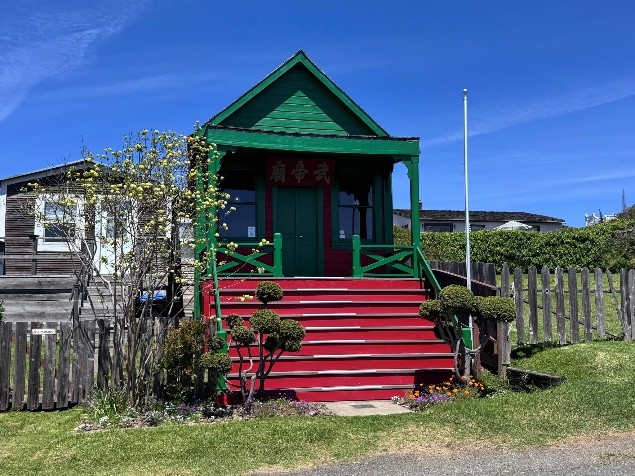
Overview
The Temple of Kwan Tai at 45160 Albion Street is a small Taoist temple that survives from Mendocino's once substantial 19th-century Chinese community.
Dedicated to Kwan Tai — also known as Guan Di, Kwan Dai, or Kwan Yu — the temple honors a figure traditionally associated with loyalty, integrity, courage, and justice. Although often described simply as the Chinese god of war, his importance reaches well beyond warfare, and he became a patron figure for merchants and others seeking protection and guidance.
The building is California Historical Landmark No. 927 and is especially significant because the other Chinese temples that once existed along California's North Coast have disappeared. California State Parks describes it as one of the oldest Chinese houses of worship in the state to remain in continuous use.
Location
The temple stands on a south-facing hillside at 45160 Albion Street, overlooking Mendocino Bay.
Its position is important to understanding the building. Mendocino once had a much larger Chinese neighborhood, but nearly all physical evidence of that community vanished. The temple survived while the surrounding Chinatown did not.
Today the little red-and-green building can easily be missed by someone concentrating on Mendocino's larger Victorian homes and commercial buildings. That was reflected in the replies to the original post, with visitors saying it took several trips to Mendocino before they finally stopped to see it.
History
Chinese immigrants began arriving on the Mendocino Coast during the early years of California settlement. Exactly how the first Chinese reached this particular stretch of coast remains partly a matter of historical debate. Some accounts connect their arrival with people moving north from the California gold fields or Monterey, while another long-told story connects some of the earliest Chinese residents with the 1850 wreck of the trading vessel Frolic near Point Cabrillo.
What is clear is that a sizable Chinese population developed here. The temple's own history reports that by the 1860s, Mendocino may have had between 500 and 700 Chinese residents. Many worked in the redwood lumber industry as cooks, laundry workers, laborers, and water slingers, carrying water in logging operations.
Among the early settlers were Lee Sing John and his wife Fong Sun Choy, both from Guangdong Province in southern China. Lee Sing John worked in the woods and later in the Caspar Mill cookhouse. Their descendants would become central to the survival of the temple.
The exact construction date remains one of the fascinating uncertainties in the building's story. Hee family oral history, particularly information preserved by Grace Hee Yee, places the temple's construction around 1852. A later examination by the California State Architect concluded that its materials were consistent with an early-1850s construction date.
The surviving documentary record is later. Official temple records report that the Albion Street property was sold to the Chinese in 1867. The deed was recorded to Lee Sing John in 1871, and a newspaper account describes formal opening ceremonies on November 4, 1882.
California State Parks therefore takes the cautious position that the temple may date to about 1854, while its firmly documented history begins in the early 1880s. That difference between family history, architectural evidence, and surviving written records is worth preserving rather than forcing the temple into one unquestioned construction date.
The Building Today
Inside, the building is remarkably simple. A prayer table and bamboo mat stand before the shrine to Kwan Tai. A small stove was traditionally used for burning prayer papers. Fortune sticks once used by the temple priest remain part of the collection, and simple wooden benches line the walls. The temple reports that, with only a few exceptions, its interior furnishings are original. A priest apparently lived in a tiny anteroom during the 1870s.
By the 1990s, preserving a wooden building more than a century old required considerably more than family maintenance. A nonprofit organization was established to preserve the temple and teach the history of Chinese immigrants on the Mendocino Coast, and the temple's official history says Hee family members deeded the property to the nonprofit in 1995.
In 1998 and 1999, architect Laura Culberson of Carey & Company carried out an extensive historic building assessment. That work helped establish what needed to be preserved and provided the documentation necessary to obtain restoration assistance. The restoration involved the Hee family, Temple trustees, local young people, preservation organizations, and state assistance. The restored Temple of Kwan Tai was formally rededicated in October 2001.
Why It Matters
Almost all of Mendocino's early Chinese neighborhood is gone. Mendocino's Chinatown was destroyed by fire in 1910, and as the Chinese population declined the businesses, homes, and gathering places disappeared with it. This one building makes that community visible again.
It is not simply an old building preserved because it looks unusual. It is one of the last physical links to hundreds of Chinese men and women who lived and worked along this coast, helped build Mendocino's early economy, established families and a community here, and left relatively few buildings behind to tell their story.
Community Memories
The replies to the original post described the temple as sacred, spiritual, beautiful, easily overlooked, and an important cultural resource. One person remembered visiting and shopping there many years ago — an interesting memory that deserves more investigation, because I have not yet found documentation explaining what commercial use may have been associated with the property.
Another reply came from a member of the Hee family, whose relatives helped preserve the temple through generations, thanking the community for helping bring attention to the structure.
Timeline
c. 1852-1854 — Family history and architectural evidence suggest the temple was built.
1867 — Temple records report the Albion Street property was sold to the Chinese.
1871 — The deed is recorded to Lee Sing John.
November 4, 1882 — A newspaper account describes formal opening ceremonies.
1910 — Fire destroys Mendocino's Chinatown; the temple survives.
June 29, 1979 — The Temple of Kwan Tai becomes California Historical Landmark No. 927.
1995 — Hee family members deed the property to a preservation nonprofit.
1998-1999 — Historic building assessment by architect Laura Culberson of Carey & Company.
October 2001 — The restored temple is formally rededicated.
Sources & Original Research: Temple of Kwan Tai official website and historical archive — temple history, Hee family history, Chinese community, interior furnishings, restoration and preservation information; California State Parks, Office of Historic Preservation — California Historical Landmark No. 927, registered June 29, 1979; Visit Mendocino County — location, landmark information and restoration history; Temple of Kwan Tai Taoist Religion history — background on Kwan Tai and the temple's religious significance. Community history and memories contributed by India Gingell, James Evan Snidow, Frances Hurley, Charmaine Caster, Lorraine Hee-Chorley, Billy Q. Smith, Kathy Ines B, Sandra Sawyer, Janice Wooten, Sue Thomas-Huse, and others replying to the original Buildings and Businesses in Mendocino, Ca. with history post. Original post photographs, community replies, continuing research, and compilation by Gee Bee.
Sources & Original Research
This article blends verifiable historical records with personal recollections shared by longtime Fort Bragg residents. Much of this information comes from community memory and is not available in any published source.
