Welcome Inn
148 E. Redwood Ave. — A modest mid-century bar on East Redwood that opened at six in the morning for loggers and fishermen, connected to the Welcome Inn restaurant that later became Lee's Chinese.
Last updated: October 3, 2026
A longtime East Redwood Avenue bar tied to the neighboring Welcome Inn restaurant, early-morning working-town routines, memorable bartenders and the cluster of downtown watering holes once jokingly called the “Barmuda Triangle.”
Overview
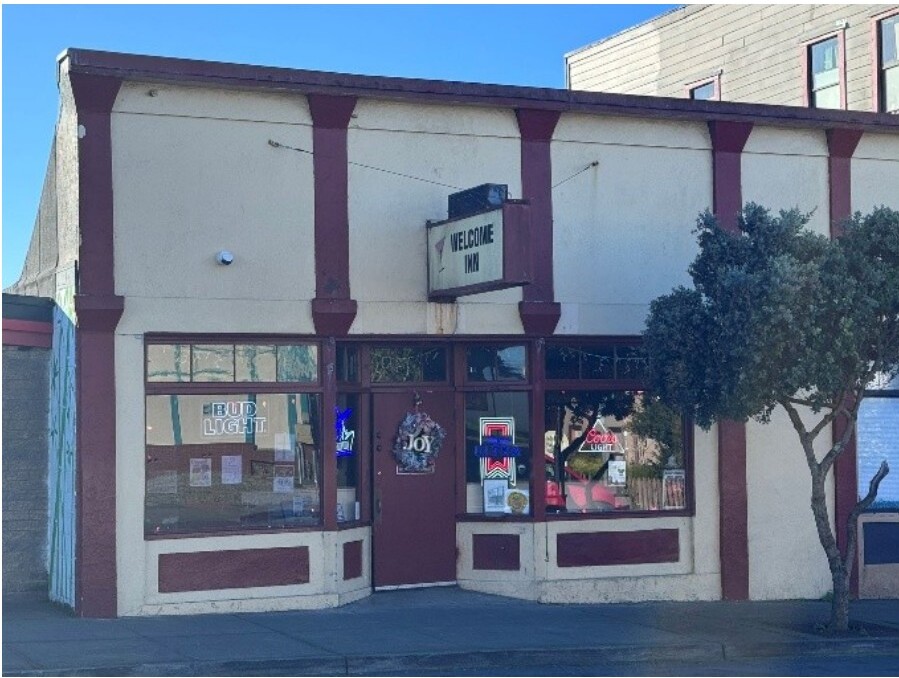
The Welcome Inn at 148 E. Redwood Avenue is one of Fort Bragg’s longtime neighborhood bars.
Its small, straightforward storefront fits naturally into a block long associated with bars, cafés, restaurants and other downtown businesses.
The bar’s history is closely connected with the restaurant immediately next door at 154 E. Redwood Avenue. Local family recollections remember the two establishments as the Welcome Inn bar and restaurant, once connected by an interior passage.
The restaurant later became Lee’s Chinese, while the Welcome Inn continued at 148 E. Redwood as a separate bar.
Location
The Welcome Inn is at 148 E. Redwood Avenue in downtown Fort Bragg.
Lee’s Chinese is immediately next door at 154 E. Redwood Avenue, and the Golden West Saloon is nearby at 128 E. Redwood.
Together with other former bars and restaurants in the area, these businesses helped make East Redwood Avenue one of downtown Fort Bragg’s best-known gathering places.
History
Community memory places the Welcome Inn restaurant next door to the bar by the early 1960s.
According to a family recollection, the restaurant building was constructed by Ed Mertle for the woman who opened and operated it. The restaurant and bar were connected inside, allowing people to move directly between the two spaces.
Children growing up around the restaurant remembered walking into the bar for peanuts, jerky and Shirley Temples. A bartender named Carlos is particularly remembered from this period.
The restaurant eventually became Lee’s Chinese. Lee’s was operating at 154 E. Redwood Avenue by 1980 and has continued the building’s restaurant tradition through later changes in ownership.
Another community recollection mentions a hot-dog business remembered as Yankee Doodle Dog or Yankee Doodle Doggy somewhere along this part of Redwood Avenue. Records confirm Yankee Doodle Doggy was operating on Redwood Avenue beginning in 1985, although its exact connection to the Welcome Inn or Lee’s storefronts has not been established.
The Welcome Inn remained a bar and became especially associated with the early hours of Fort Bragg’s logging, fishing and mill years.
Community Memories
One of the strongest memories of the Welcome Inn is its early opening time.
A former customer remembered stopping there at six in the morning for a quick drink before heading to the river for steelhead.
Other residents pointed out that early opening was common among Fort Bragg bars during the working-town years. For fishermen, loggers, mill workers and night-shift employees, six in the morning could mark either the beginning or the end of a workday.
People also remember the bartenders. Carlos is associated with the earlier years, while Will is remembered from a later period.
The surrounding bar scene developed a nickname of its own. With several drinking establishments operating within a short distance, locals jokingly called the area the “Bermuda Triangle,” or more memorably, the “Barmuda Triangle.”
Which establishments belonged to the triangle depended on the year and who was telling the story. Memories include the Welcome Inn along with various combinations of the Golden West, El Sombrero, Hoare House, Ship’s Wheel, Old Coast and Milano’s.
One former Fort Bragg police officer remembered having plenty of stories from the area.
The Welcome Inn also acquired an unofficial nickname of its own — the “Unwelcome Inn” — remembered today with humor as another piece of local bar-room folklore.
The bar remains at 148 E. Redwood Avenue, while Lee’s Chinese continues the restaurant tradition next door at 154 E. Redwood.
Why It Matters
The Welcome Inn preserves a piece of Fort Bragg history tied directly to the rhythms of a working town.
Its story includes fishermen stopping before daylight, mill and logging schedules that did not follow ordinary business hours, bartenders remembered decades later and children walking through from the adjoining restaurant for peanuts, jerky and Shirley Temples.
It is also part of the history of East Redwood Avenue, where several bars and restaurants once operated within a remarkably small area and created their own network of regulars, bartenders, friendships and stories.
Many of those businesses and routines have disappeared, but the Welcome Inn remains.
Its survival at 148 E. Redwood Avenue provides a direct link to an older Fort Bragg shaped by logging, fishing, mill work and the neighborhood establishments that served the people who kept those industries running.
Sources & Original Research
This article blends verifiable historical records with personal recollections shared by longtime Fort Bragg residents. Much of this information comes from community memory and is not available in any published source.
City of Fort Bragg / Visit Fort Bragg — Welcome Inn listing and Redwood Avenue business information.
Fort Bragg Restaurant Week — Lee’s Chinese listing at 154 E. Redwood Avenue.
InFortBragg.com — Welcome Inn and Lee’s Chinese historical research.
Walter Frederick Lina obituary — information on Yankee Doodle Doggy and later family ownership of Lee’s Chinese.
Broadcasting Yearbook records — Edward A. Mertle documented in Fort Bragg during the 1950s in connection with Mendocino Coast Broadcasting and KDAC. These records confirm his presence and business activity in Fort Bragg but do not independently establish that he constructed the Welcome Inn restaurant.
Original post and photographs provided by Gee Bee.
Community recollections from Joni Goble, Heather Capps, Ken Kim, Jim Nailor, Kelly Hilliard, Mikael Haye, Jeffrey Allen, Sarah Eliason, Navin Johnson and Anna Roeth.
