Bever House
45121 Little Lake Street, Mendocino — An 1880s residence whose wooden water tower, garden, and Bever brothers history still mark Little Lake Street.
Last updated: August 5, 2026
Overview
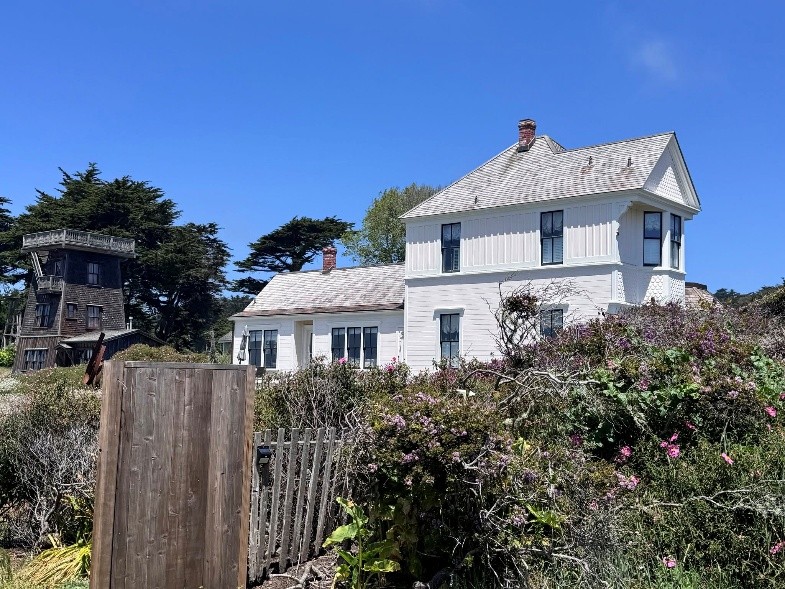
Some Mendocino houses seem to carry two histories at once — the family story inside the walls, and the working village story standing beside it in the form of a water tower.
The Bever House at 45121 Little Lake Street is one of Mendocino's recognizable historic residential properties. The house was built during the 1880s after brothers Sam and Ben Bever purchased the lot from William Heeser. Although the property carries the Bever name, the brothers apparently did not move into the house immediately. For part of its early history, it was used as a rental while they continued operating their hotel business in Mendocino.
Over the years, the property became associated with several residents, a substantial addition, a productive garden, a windmill and tank tower, and the Bever brothers' eventual retirement from hotel work. The wooden water tower standing beside the residence gives the property much of its visual character today. Although it follows Mendocino's traditional water-tower form, the present tower is a replacement constructed in 1991.
Location
The Bever House stands at 45121 Little Lake Street in the historic village of Mendocino. Little Lake Street forms part of the northern side of the old village and contains a collection of residences, gardens, water towers, churches, and other buildings connected to Mendocino's nineteenth-century development.
The house and tower fit naturally into this setting. Together, they reflect a period when village homes were supported by private wells, windmills, elevated water tanks, gardens, and other practical features that helped residents live and work before modern municipal services became standard.
History
Sam and Ben Bever were early Mendocino businessmen best remembered for their years in the hotel trade. The brothers acquired the Little Lake Street property from William Heeser, one of Mendocino's most influential early landowners and businessmen, who was involved in banking, publishing, road construction, surveying, local government, and property development throughout the village.
The Bever brothers built the house during the 1880s but continued operating their hotel for many years. During that period, the Little Lake Street residence was occupied by tenants. In 1889, Mendocino postmaster William Mullen and his family moved into the house. A few years later, in 1893, the residence was occupied by Professor R. Y. Glidden and his family. Glidden was the first principal of Mendocino High School, connecting the property with the early development of public education in the community.
In 1894, the Bever brothers constructed an addition to the house. The surviving historical account does not describe the work in detail, but the addition suggests that the brothers were improving and enlarging the property well before they retired. Like many older Mendocino homes, the Bever House appears to have developed in stages rather than being completed in its present form all at once.
In May 1904, Sam and Ben Bever announced their retirement after roughly 25 years in the hotel business. They sold their hotel property and business to John A. Silvia of Mendocino and moved into their cottage on Little Lake Street, which newspapers reported was being thoroughly renovated and repaired in preparation for their occupancy. What had previously served as a rental became the brothers' own home and retirement residence.
The Bever brothers added a water tower to the property in July 1904. At that time, a tower and elevated tank were practical household equipment rather than decorative architecture. Water could be pumped into the tank by a windmill or another pumping system and then distributed through the house by gravity. These towers became one of Mendocino's most recognizable architectural features. The tower now standing beside the Bever House is not the original 1904 structure; historical information from the Kelley House Museum states that it was replaced in 1991, preserving the traditional shape and the visual relationship between house and tower.
The property was offered for sale in 1923. A period description presented it as a well-developed residential property with approximately 120 feet of frontage, a fine garden, a windmill and tank tower, and a well-built and furnished house, along with conveniences noteworthy for the period including a steel range, hot-water boiler, and bath. Oliver and Selma Olson of Albion purchased the home later that year.
The Building Today
The Bever House is a wood-frame Mendocino residence with the proportions and details associated with the village's late nineteenth-century architecture. Its broad exterior walls, porch, windows, rooflines, garden setting, and neighboring tower create the appearance of a home that grew alongside the village rather than being imposed upon it later.
The tower is especially important to the property's identity. Without it, the residence would still be historically interesting, but the pairing of house and tower makes the property immediately recognizable as part of old Mendocino. Many improvements have been made over the years, and the house has continued to function as a living property rather than a building frozen at a single moment in its past.
The Bever House remains a private residential property. Its continued survival helps preserve the historic character of Little Lake Street and the larger Mendocino village landscape. Although the property has passed through different owners and undergone improvements, the Bever name remains attached to it because of the brothers who built the house, enlarged it, retired there, and added its original water tower.
Why It Matters
The Bever House tells more than the story of one old residence. It connects Mendocino's hotel business, postal service, early public education, domestic water systems, gardens, and residential growth. It also demonstrates how houses in the village were altered and improved as the lives of their occupants changed.
Most importantly, the house and water tower survive as a pair. Together, they preserve the appearance of a working Mendocino home from an era when a tower was not simply a picturesque village landmark. It was part of the machinery of everyday life.
Community Memories
The original Buildings and Businesses in Mendocino post did not receive additional historical recollections about former residents or uses of the property. The post did, however, include recognition of the photograph used to document the Bever House and its water tower.
Timeline
1880s — Sam and Ben Bever purchase the lot from William Heeser and construct the residence.
1889 — Mendocino postmaster William Mullen and his family occupy the house.
1893 — Professor R. Y. Glidden, the first principal of Mendocino High School, lives in the residence with his family.
1894 — The Bever brothers build an addition to the house.
May 1904 — Sam and Ben Bever retire from the hotel business, sell their hotel property to John A. Silvia, and renovate the Little Lake Street residence.
July 1904 — The brothers add a water tower to the property.
1923 — The house, garden, windmill, and tank tower are offered for sale; later that year Oliver and Selma Olson of Albion purchase the property.
1991 — The wooden water tower is replaced.
Today — The Bever House remains a private residence and a recognizable part of historic Mendocino.
Sources & Original Research
This article blends verifiable historical records with personal recollections shared by longtime Fort Bragg residents. Much of this information comes from community memory and is not available in any published source.
This article blends verifiable historical information with the original Buildings and Businesses in Mendocino post and its accompanying photograph. Historical information about the Bever brothers, early tenants, the 1894 addition, retirement from the hotel business, construction of the original water tower, the 1923 property advertisement, the sale to Oliver and Selma Olson, and the replacement of the tower in 1991 comes from the Kelley House Museum's Bever House history. Additional background concerning William Heeser and the Mendocino historic district was reviewed for historical context. Current real-estate information was consulted only to confirm the property's continued residential character and was not used as a primary source for its early history.
Sources: Original post text provided by Gee Bee. Photograph provided by Kyla Demetrio.
