Blue Door Inn
10481 Howard Street, Mendocino — An 1883 Victorian that served as a home, a cooperative hospital, a healing-arts center, the Whitegate Inn, and today’s Blue Door Inn.
Last updated: August 5, 2026
Overview
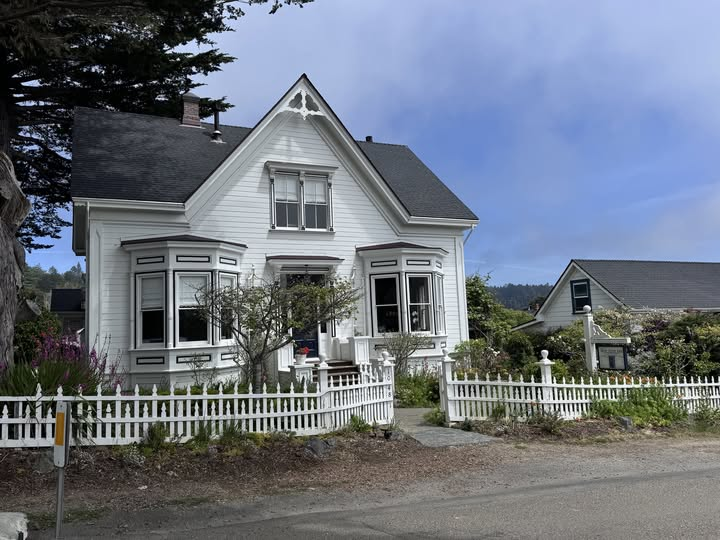
This house has worn more identities than its quiet white exterior first lets on.
The Blue Door Inn stands at the southeast corner of Howard and Ukiah streets in Mendocino. Built in 1883, the ornate white residence has served as a private home, an early hospital, a center for medical and healing practices, several commercial enterprises, the Whitegate Inn, and finally the Blue Door Inn. The property's long association with physicians, medical care, and doctors' families led it to be remembered locally as the House of Doctors.
Its pointed front gable, paired bay windows, decorative woodwork, white picket fence, and garden setting make it one of the most recognizable Victorian-era buildings on Howard Street.
Location
The Blue Door Inn is located at 10481 Howard Street, at the southeast corner of Howard and Ukiah streets in the historic village of Mendocino. Although its official address is on Howard Street, the house is closely associated with both streets because of its prominent corner location.
The main residence occupies the corner, while a smaller house stands beside it. Former employees remember that the smaller building was once used as the residence of the inn's owners.
History
The house was designed and built in 1883 by local builder A. F. Carmichael as a residence for W. T. Wilson, a Mendocino restaurant and hotel owner. Wilson operated businesses on Main Street, including a hotel and the Oyster and Coffee Saloon. His new Howard Street residence was considered one of the more desirable homes in Mendocino, with large double parlors, bathrooms, and enough interior space to support its later medical use.
In 1887, Dr. William McCornack rented the house and opened the Mendocino Hospital Company, an early cooperative medical organization created largely for working men employed in mills, logging camps, and other physically dangerous occupations along the Mendocino Coast. Members paid a joining fee and regular dues in exchange for medical care, medicine, nursing, room, and board when they became sick or injured. Within only a few months, the organization reportedly had hundreds of members, showing how strongly the community needed dependable and affordable medical care.
The hospital remained in the Howard Street house until 1895, when Dr. McCornack and pharmacist Herman Baum moved the operation into a larger building on Main Street, across from the Ford House. Several patients were reportedly transferred to the new hospital and drug-company building. The hospital later relocated to Fort Bragg in 1897, and the Howard Street house returned to residential use.
After the hospital moved, the property passed into the ownership of early Mendocino tailor P. H. McClellan and was later occupied by members of his family. The house was also associated with Lena Flanagan, a well-known Mendocino elementary school teacher, who continued living there after her marriage to Charles Boyle. A former resident later visited the building when it was operating as an inn and recalled staying there as a child while attending school, remembering that his teacher also lived in the house.
The house remained primarily residential until about 1970, when it began a new period of commercial use. Businesses associated with the property included the Victorian Complex, the Sea Change Inn, and the McCornack Center for the Healing Arts. The McCornack Center opened in 1974, named in recognition of the doctor who had operated the earlier hospital in the building, and reportedly included the practices of a physician, massage therapist, and chiropractor. Its presence returned the building to medical and wellness-related use decades after the original Mendocino Hospital Company had moved away.
In 1980, the property became the Whitegate Inn, beginning its long operation as visitor lodging. The large Victorian house, corner location, gardens, and smaller neighboring residence made it well suited to conversion into a Mendocino bed-and-breakfast inn. Former employees remember George and Carol Bechtloff as owners who lived in the small house next door; Richard and Susan Strom later purchased the inn and continued operating it under the Whitegate name.
The Whitegate Inn was later renamed the Blue Door Inn. Around 2011, the interior underwent an extensive renovation that former employees remembered as a complete gutting and remodeling of the inside. The renovation introduced a more contemporary lodging style, and while some visitors welcomed the updated appearance, people who remembered the Whitegate years felt much of the building's earlier Victorian atmosphere had been removed.
The Building Today
The Blue Door Inn is an important historic Mendocino residence, displaying many features associated with late nineteenth-century architecture: a steeply pitched roof, a prominent central gable, decorative trim beneath the gable peak, two projecting front bay windows, tall narrow windows, horizontal wooden siding, ornamental porch and fence details, and a formal entrance centered between the bays.
The nearly symmetrical front gives the house a dignified appearance, while the decorative brackets, garden, and white picket fence soften the building's scale. Despite years of institutional and commercial use, it still looks very much like the substantial village residence it was originally built to be. A smaller building stands beside the main inn, where the Whitegate Inn's owners once lived while operating the business.
The building continues to provide visitor accommodations under the Blue Door Inn name. Modern reservations and guest services have increasingly moved toward online booking, electronic communication, keypad entry, and less direct interaction between guests and innkeepers — an operating style that differs from the earlier bed-and-breakfast model remembered by former employees.
Why It Matters
The Blue Door Inn is more than an attractive Victorian lodging property. It was the first home of one of Mendocino's most important early cooperative medical organizations. It provided care for workers who faced injury and financial hardship, housed doctors and teachers, returned to medical use during the 1970s, and later welcomed generations of travelers as the Whitegate Inn and Blue Door Inn.
Few Mendocino residences have moved so naturally between private life, community healthcare, commercial activity, and hospitality. The building's changing identities are not separate stories. Together, they explain why this quiet white house has remained such a familiar part of Mendocino for more than 140 years.
Community Memories
Community recollections add details that are difficult to recover from property records alone. The building is remembered as a doctor's office where local patients received care, including visits to Dr. Swallow. Former employees remember the Whitegate Inn years, its Victorian interior, cookbook, rhubarb patch, owners, staff, and the smaller residence next door. One former employee recalled growing rhubarb on the property and using it in a special pastry.
One former employee recalled an elderly visitor arriving at the door and explaining that he had lived in the house as a schoolchild. Another remembered the Whitegate Inn as the beginning of a long career in innkeeping. Former employees also remembered the extensive interior remodeling completed after the property became the Blue Door Inn, and some felt the changes removed much of the warmth and historic atmosphere they associated with the Whitegate years.
Contributors: Sandra Liljeberg, Jeni Lee Smith, Jeri Cohen-Hegenbart, June Locke.
Timeline
1883 — A. F. Carmichael builds the house as a residence for restaurant and hotel owner W. T. Wilson.
1887 — Dr. William McCornack opens the cooperative Mendocino Hospital Company in the rented residence.
1895 — The hospital moves from Howard Street to a larger building on Main Street.
1897 — The hospital operation later relocates to Fort Bragg.
Late 1890s through the mid-1900s — The building serves as a private residence occupied by several Mendocino families, teachers, and doctors.
Around 1970 — The Victorian Complex operates in the building.
Early 1970s — The property is associated with the Sea Change Inn.
1974 — The McCornack Center for the Healing Arts opens in the house.
1980 — The building becomes the Whitegate Inn.
Later years — George and Carol Bechtloff and then Richard and Susan Strom are remembered in connection with the Whitegate Inn.
Around 2011 — The interior undergoes an extensive renovation as the property transitions to the Blue Door Inn.
Today — The Blue Door Inn continues the building's lodging use at the corner of Howard and Ukiah streets.
Sources & Original Research
This article blends verifiable historical records with personal recollections shared by longtime Fort Bragg residents. Much of this information comes from community memory and is not available in any published source.
This article blends verifiable historical information with the original Buildings and Businesses in Mendocino post and its community discussion. Historical information about the building's 1883 construction by A. F. Carmichael for W. T. Wilson, the Mendocino Hospital Company, later residents, commercial uses, the McCornack Center for the Healing Arts, the Whitegate Inn, and its transition to the Blue Door Inn comes from Kelley House Museum research and related historical material.
Sources: Original post text and photograph provided by Gee Bee. Comment thread provided by Gee Bee with contributor memories from Sandra Liljeberg, Jeni Lee Smith, Jeri Cohen-Hegenbart, and June Locke.
