Café Beaujolais
961 Ukiah Street, Mendocino — An 1893 Victorian farmhouse that became a maternity home, a family café, and one of the coast’s best-known restaurants.
Last updated: August 5, 2026
Overview
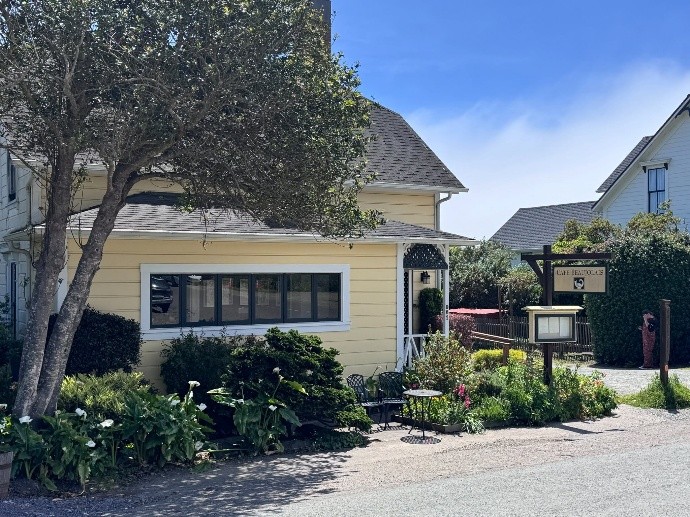
Some Mendocino buildings become famous without ever losing the feeling that they started as somebody's home.
Café Beaujolais sits at 961 Ukiah Street in an 1893 Victorian farmhouse surrounded by gardens, hedges, gravel paths, and the quiet sign that has become part of Mendocino's food memory. The restaurant opened in 1968, but the property's history began much earlier. Before becoming a dining destination, the house was a family residence and, for a time, a maternity home where many local babies were delivered.
Café Beaujolais rose to national prominence after Margaret Fox purchased the property in 1977. Her breakfasts, baked goods, cookbooks, mail-order foods, and approach to fresh ingredients helped make the restaurant one of the best-known culinary destinations on the Mendocino Coast. The restaurant has since passed through several owners and expanded to include the Brickery, the Waiting Room, and the neighboring Nicholson House.
Location
Café Beaujolais is located at 961 Ukiah Street in the historic village of Mendocino. The restaurant sits away from the busier commercial streets in a residential-looking setting. Its gardens, paths, porches, and farmhouse appearance make arriving there feel more like visiting a private home than entering a conventional restaurant.
That atmosphere has always been part of its identity. The building is large enough to accommodate a dining room and commercial kitchen, yet it still carries the scale and character of the house it was originally built to be.
History
The house was built in 1893 by Pete Hanson, who operated a shoemaker's shop on Main Street. Hanson lived there with his wife, Caroline Augusta Hinchelday. Their son, Ed Hanson, later married Alice C. Wright. The restaurant's official history continues to identify the building as the Hanson family home before its later medical and commercial uses.
In 1928, Lewis Anderson and Kate Bannerman purchased the house. Working in association with Dr. Preston, Bannerman used the property as a maternity home, and many babies were reportedly delivered there during the following decade. Long before the dining room became known for breakfasts and dinners, the house was connected with childbirth, medical care, and the beginnings of local family stories. Bartley and Florence Swartz purchased the property during the 1940s, forming the bridge between its earlier residential and maternity-home history and its eventual conversion into a restaurant.
In 1968, the Pitsenbarger family purchased the house and converted part of it into a small café. The family lived upstairs and served dinners on weekends. They chose the name Café Beaujolais because they liked the way it sounded; Beaujolais is also the name of a wine-producing region in France. What began as a modest restaurant inside a family home gradually developed into one of Mendocino's longest-running and best-known dining establishments.
Margaret Fox purchased Café Beaujolais in 1977 when she was 25 years old. She began serving breakfast and lunch and developed the dishes that brought the restaurant widespread attention. Her cooking emphasized generous breakfasts, fresh ingredients, breads, pastries, desserts, and food that could feel both comforting and inventive. Diners made special trips for breakfast and brunch, and her buttermilk cinnamon coffee cake, black bean chili, and baked goods became especially closely associated with the restaurant. Fox created a mail-order business offering Café Beaujolais food products and published the original Café Beaujolais cookbook in 1984, followed by Morning Food in 1990.
In 1984, Café Beaujolais began serving dinner with Christopher Kump as executive chef. Kump had trained and worked in France and brought another layer of culinary experience to the restaurant. He and Fox later married, combining their work and personal lives during one of Café Beaujolais' most influential periods.
The Café Beaujolais Brickery opened in 1990. Its wood-fired brick oven was used to bake breads and later pizzas, adding another recognizable part of the property's food history. Community recollections remember a time when people who could not yet afford a full meal would go around the back for almond croissants and other baked goods.
After owning Café Beaujolais for more than 23 years, Margaret Fox sold the restaurant in 2000 to Steve and Ashley Jenks, who updated the interior while continuing the established restaurant with longtime chef John Stroup and other existing staff. Chef David LaMonica purchased Café Beaujolais in 2006, continuing dinner service and expanding branded products including its well-known granola, and operated the restaurant until 2016.
Peter and Melissa Lopez purchased Café Beaujolais in late 2016 with their son, chef Julian Lopez. The family continued the restaurant's established identity while restoring and improving the vintage property and grounds. The Brickery's wood-fired pizza returned in 2017, and the garden was renewed as a space where visitors could eat and gather. In 2020, the Waiting Room opened at the property's last door on Ukiah Street, serving coffee, pastries, beer, and wine. In 2022, the nearby Nicholson House joined the Café Beaujolais group, adding lodging. The cookbook tradition continued in 2026 with The New Café Beaujolais Cookbook by Julian Lopez, including more than 85 recipes with updated classics from Margaret Fox.
The Building Today
The Café Beaujolais building retains the appearance of a late nineteenth-century farmhouse. Its steep roof, siding, trim, porches, windows, gardens, and residential scale help preserve the feeling that the restaurant grew inside an older home rather than replacing it.
The rooms have been altered over time to support commercial dining, kitchens, storage, and guest service. Mirrors and other interior changes have also been used to make portions of the dining space appear larger. Not every visitor has responded to those changes in the same way — some remember the rooms as warm and distinctive, while others found particular design features less appealing.
Café Beaujolais continues to operate at 961 Ukiah Street. Its cooking remains centered on seasonal ingredients, locally sourced produce, humanely raised meats, and seafood obtained from local fishermen, and the restaurant maintains a large wine list that includes Mendocino County wines. The ownership, menus, dining hours, and related businesses have changed over the decades, but the farmhouse continues to serve the same broad purpose it adopted in 1968: welcoming people into an old Mendocino home to share food.
Why It Matters
Café Beaujolais matters because its history reaches far beyond one restaurant. The building began as a family home, became a maternity home, returned to residential use, and then entered a restaurant life that has continued for more than half a century.
Under Margaret Fox, it helped place Mendocino on the culinary map. Its breakfasts, baked goods, dinner service, cookbooks, mail-order foods, and emphasis on quality ingredients influenced both visitors and home cooks. Later owners preserved that legacy while adding new chapters through the Brickery, the Waiting Room, Nicholson House, renewed gardens, and a new cookbook. Through every change, the old farmhouse has remained at the center of the story. Café Beaujolais became famous, but it never completely stopped feeling like somebody's home.
Community Memories
Community memories connect Café Beaujolais with work, celebrations, friendships, special meals, cookbooks, pastries, and the people who helped shape the restaurant.
One contributor remembered that her husband had worked on the property, adding Café Beaujolais to a long list of local buildings connected with his work. Another remembered Margaret Fox with affection and continues to use her cookbook occasionally. A longtime resident recalled a period when a full meal at the restaurant was unaffordable but almond croissants could be purchased around the back — a smaller experience that became a fond memory of the restaurant and its bakery. Other diners remembered bringing groups of friends, eating in the Victorian house, and forming their own opinions about the mirrors and interior design.
Contributors: India Gingell, Elaine Bauer, Sarah Quentin, Anna Roeth, Karen Hamilton.
Timeline
1893 — Pete Hanson builds the house as a family residence.
1928 — Lewis Anderson and Kate Bannerman purchase the property.
Late 1920s–1930s — Bannerman operates a maternity home in association with Dr. Preston, and many local babies are delivered in the house.
1940s — Bartley and Florence Swartz purchase the property.
1968 — The Pitsenbarger family converts part of the house into a small restaurant and names it Café Beaujolais.
1977 — Margaret Fox purchases the restaurant and begins serving breakfast and lunch.
1984 — Café Beaujolais begins dinner service with Christopher Kump as executive chef, and Fox publishes the first Café Beaujolais cookbook.
1990 — The Café Beaujolais Brickery opens and begins producing wood-fired breads.
2000 — Steve and Ashley Jenks purchase the restaurant.
2006 — Chef David LaMonica purchases Café Beaujolais.
2016 — Peter and Melissa Lopez purchase the restaurant with their son, chef Julian Lopez.
2017 — Wood-fired pizza returns at the Brickery, and the garden is revitalized.
2020 — The Waiting Room opens for coffee, pastries, beer, and wine.
2022 — Nicholson House joins the Café Beaujolais group.
2026 — The New Café Beaujolais Cookbook is published.
Today — Café Beaujolais continues serving guests in the 1893 farmhouse at 961 Ukiah Street.
Sources & Original Research
This article blends verifiable historical records with personal recollections shared by longtime Fort Bragg residents. Much of this information comes from community memory and is not available in any published source.
This article blends verifiable historical information with the original Buildings and Businesses in Mendocino post and its community discussion. Sources include Café Beaujolais' official history and current restaurant information; historical and biographical material concerning Margaret Fox and Christopher Kump; reporting from the San Francisco Chronicle, Los Angeles Times, Anderson Valley Advertiser, Mendocino Voice, and Word of Mouth Magazine; publisher information for The New Café Beaujolais Cookbook; and original research compiled for the Fort Bragg Buildings and Businesses archive.
Sources: Original post text and photograph provided by Gee Bee. Comment thread provided by Gee Bee with contributor memories from India Gingell, Elaine Bauer, Sarah Quentin, Anna Roeth, and Karen Hamilton.
