Crow's Nest Interpretive Center
South Coastal Trail — A small redwood A-frame on the Noyo Headlands with a Georgia-Pacific visitor-center past and a marine-science life today.
Last updated: June 27, 2026
Overview
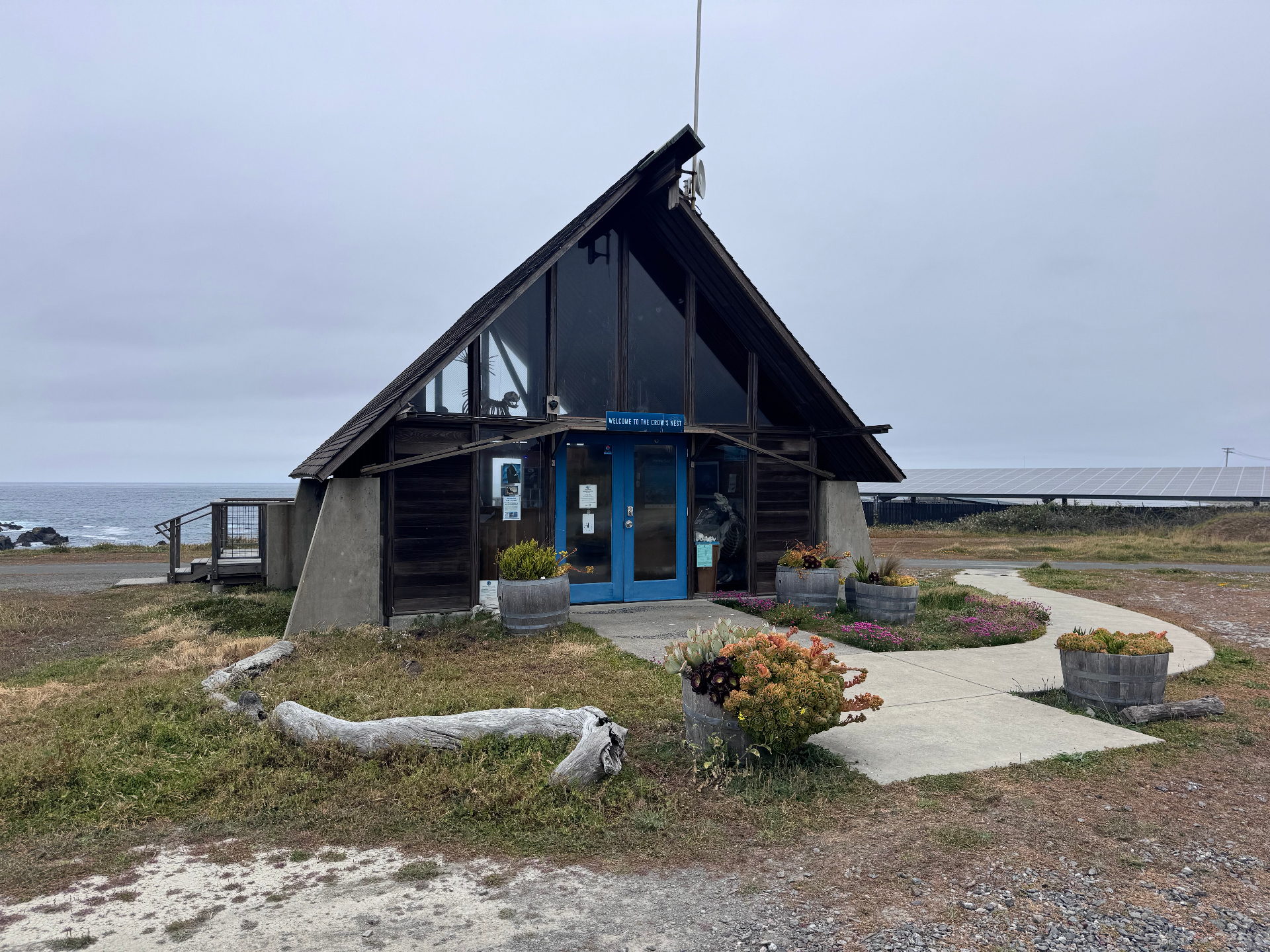
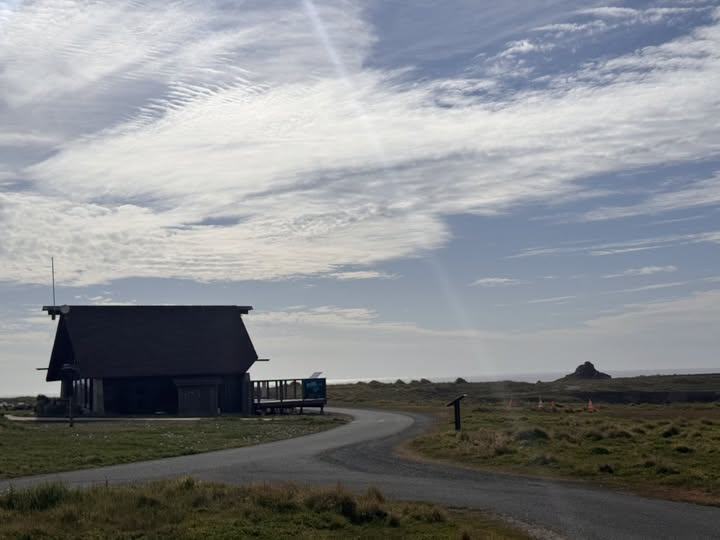
Crow's Nest Interpretive Center
Some Fort Bragg buildings only make full sense when you stand where they stand.
The Crow's Nest is one of those places. This small redwood A-frame sits on the Noyo Headlands with the ocean behind it, the trail running past it, and the old mill site story all around it. It is not a storefront, and it is not really an office. It feels like a lookout with a job — a place built to make people stop, look out, and understand what they are seeing.
Location
Crow's Nest Interpretive Center is located along the Noyo Headlands South Trail in Fort Bragg. It is reached by walking or biking the coastal trail, including from the Noyo Headlands parking area off West Cypress Street.
Its location matters because the surrounding land was once part of the Georgia-Pacific mill site, a major industrial property that shaped Fort Bragg's coastline for generations. Today that same landscape has been transformed into public access, coastal trail, marine education, and open space.
History
The Crow's Nest has a history that reaches back before its current interpretive-center role. Local memory places the A-frame at the south end of the old Georgia-Pacific tree nursery parking lot before it was moved to its current headlands location. In that earlier setting, it served as a visitor center connected to the mill property.
The building's wood interior was remembered as a showcase of products once manufactured by Georgia-Pacific. That detail is important because it places the Crow's Nest directly inside Fort Bragg's timber-era story. Before it interpreted marine life, whales, tide pools, and headlands restoration, it helped interpret wood products, mill work, and the industrial landscape that once dominated this part of the coast.
The move itself has become part of the building's story. One memory recalled the A-frame being moved from its old location to the new one, with approval to cross Georgia-Pacific property so it could travel the shortest possible distance. That practical detail fits the building perfectly. It was not simply abandoned or demolished when its first use ended. It was carried forward, literally, from the old mill landscape into the public headlands landscape.
The Building Today
Today, Crow's Nest Interpretive Center is part of the Noyo Center for Marine Science. The Noyo Center identifies it as an interpretive stop on the Noyo Headlands South Trail, with a tide pool aquarium, marine mammal exhibits, and a 73-foot terraformed blue whale representing the size of the center's blue whale skeleton.
The Whale Trail describes the site as a place for wide Pacific views, marine mammal watching, spotting scopes, and rotating marine-science exhibits. Gray whales pass by during migration, and seals and sea lions can often be seen from the trail and nearby rocks.
Why It Matters
Crow's Nest matters because it carries one of Fort Bragg's clearest transitions in a single small building.
It began as part of the Georgia-Pacific mill world, a visitor-facing structure tied to timber, wood products, and industrial Fort Bragg. Today it stands on public coastal land, interpreting marine life, ocean conservation, whales, tide pools, and the restored headlands. That change mirrors the larger story of the former mill site itself.
Fort Bragg did not erase this little A-frame. It moved it, reused it, and gave it a new job. That is what makes it worth remembering. The building now looks out over the same coastline that shaped the town, but it tells a different part of the story than it once did.
Community Memories
Community memories connect the Crow's Nest to the old Georgia-Pacific tree nursery parking lot, its earlier visitor-center use, wood-product displays, and the move from the mill property to the Noyo Headlands. Those memories help preserve the building's timber-era chapter alongside its current marine-science role.
Timeline
Georgia-Pacific Era — A-frame remembered near the old Georgia-Pacific tree nursery parking lot, serving as a visitor center and wood-products display space.
Mill Site Transition — Former industrial land begins shifting toward public access, open space, trail development, and marine education.
Move to Headlands — Building relocated from its earlier Georgia-Pacific site to the Noyo Headlands area.
Noyo Center Era — Becomes Crow's Nest Interpretive Center, part of the Noyo Center for Marine Science.
Present — Serves visitors along the South Coastal Trail with marine exhibits, tide pool displays, whale interpretation, and ocean views.
Sources & Original Research
This article blends verifiable historical records with personal recollections shared by longtime Fort Bragg residents. Much of this information comes from community memory and is not available in any published source.
Sources: Original post text and photo provided by Gee Bee; comment thread provided by Gee Bee with contributor memories from Diane Ogle, Karen Damron Green, and Jo-Ann Allison; Noyo Center for Marine Science, Crow's Nest Interpretive Center; Noyo Center for Marine Science, Our Story; The Whale Trail, Noyo Center for Marine Science; Mendocino Land Trust, Noyo Headlands Trail; Fort Bragg Headlands Consortium, Open Space.
