The Fort Building / Kai Poma Center
430 N. Franklin St., Fort Bragg, CA 95437 — The last surviving structure from Fort Bragg’s 1857–1864 military post — moved, reused, preserved, and today carrying a new Native-centered chapter as the Kai Poma Center.
Last updated: September 17, 2026
Overview
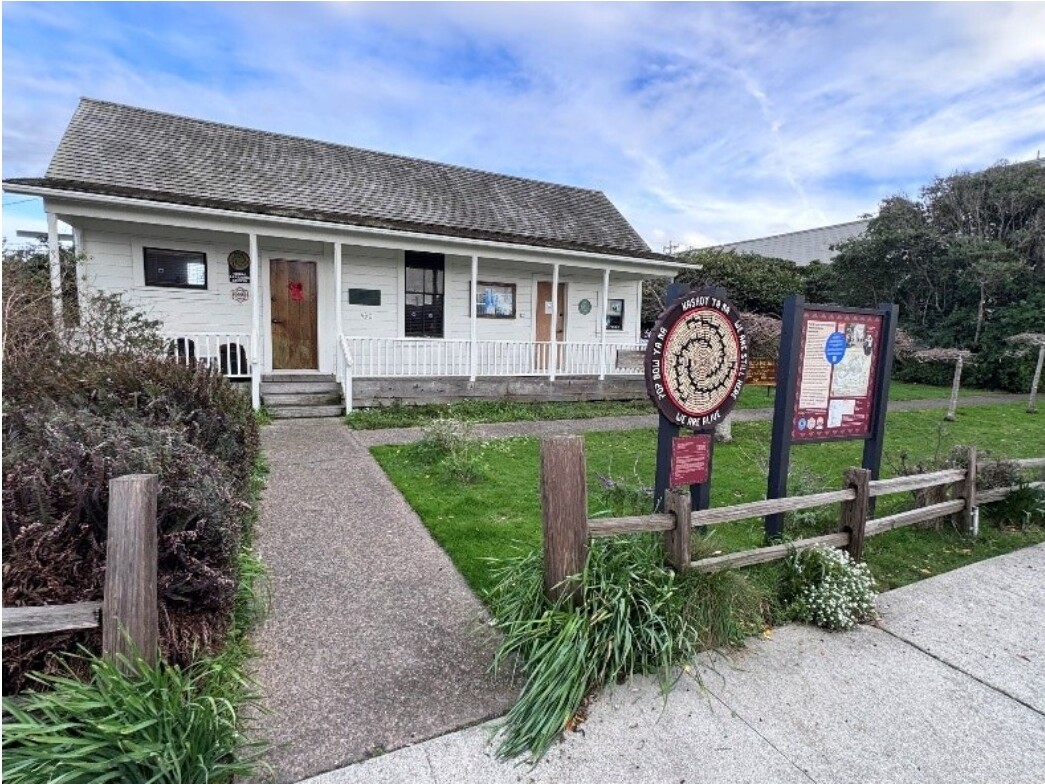
The Fort Building at 430 N. Franklin Street is a small structure carrying an unusually large piece of Fort Bragg history.
A historical marker identifies it as the last surviving building from the Fort Bragg military post and as the former quartermaster storehouse and commissary. The military post operated from 1857 to 1864, and the building originally stood near Laurel and Redwood avenues.
Its importance goes beyond its age. The military post was established within the Mendocino Indian Reservation during a period of forced confinement, displacement, and violence affecting Native communities of the Mendocino Coast.
Today the building is associated with the Kai Poma Center, adding a Native-centered chapter to a structure whose beginnings were tied to the military occupation of reservation land.
Location
The Fort Building now stands at 430 N. Franklin Street near Fort Bragg City Hall.
This is not its original location. Historic records place the quartermaster storehouse and commissary within the old military post near Laurel and Redwood avenues.
Its present site also carries another layer of Fort Bragg history. Community memories identify this area with the former Community Hospital and nearby houses that stood here before the property was cleared following the opening of Mendocino Coast Hospital.
The Fort Building was later moved to the Franklin Street property, where restoration and landscaping created the setting seen today.
History
Fort Bragg’s military post was established in 1857 within the Mendocino Indian Reservation.
The surviving building served as the post’s quartermaster storehouse and commissary, a practical supply building rather than a ceremonial structure.
The military post was abandoned in 1864, but the building survived through reuse and relocation.
Community recollections connect it to a later Union Lumber Company chapter, when it reportedly served as a museum containing historic company photographs.
Residents also remember the Fort Bragg Kiwanis playing an important role in moving the building to its present Franklin Street location. Local memories credit community members with helping arrange the relocation and later improvements.
After the move, the front porch was replaced, steps were added, and landscaping was completed around the building. A redwood fence along the sidewalk was reportedly built from old-growth redwood donated from fencing on an Airport Road property.
Before the Fort Building arrived, the property was associated with the old Community Hospital. Residents remember the hospital and neighboring houses remaining here until the area was eventually cleared.
Today the building is connected with the Kai Poma Center.
Its present role creates a significant historical contrast: a surviving structure from a military post established within the Mendocino Indian Reservation is now associated with Native-led activity.
That does not erase its earlier history. It adds another chapter to it.
Community Memories
Residents remember the site through both the Fort Building and the Community Hospital that preceded it here.
One resident remembered a husband spending a night in Community Hospital in 1966.
Another remembered being born there and later entering the abandoned hospital before it was demolished.
A longtime resident recalled the Fort Building being moved from a location west of Chief Celeri Drive and remembered Fort Bragg Kiwanis members helping make the relocation possible.
That same memory described the building’s earlier use as a Union Lumber Company photo museum and recalled later work on the porch, steps, landscaping, and sidewalk fence.
Another family recollection survives through a photograph of a house that once stood next door and was remembered as the home of a resident’s aunt.
Together, these memories connect several layers of the property’s history: the military post, Union Lumber Company, Community Hospital, nearby homes, preservation work, and the building’s present use.
Timeline
1857 — Fort Bragg military post established within the Mendocino Indian Reservation.
1857–1864 — Building serves as the military post’s quartermaster storehouse and commissary.
1864 — Military post abandoned.
Later years — Building survives through reuse and relocation.
20th century — Community memories associate the building with a Union Lumber Company historical photo museum.
1966 — Community Hospital still operating on the property later occupied by the Fort Building.
After Mendocino Coast Hospital opened — Community Hospital and nearby houses were eventually cleared.
Later — Fort Bragg Kiwanis and community members remembered as helping move the Fort Building to its present Franklin Street location.
1986 — Historical marker dedicated identifying the structure as the last remaining building of the Fort Bragg military post.
Present — Building associated with the Kai Poma Center.
Sources & Original Research
This article blends verifiable historical records with personal recollections shared by longtime Fort Bragg residents. Much of this information comes from community memory and is not available in any published source.
This article combines documented historical records with personal recollections shared by longtime Fort Bragg residents. Community memories are identified as recollections where documentary confirmation has not been established.
Sources: Historical Marker Database, Fort Building marker; Early Military Posts of Mendocino historical study; Fort Bragg Headlands Consortium historical material; InFortBragg.com research and archival material; original Facebook posts and photographs supplied by Gee Bee; community memories from Barbara Winters, Rus Jewett, Don Oliver, Theresa Timmer, and Marilla Peeler, including recollections of Community Hospital, nearby houses, the building’s relocation, Union Lumber Company photo museum use, Kiwanis involvement, landscaping, porch and fence work, and the surrounding property.
