The Depot / Olinsky Building
401 N. Main St. — From Army surplus and stage trucks to post office mail, bowling lanes, automobile dealerships, shops and museum displays, the Olinsky Building has carried more than a century of Fort Bragg transportation and commercial history under one roof.
Last updated: October 7, 2026
Overview
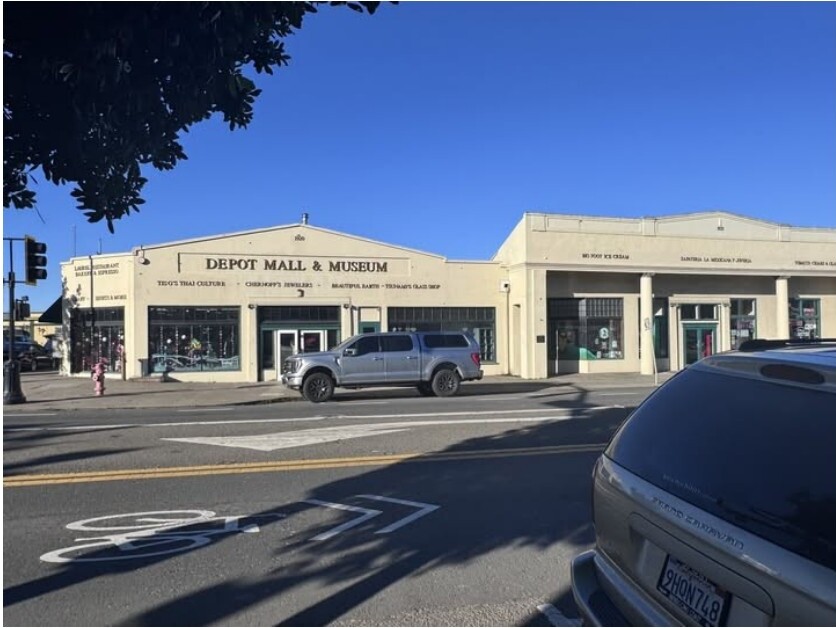
The Depot / Olinsky Building at 401 N. Main Street is one of Fort Bragg's most historically important surviving commercial buildings.
The original southern portion was built in 1920 by Julius Olinsky. A major northern addition followed in 1925, creating the building substantially as it appears today. Constructed of reinforced poured concrete, the original section was only the second Fort Bragg building constructed that way.
Over the decades, the building has served as an Army surplus store, transportation center, garage, post office, hardware store, confectionery, employment office, bowling alley, truck and automobile dealership and, later, the Fort Bragg Depot.
Its long connection with transportation led to the Olinsky Building being listed on the National Register of Historic Places on August 4, 1995, with transportation identified as its principal area of historical significance.
Today, the historic building remains in commercial use as the Fort Bragg Depot, with Laurel Deli & Desserts and historical displays continuing the property's combination of everyday business and local history.
Location
The Olinsky Building stands at 401 N. Main Street at the corner of Main and Laurel streets, one of downtown Fort Bragg's busiest and most visible intersections.
Its Main Street frontage placed it directly along routes used by automobiles, trucks and travelers, while its location near the railroad and downtown business district made it especially well suited to transportation-related uses.
Over time, the building became known by several names reflecting different chapters in its history, including the Post Office Building, Sutherland Building, Anchor Ford Building and Fort Bragg Depot.
History
In 1920, Julius Olinsky constructed the original southern portion of the building at Main and Laurel streets.
Its first use was as an Army surplus store, but that chapter was brief. The building soon became a transportation center for Coast Line Stages, a trucking company that shared the property with State Garage. Trucks were maintained there, while the garage also handled general automobile repair.
That change established a pattern that would define the property for much of the next seven decades: transportation, vehicle repair and businesses connected with moving people, freight and mail along the Mendocino Coast.
By 1924, Fort Bragg needed a larger post office. Julius Olinsky proposed adding a new section to his existing building, and in 1925 the structure was expanded northward.
The addition contained Fort Bragg's new post office along with Olinsky's Confectionery Store and Kemppe Hardware. An open hallway across the front connected the original and new sections.
Coast Line Stages also obtained the mail-hauling contract. Mail could be transferred between the post office and transportation company, closely linking two of the building's most important functions.
Coast Line Stages remained here until 1946 and became a major carrier of freight and supplies into and out of Fort Bragg during an era when overland transportation to the Mendocino Coast remained difficult.
The post office moved to new quarters in 1939.
Its former space was then divided between the California State Employment Office and Fort Bragg's first regulation-size, family-oriented bowling alley. The bowling alley became a popular recreational destination and remained in the building until 1950.
Another major chapter began in 1946 when Ralph Sutherland moved his truck and equipment business into the southern portion vacated by Coast Line Stages.
Sutherland sold trucks and farming equipment needed by coastal businesses as well as Packard automobiles and, later, Chrysler cars and trucks.
When the bowling alley moved out in 1950, Sutherland took over the entire building, returning virtually the whole property to transportation and automotive use.
Sutherland retired in 1968.
Anchor Ford, already a longtime Fort Bragg automobile dealership, then took over the building and remained there until closing in 1992. By that time, it was one of only two automobile dealerships remaining in Fort Bragg.
After Anchor Ford closed, the building stood vacant for approximately two years before being renovated as the Fort Bragg Depot.
The redevelopment turned a structure that had spent most of its life handling freight, mail, trucks and automobiles into a combination of commercial and historical space.
The building's preservation recognized an unusual continuity in its history. Rather than becoming a museum separated from everyday activity, the Olinsky Building remained a place where people could eat, shop, walk through and encounter pieces of Fort Bragg history at the same time.
Community Memories
Anchor Ford remains one of the businesses most strongly associated with the building by longtime residents who remember when automobiles filled the property.
Chernoff's is another remembered business. One customer recalled still wearing earrings purchased there about 25 years earlier and remembered the proprietor as kind and reasonably priced.
One comment placed Daly's in the building, while another longtime resident immediately disputed that memory. Daly's is documented elsewhere in the Buildings & Businesses project at the Company Store at 301 N. Main Street, so it is not included here as a confirmed Olinsky Building tenant.
The spelling of the building's name also came up in the discussion. The historical name is Olinsky, matching Julius Olinsky and the National Register documentation.
These memories add the everyday shopping and automobile-dealership years to a building already documented for its larger role in Fort Bragg's transportation history.
Timeline
1920 — Julius Olinsky builds the original southern portion of the Olinsky Building as an Army surplus store.
Early 1920s — Coast Line Stages and State Garage establish transportation, trucking and automobile-repair operations in the building.
1925 — The building is expanded northward for Fort Bragg's new post office, Olinsky's Confectionery Store and Kemppe Hardware.
1925–1939 — The post office operates in the new addition while Coast Line Stages carries the mail.
1939 — The post office moves out. The California State Employment Office and a regulation-size family bowling alley occupy the former post office area.
1939–1950 — Bowling operates in the building.
1946 — Ralph Sutherland moves his truck, equipment and automobile business into the southern portion after Coast Line Stages leaves.
1950 — The bowling alley relocates and Sutherland takes over the entire building.
1950s–1968 — The Sutherland business continues with trucks, equipment and Packard and later Chrysler vehicles.
1968 — Anchor Ford takes over the building.
1968–1992 — Anchor Ford operates at 401 N. Main Street.
1992 — Anchor Ford closes.
Around 1994 — After approximately two years vacant, the building is renovated as the Fort Bragg Depot.
1995 — The Olinsky Building is listed on the National Register of Historic Places.
Today — The historic Depot remains in commercial use while displays inside preserve pieces of Fort Bragg's transportation and business history.
Why It Matters
Few Fort Bragg buildings connect as many pieces of the town's history as the Olinsky Building.
It began during the period when trucks and automobiles were transforming travel on the Mendocino Coast. Coast Line Stages moved freight and mail through the building. The post office connected Fort Bragg with the outside world. A bowling alley brought families through the doors. Sutherland and Anchor Ford kept the property tied to trucks, equipment and automobiles for decades.
Its importance is not simply that many businesses occupied the building. Many of those businesses were directly connected to how Fort Bragg functioned — how goods arrived, how mail moved, how vehicles were repaired, how people traveled and how residents spent their everyday lives.
More than a century after Julius Olinsky built the first section, the building is still being used rather than simply remembered.
That continuity makes the Depot / Olinsky Building an important surviving piece of Fort Bragg's commercial and transportation history.
For more local history, photographs, and archived articles, explore the complete Fort Bragg History collection.
See the full archive: www.infortbragg.com
Sources & Original Research
This article blends verifiable historical records with personal recollections shared by longtime Fort Bragg residents. Much of this information comes from community memory and is not available in any published source.
National Register of Historic Places nomination for the Olinsky Building, 401 N. Main Street, Fort Bragg; National Park Service, National Register of Historic Places, Olinsky Building, Reference No. 95000995; California Office of Historic Preservation; Fort Bragg Advocate historical newspaper references listed in the National Register nomination; Sanborn Fire Insurance Map, 1941, as referenced in the National Register nomination; City of Fort Bragg Feasibility Study, 1991, as referenced in the National Register nomination; Original posts, photographs and project research supplied by Gee Bee; Community comments and recollections from the original Depot / Olinsky Building discussions; InFortBragg.com historical archive.
