G-P Mill Site Main Gate
215 S. Main St — The old main gate to the Georgia-Pacific mill site, where generations of Fort Bragg workers crossed the threshold between town life and the industrial waterfront.
Last updated: June 8, 2026
Overview
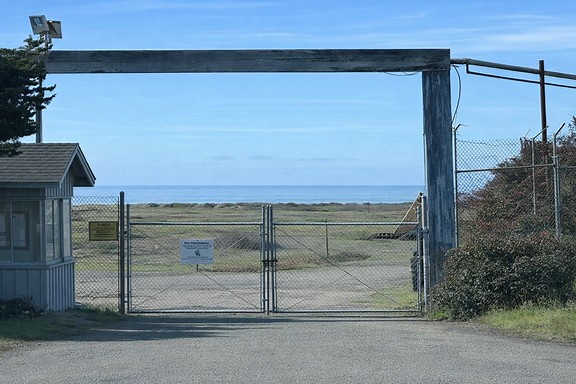
G-P Mill Site Main Gate
This address is one of those Fort Bragg receipts that still carries a whole era inside it.
The old main gate to the Georgia-Pacific mill site was not just an entrance. It marked the edge of the working waterfront, the line between town life and the place where generations of people went in to earn a living. For a long time, this gate stood at the threshold of one of the biggest forces in Fort Bragg's history.
Location
The gate stood at 215 South Main Street, along the edge of the former mill site. This was one of the places where town met industry directly.
The larger Georgia-Pacific mill property stretched across a huge part of Fort Bragg's oceanfront. For more than a century, much of that shoreline was industrial land, fenced off from public use and tied to lumber production, shipping, rail, trucking, and mill work.
This gate mattered because it was not just a property line. It was a daily crossing point.
History
The deeper story behind the gate goes back well before the Georgia-Pacific name. Fort Bragg's lumber operation grew out of the Fort Bragg Redwood Company, then became Union Lumber Company in 1905. Later came Boise Cascade, and by 1973 the mill had become part of Georgia-Pacific.
By then, the mill site had already shaped Fort Bragg for generations, tying the shoreline, railroad, harbor, lumber yards, shipping, and local paychecks into one enormous working landscape.
Workers went through this gate. Trucks rolled through it. Security watched it. People measured their days by the whistle, the shifts, the lunch break, the steam, the smell of timber, and the traffic moving in and out of the mill.
The comments brought that world back in a way official history never quite can. People remembered the noon whistle and the afternoon whistle, some missing them deeply because they helped structure the whole town's day. Others remembered the steam from the stacks and how locals would correct visitors who called it smoke.
There were memories of the mill smell, the busy feeling, the logging trucks, the office workers, the security shack, and the strange way the mill could feel both ordinary and enormous at the same time.
The Building Today
Today, the larger former mill site is part of Fort Bragg's ongoing story of cleanup, public access, redevelopment, and reimagining the coast. The old gate area no longer functions as the daily industrial threshold it once was, but it still reads as a piece of industrial memory left in plain sight.
Even stripped down to posts, fencing, pavement, and open space beyond, the site marks one of the most important transitions in Fort Bragg history.
Why It Matters
The G-P Mill Site Main Gate matters because it represents the working-town Fort Bragg that shaped generations of local life.
Behind this gate was the world that once defined the town: lumber, shifts, trucks, steam, paychecks, whistles, danger, pride, pollution, and work. It was the heart of a mill-town economy, and for many families, it was directly connected to buying homes, raising children, and building lives on the coast.
The mill itself was complicated in memory. People missed it because it was the heart of a working town. It provided jobs and gave Fort Bragg a bustling industrial identity. But the comments also remembered the harder side — pollution, PCB concerns, berries growing along contaminated ground, and the long environmental shadow left behind after the industry moved on.
Both parts belong in the story. The mill gave Fort Bragg work, identity, and community structure, but it also left behind cleanup, debate, and a changed shoreline.
Some places are remembered because of what was built there. This one is remembered because of what people passed through there — day after day, shift after shift, generation after generation.
Community Memories
Community memories connect this gate to the noon whistle, afternoon whistle, steam from the stacks, the smell of timber, logging trucks, mill workers, office workers, security, the security shack, lunch breaks, wind direction, smoke-versus-steam debates, the busy feeling of a mill town, and the complicated environmental legacy left behind.
The gate location also stirred local debate. One memory identified this as the main gate of Union Lumber Company, with security in the shack on the left. Another remembered the Oak and Highway 1 entrance as the logging-truck entrance, while Redwood Avenue was described as the official main gate in that era. That kind of detail matters because the mill was not one simple doorway. It was a whole industrial city inside the city, with different entrances, routines, and meanings depending on who was using them.
Timeline
Late 1800s — Fort Bragg's lumber operation grows out of the Fort Bragg Redwood Company era.
1905 — Union Lumber Company becomes the major lumber company identity tied to Fort Bragg.
Later 20th Century — Boise Cascade becomes part of the ownership sequence.
1973 — The mill becomes part of Georgia-Pacific.
Mill Era — Workers, trucks, security, whistles, steam, lumber operations, and daily industrial routines define the site.
2002 — Georgia-Pacific closes the Fort Bragg mill.
Post-Mill Era — Former mill site becomes part of Fort Bragg's ongoing cleanup, access, redevelopment, and coastal reuse discussions.
Present — The old main gate remains part of local memory as a threshold between town life and the industrial waterfront.
Sources & Original Research
This article blends verifiable historical records with personal recollections shared by longtime Fort Bragg residents. Much of this information comes from community memory and is not available in any published source.
Sources: Original post text supplied by Gee Bee; comment thread supplied by Gee Bee including memories from Clancey Kennedy, Dave Martin, Tina Krenov, Rus Jewett, Patty Reed Barrow, Wendy Loomis, Sandra Liljeberg, Dave Birdsall, Tom Gossard, Nancy Atkinson, Heather Capps, Heather Currier, and Katherine Ritchey; City of Fort Bragg Former Mill Site Reuse materials; Fort Bragg-Mendocino Coast Historical Society materials; Visit Fort Bragg timeline references; California State Coastal Conservancy Fort Bragg Waterfront Acquisition materials.
