Masonic Hall / Savings Bank of Mendocino County
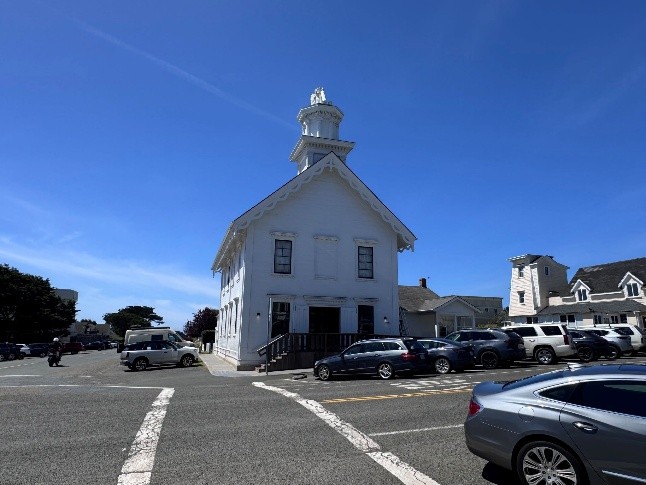
10500 Lansing Street, Mendocino — The 1866 Masonic Hall crowned by Erick Albertson's redwood sculpture Time and the Maiden.
Last updated: August 13, 2026
Some Mendocino buildings are famous before people even know what they are, and this one has been stopping people in the street for generations.
Overview
The old Masonic Hall at 10500 Lansing Street is one of Mendocino's most recognizable landmarks. The formal white building is distinctive enough, but the sculpture rising above its roof is what makes it unforgettable.
Known as Time and the Maiden, or Father Time and the Weeping Virgin, the roughly ten-foot-tall sculpture was carved by Erick Jensen Albertson from a single block of local redwood. It has watched over the corner of Lansing and Ukiah Streets for more than a century.
Today the first floor is occupied by the Savings Bank of Mendocino County, while Mendocino Masonic Lodge No. 179 continues to use the upstairs lodge room.
Location
The Masonic Hall stands at 10500 Lansing Street at the corner of Lansing and Ukiah Streets in the heart of Mendocino.
The building was originally erected beginning in 1866. In 1883 it was moved to its present position to accommodate the widening of the streets.
History
Mendocino Masonic Lodge No. 179 was organized in 1865 and is believed to be the oldest continuously operating fraternal organization on the Mendocino Coast.
Before the lodge had a building of its own, members met in a room above William Heeser's General Store. Heeser later donated land at Lansing and Ukiah Streets for a permanent Masonic hall.
In February 1866, Erick Jensen Albertson was awarded a $1,000 contract to construct the building. Albertson, a lumber-mill worker and the lodge's first Worshipful Master, worked with John Gschwend on the design. Construction stretched over approximately six years because the men were also working at the mill and money for the project came in gradually. The completed hall ultimately cost about $3,860.
Albertson also created much of the elaborate interior decoration, including the curved barrel-vault ceiling, fluted columns, arches and other carvings containing Masonic symbolism.
But his most famous work sits above the roof.
Albertson began carving Time and the Maiden even before construction of the hall. Kelley House Museum records describe him working on the sculpture at night in a shelter near Big River beach. The finished carving was made from a single block of redwood and was eventually placed on a specially built cupola atop the hall.
The sculpture is filled with Masonic symbols. Father Time stands behind a mourning maiden beside a broken column. Around them are an hourglass, open book, urn, sprig of acacia and scythe. The hourglass represents the passing of life; the broken column represents a life cut short; the maiden represents mourning; the open book symbolizes the lasting record of a life; and the acacia is associated with immortality of the soul. One commonly given interpretation of the entire scene is that time, patience and perseverance will accomplish all things.
Albertson died in August 1872, shortly after completing his work on the hall and sculpture. He is buried in Evergreen Cemetery, east of the Masonic Hall.
The building entered another chapter in the 1970s. The Masonic Lodge sold it to the Savings Bank of Mendocino County in 1976 while retaining the right to continue using the upstairs lodge room as long as the lodge remains active. The bank opened its Mendocino branch on the first floor in October 1977.
The Building Today
More than 150 years after construction began, the building still serves both of its later identities — bank downstairs and Masonic lodge upstairs — while Albertson's figures continue doing what they have done for generations: making people stop, look up and wonder what story is sitting on that roof.
Why It Matters
The hall combines local craftsmanship, fraternal history and one of the most unusual pieces of public sculpture on the California coast, all built by mill workers over six years of part-time labor.
Community Memories
A community memory shows just how powerful a landmark the building became. One longtime resident remembered childhood drives from Willits through the coast country, watching for familiar landmarks along the way. Of all of them, the Masonic Hall in Mendocino was remembered as the "crown jewel" of the trip.
The building has also found its way onto television. The Masonic Hall has appeared as a Mendocino backdrop in productions including Murder, She Wrote and the 2000–2001 television version of The Fugitive. One community memory recalls working as an extra during filming of The Fugitive, standing across the street while a scene involving the fugitive running from the bank was filmed.
Timeline
1865 — Mendocino Masonic Lodge No. 179 is organized.
February 1866 — Erick Jensen Albertson is awarded a $1,000 contract to build the hall on land donated by William Heeser.
c. 1872 — The hall is completed at a cost of about $3,860; Albertson dies in August 1872.
1883 — The building is moved to its present position for the widening of the streets.
1976 — The lodge sells the building to the Savings Bank of Mendocino County, retaining use of the upstairs lodge room.
October 1977 — The bank opens its Mendocino branch on the first floor.
Today — Bank downstairs, Masonic lodge upstairs, with Time and the Maiden still atop the roof.
Sources & Original Research: Kelley House Museum historical research on the Mendocino Masonic Lodge, Erick Jensen Albertson, construction of the hall, its interior craftsmanship, Time and the Maiden, the sculpture's symbolism and the later sale of the building to the Savings Bank of Mendocino County. Savings Bank of Mendocino County history documenting the Mendocino branch opening in the historic Masonic Lodge Building in October 1977. Historic marker and building records documenting the hall's move to its present location in 1883. Original post text and community replies provided by Gee Bee, with memories and information from Chuck Ross, India Gingell, John Manning and Larry Chamberlain.
Sources & Original Research
This article blends verifiable historical records with personal recollections shared by longtime Fort Bragg residents. Much of this information comes from community memory and is not available in any published source.
