Mendocino College Coast Center
1211 Del Mar Dr. — A quiet Fort Bragg campus with roots in College of the Redwoods, now Mendocino College's Coast Center serving generations of coast students.
Last updated: July 25, 2026
Overview
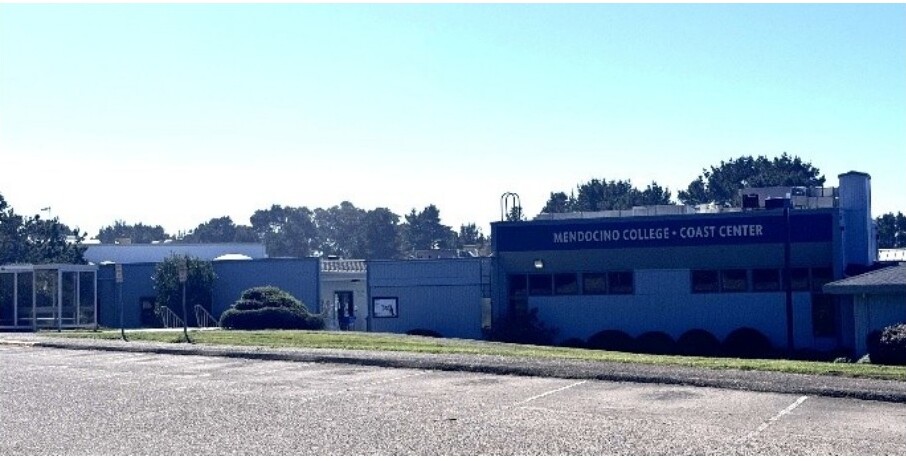
Some Fort Bragg places do not need a large sign, elaborate architecture, or a prominent Main Street location to matter.
This one matters because it gave the Mendocino Coast something it had needed for a long time: a permanent local doorway into college.
The campus at 1211 Del Mar Drive is now the Mendocino College Coast Center. It serves students from Fort Bragg and surrounding coastal communities with college courses, registration assistance, counseling, financial aid support, EOPS, CalWORKs, food pantry access, computer resources, and other student services.
For generations of local students, the campus has made it possible to begin college, return after time away, earn a degree, prepare for a new career, or complete coursework without having to drive over the hill for every class and appointment.
The Campus
The Coast Center is a practical, straightforward campus made up of two principal buildings.
Building 100 contains registration and student services, the Learning Commons, video-conferencing classrooms, a computer lab, science facilities, and general academic classrooms.
Building 200 is devoted primarily to art instruction.
The campus is not designed as a grand university setting. Its importance comes from accessibility and usefulness. It provides classrooms, technology, instructors, advising, and support services close to the people who need them.
For a remote coastal community, that local access can determine whether someone is able to attend college at all.
College of the Redwoods
Before the property became Mendocino College’s Coast Center, it served as the Fort Bragg campus of College of the Redwoods.
Local memory credits College of the Redwoods with developing the Del Mar Drive campus and giving coast students their first permanent college center.
Before the campus was constructed, College of the Redwoods reportedly maintained offices in the area now associated with the North Coast Brewing pub, while classes were held at a variety of community locations around Fort Bragg.
That earlier arrangement shows how determined local students and instructors were to make higher education work on the coast even before there was a dedicated campus. Classes existed, but they lacked a central home.
The development of the Del Mar Drive property brought the offices, classrooms, instructors, and students together in one place.
Competing College Districts
The larger history of community college education on the Mendocino Coast was not simple.
During the 1970s, both Mendocino Community College and College of the Redwoods offered courses in the coastal area. As demand increased, residents pushed for a permanent campus and stronger local educational services.
The coast eventually became connected with College of the Redwoods, although community memories of that decision remain mixed. Some residents remember discussions or expectations that the coast might receive greater local control or autonomy than it ultimately did.
Whatever the administrative disagreements, the College of the Redwoods era established a physical campus where coastal students could attend classes without leaving the region.
Adaptive Education and Community Programs
The College of the Redwoods campus offered more than traditional academic courses.
Community memory recalls an adaptive physical education program that served local students for many years. The campus also offered adaptive art, providing creative and educational opportunities for people who might otherwise have had limited access to suitable classes.
These programs required instructors and staff who understood that education does not look the same for everyone.
One former employee remembered working at the campus for ten years in adaptive physical education alongside Susan Larkin and also helping with the adaptive art class. The work was remembered as deeply rewarding and important to the community.
The programs also faced repeated pressure from College of the Redwoods administrators outside the area. Local staff and supporters had to fight to keep some services from being reduced or eliminated.
That experience became part of the broader community support for joining Mendocino College. The transition was seen not only as an administrative change but as a way to protect and strengthen programs that directly served coast residents.
Degrees Close to Home
The strongest measure of the campus is what students were able to accomplish there.
Local residents remember earning associate degrees at the Fort Bragg campus and then transferring to four-year universities. Sacramento State was one destination mentioned in community recollections.
The campus also participated in a Chico State satellite bachelor’s degree program. This allowed some students to continue beyond an associate degree and earn a bachelor’s degree while remaining in Fort Bragg.
For people with jobs, children, family responsibilities, limited transportation, or strong ties to the coast, that opportunity was significant.
One local graduate remembered earning both an associate degree and a Chico State bachelor’s degree through programs offered in Fort Bragg and expressed gratitude for being able to complete both without leaving her hometown.
Stories like that explain the true value of a small regional campus. It does not merely offer classes. It removes obstacles that might otherwise keep people from continuing their education.
Marine Science
Marine science was another memorable part of the College of the Redwoods years.
Students remember taking classes with Greg Grantham and participating in ocean research trips that turned the Mendocino Coast into a working outdoor classroom.
This was education directly connected to place. Students were not studying a distant or abstract environment. They were learning about the ocean, marine ecosystems, and coastal conditions immediately outside their own community.
Programs like marine science helped connect higher education with the natural setting and working traditions of the Mendocino Coast.
Transition to Mendocino College
The transition from College of the Redwoods to Mendocino College took place over several years.
Mendocino College began offering courses at the Del Mar Drive instructional center in fall 2014 through an agreement with the Redwood Community College District.
In 2015, Mendocino College and College of the Redwoods finalized an arrangement for the Mendocino-Lake Community College District to provide educational programs and student support services at the Fort Bragg campus.
The land and educational services were formally transferred in 2017, when Mendocino College acquired the Coast Center.
The change brought the Fort Bragg campus into a district more closely centered on Mendocino County. For many local students, instructors, and program supporters, the transition offered the possibility of stronger local attention and a more secure future for coast education.
The Coast Center Today
Mendocino College describes the Coast Center as its newest location and an essential service point for the remote coastal portion of the district.
Students can receive help with registration, financial aid, counseling, educational planning, EOPS, CalWORKs, food assistance, and other services that extend well beyond classroom instruction.
Those support systems are especially important at a smaller regional campus. Students may be returning to education after many years, balancing school with employment, raising families, living on limited incomes, or becoming the first members of their families to attend college.
A successful campus must do more than offer a course schedule. It must help students find their way through the system.
Why It Matters
The Mendocino College Coast Center is one of Fort Bragg’s greatest community assets.
It is not a tourist attraction or a postcard landmark. It is a working educational place where people have earned degrees, transferred to universities, studied art and science, received adaptive education, developed job skills, and discovered that college was possible for them.
Its importance can be found in the student who begins with one evening class, the adult who returns after decades away from school, the person who earns an associate degree and transfers, or the hometown student who completes both an associate degree and a bachelor’s degree without having to leave the coast.
For a small and geographically isolated community, a college campus creates possibilities that might not otherwise exist.
The Coast Center has helped generations of local students start, restart, and keep going. That is why this quiet Del Mar Drive campus belongs in the history of Fort Bragg’s buildings and businesses.
Sources & Original Research
This article blends verifiable historical records with personal recollections shared by longtime Fort Bragg residents. Much of this information comes from community memory and is not available in any published source.
Sources: The article includes the original post text and photograph provided by Gee Bee; community recollections concerning the College of the Redwoods campus, earlier offices and scattered classroom locations, associate degree and university transfer opportunities, the Chico State satellite bachelor’s degree program, marine science courses and ocean research trips, adaptive physical education and adaptive art programs, and efforts to preserve local programs; Mendocino College Coast Center information; Mendocino College institutional history; Mendocino College and College of the Redwoods announcements concerning the instructional agreement and campus transfer; Mendocino College Foundation Coast Center information; and the American Association of Community Colleges listing for the Mendocino College Coast Center. Contributors: Rus Jewett, Sue Langford, Dick Whetstone, Linda Stanton, John Manning, and Gee Bee.
