Mendocino Volunteer Fire Department
10461 Lansing Street, Mendocino — A 1939 village firehouse still serving as Station 841, carrying a volunteer tradition begun in 1887.
Last updated: August 17, 2026
That red siren above the roof says almost everything before the sign even gets a chance.
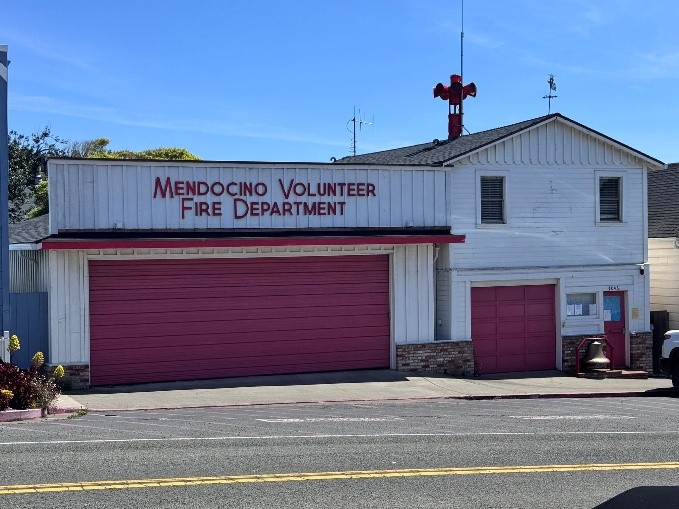
The white siding, red apparatus doors, old fire bell and unmistakable firehouse shape make 10461 Lansing Street one of Mendocino's most recognizable working historic buildings. But the story here reaches much farther back than the present station.
Overview
The Mendocino Volunteer Fire Department traces its beginning to 1887, when twenty-eight men organized the town's first formal fire company. Its early leaders included several names closely tied to Mendocino history, including William Kelly, Jerome C. Ford, William Heeser, Henry H. Jarvis and others.
The building at 10461 Lansing Street was constructed as a fire station in 1939 on property that had previously been occupied by a blacksmith shop. Today it is identified as Station 841. The department's larger Station 840 at 44700 Little Lake Road became its principal modern facility after being constructed during the 1990s.
Location
Station 841 stands at 10461 Lansing Street in the center of Mendocino village, close to Albion and Ukiah streets and directly among many of the historic commercial and civic buildings the department has protected for generations.
Long before the fire station was built, this property had another practical village use. Kelley House Museum research identifies a blacksmith and wagon shop here during the 1890s, associated with Jacob Stauer and later Emil Seman. That shop was eventually demolished, and the present fire station was constructed on the property in 1939.
History
Mendocino had already suffered serious fires before residents organized a formal fire company in 1887. By that summer the new company had a hand-operated pumper, hose cart, hook-and-ladder equipment, water cisterns and a fire bell. Its first station stood on the south side of Main Street across from what was then the Central Hotel.
That first firehouse had a bell tower containing a 700-pound bell used to summon firefighters and alert the village. A siren replaced the bell as the principal alarm in 1922. The historic bell survives and is now displayed outside the Lansing Street station.
The Lansing Street firehouse became part of the department's story in 1939. It later benefited from some very Mendocino-style recycling. In 1949, the deteriorating J. D. Johnson water tower behind the Masonic Hall was given to the fire department. Firefighters dismantled it and reused its lumber for improvements to the Lansing Street station.
The department itself nearly faded during World War II as many younger residents left for military service. After the war, Mendocino native Eugene "Foggy" Gomes returned from Navy service and helped revive it. He became chief and remained in that position for 53 years, retiring in 1997.
One of the best-known pieces of equipment from the Gomes era is the 1948 fire engine known as "The White," sometimes affectionately remembered as the "Great White." Purchased largely with community donations for $13,689, it carried 500 gallons of water and became a familiar part of department events and parades.
The Building Today
By the late twentieth century, the Lansing Street station had become far too tight for modern apparatus. Department history recalls that truck mirrors had to be folded in and firefighters sometimes had to climb through windows because there was not enough room to open the vehicle doors once the engines were parked inside.
Construction therefore began in 1992 on a much larger station at 44700 Little Lake Road. The new Station 840 was formally dedicated to Chief Foggy Gomes on August 27, 1995. The Lansing Street firehouse nevertheless remained part of the department and continues to be recognized as Station 841.
Why It Matters
The building has changed, equipment has changed, alarms have changed, and the department eventually needed a larger station. But for generations, when Mendocino needed help, volunteers answered.
Community Memories
The replies to the original post add the human side that official histories cannot always capture.
One family remembers a grandfather serving with the department and making the bell mounted on the department's old White fire engine. A family photograph shows Gerald Lee ringing that bell while the White stood in front of the firehouse.
That bell should not be confused with the department's much older 700-pound fire alarm bell now displayed at the Lansing Street station. The two are separate pieces of Mendocino firefighting history.
Another memory describes what it was like living close enough to watch the volunteers regularly. When the siren sounded, the casual atmosphere disappeared immediately and the firefighters went straight to work.
And another remembers an entirely different side of the firehouse: older local men sitting around the station watching the cars and village life go by. It is a small memory, but it says something important about the building. The firehouse was not simply a garage for engines. It was part of the everyday social fabric of Mendocino.
Timeline
1887 - Twenty-eight men organize Mendocino's first formal fire company.
1922 - A siren replaces the 700-pound bell as the village's principal alarm.
1939 - The present fire station is built at 10461 Lansing Street on the site of a former blacksmith shop.
1949 - The J. D. Johnson water tower is dismantled and its lumber reused at the Lansing Street station.
1948 - The department acquires "The White" fire engine with community donations.
1992 - Construction begins on Station 840 at 44700 Little Lake Road.
August 27, 1995 - Station 840 is dedicated to Chief Eugene "Foggy" Gomes.
1997 - Chief Gomes retires after 53 years.
Sources & Original Research: Mendocino Volunteer Fire Department, "125 Years of Community Service," Parts I and II, by firefighter Bob DeCarli; Kelley House Museum, "The Early Mendocino Fire Company"; Kelley House Museum historical research on Emil Seman's Wagon & Blacksmith Shop, the Lansing and Albion Street intersection, and the J. D. Johnson Water Tower; Mendocino County fire-service records identifying 10461 Lansing Street as a Mendocino Volunteer Fire Department station; The Volunteers: History of the Mendocino Volunteer Fire Department by Walt McKeown and Linda Wilson; original post text and photograph provided by Gee Bee; comment thread provided by Gee Bee with community memories and historical material from Patrick Pekin, Michael Lee, Andrew Leonard and Sandra Liljeberg.
Sources & Original Research
This article blends verifiable historical records with personal recollections shared by longtime Fort Bragg residents. Much of this information comes from community memory and is not available in any published source.
