Noyo Center for Marine Science Discovery Center
338 N. Main St. — A downtown storefront that connects Main Street back to the ocean, marine science, and the long story of Fort Bragg’s working coast.
Last updated: July 29, 2026
Overview
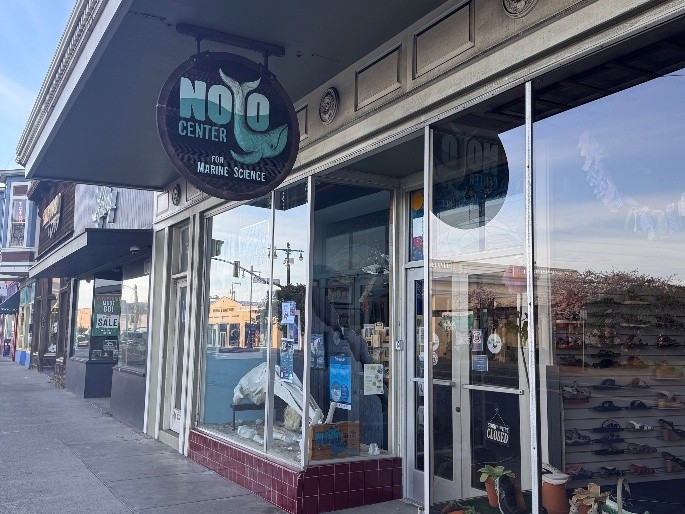
Some Main Street buildings sell you something and send you on your way. This one asks you to stop, look closer, and remember where we live.
Today, 338 N. Main Street is home to the Noyo Center for Marine Science Discovery Center, a marine science museum, exhibit space, educational center, and retail shop in the middle of downtown Fort Bragg.
It is one of those storefronts that makes the ocean feel present even from a few blocks inland.
Inside, the story is not only about whales, kelp, skulls, skeletons, tidepools, and marine animals. It is also about Fort Bragg learning how to explain itself after more than a century of being shaped by timber, fishing, shipping, and the sea.
The Discovery Center
The downtown Discovery Center introduces visitors to the marine life and natural systems of the Mendocino Coast.
Its exhibits explore local marine mammals, kelp forests, ocean science, coastal habitats, and the changing health of the ocean. Current Noyo Center information describes displays that include the world’s largest killer whale skeleton, sea lion skulls, an Alaskan walrus skull, kelp-restoration exhibits, and an Ocean Immersion Dome.
That makes this Main Street storefront part museum, part classroom, part visitor center, and part reminder that Fort Bragg’s future remains closely tied to the coast.
The Discovery Center gives residents and visitors a place to learn about the ocean without first having to walk to the harbor or headlands. Marine science is brought directly into the downtown business district, where people can wander in from Main Street and find themselves looking at the bones of enormous marine animals or learning about the kelp forests just offshore.
Building History
The building at 338 N. Main Street has a much older downtown story.
A 2025 Real Estate Magazine article about the Shafsky family reports that the Shafsky brothers built their new store at this address in 1914. The lot had previously held another building that was destroyed during the 1906 earthquake.
That history gives the address a strong connection to the rebuilding of downtown Fort Bragg.
The 1906 earthquake and the fires that followed damaged or destroyed much of the town’s commercial center. Buildings constructed during the following years helped create the Main Street streetscape that generations of residents would come to recognize.
Long before marine-science exhibits filled its windows, 338 N. Main Street belonged to that rebuilt commercial heart of Fort Bragg.
From Main Street Commerce to Marine Science
The change from an early downtown store to a modern marine-science center may seem dramatic, but both uses fit Fort Bragg.
The building’s early chapter reflects a town rebuilding after earthquake and fire, restoring its businesses and creating a stronger commercial district.
Its current chapter reflects a community trying to better understand the ocean, the headlands, the kelp forests, and the marine animals that have always shaped life here.
Not every historic building needs to remain frozen in one period. Some of the most useful buildings continue changing jobs while holding the town’s earlier stories inside their walls.
At 338 N. Main Street, the storefront still serves the public. The difference is that instead of introducing shoppers to ordinary merchandise, it now introduces them to the natural world just beyond the edge of town.
Connection to the Mill Site
The Discovery Center also fits into the larger story of the former Georgia-Pacific mill site and the proposed Ocean Science Center.
After the mill closed, Fort Bragg began the long process of deciding what the former industrial coastline might become. The Noyo Center for Marine Science emerged as part of a broader community vision involving education, conservation, research, public access, and redevelopment of the old mill property.
The City of Fort Bragg describes the downtown Discovery Center, the Crow’s Nest Interpretive Center on the Coastal Trail, and the planned Ocean Science Center as connected parts of that larger effort.
That gives the storefront at 338 N. Main Street more importance than its size might suggest.
It serves as a downtown doorway into a much larger coastal project — one intended to connect Fort Bragg’s industrial history with marine research, restoration, education, and public access to the former mill site.
Why It Matters
This storefront matters for two reasons at once.
It represents old Main Street and the generation that rebuilt Fort Bragg after the destruction of 1906. At the same time, it points toward what the town is still becoming.
The building has moved from traditional downtown commerce into marine education, but it continues doing what Main Street buildings have always done: bringing people together, encouraging them to come inside, and giving them something connected to the life of the town.
Today, that connection leads back to the ocean.
The Noyo Center for Marine Science Discovery Center reminds people that Fort Bragg’s history does not stop at the shoreline. The harbor, the fishing fleet, the mill site, the headlands, the kelp forests, and the marine life offshore are all parts of the same story.
Sources & Original Research
This article blends verifiable historical records with personal recollections shared by longtime Fort Bragg residents. Much of this information comes from community memory and is not available in any published source.
This article blends verifiable historical records with personal recollections shared by longtime Fort Bragg residents. Much of this information comes from community memory and is not available in any published source.
Sources: Original post text provided by Gee Bee; Noyo Center for Marine Science, Discovery Center and contact pages; City of Fort Bragg, Noyo Center for Marine Science page; Visit Fort Bragg, Noyo Center for Marine Science Discovery listing; Real Estate Magazine, “Shafsky Pioneers,” August 28, 2025.
