Omeo Suites Glass Beach
753 N. Main St. — A North Main motel property with roots as the old Fort Bragg Motel, remembered through postcards, road trips, restaurant meals, Travelodge years, and the everyday neighborhood life around Glass Beach.
Last updated: July 29, 2026
Overview
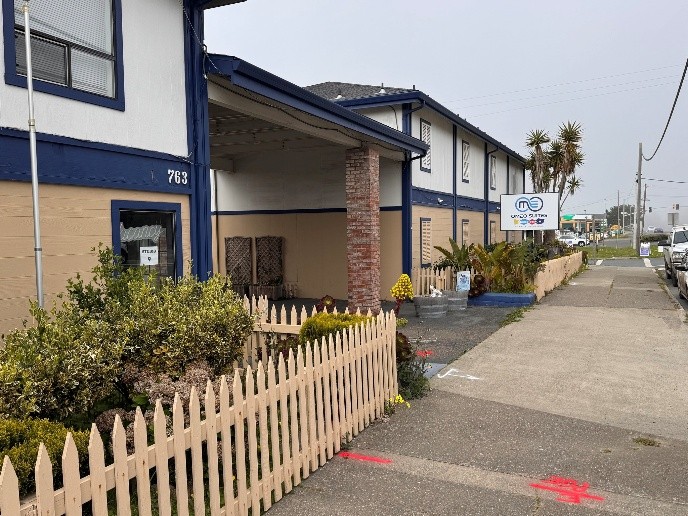
This part of North Main Street has always belonged to travelers, motels, restaurants, gas stations, and the steady movement of Highway 1.
Omeo Suites Glass Beach fits that stretch perfectly. From the street, the property has the practical roadside-motel appearance Fort Bragg grew around: long frontage, parking close to the rooms, simple two-story sections, and a location designed for people arriving in town by car.
Current lodging information describes Omeo Suites Glass Beach as a Fort Bragg hotel within walking distance of Glass Beach and close to downtown. The property offers guest rooms, parking, Wi-Fi, and the basic traveler accommodations that have kept this address useful through several names and generations of visitors.
Behind the current name is a longer story involving the old Fort Bragg Motel, restaurant memories, later Travelodge years, temporary housing, childhood adventures, postcards, road trips, and the changing neighborhood around Glass Beach.
The Fort Bragg Motel
The name that brought out the strongest memories was the Fort Bragg Motel.
The motel was already operating by 1959, when a 13-year-old member of the Tucson Arizona Boys Chorus stayed there while the group was in Fort Bragg to perform at Cotton Auditorium.
That visit became a lasting memory not only of the motel, but of the appearance and feeling of Fort Bragg during the late 1950s.
That is the kind of history roadside motels often hold. A room occupied for only one or two nights might become someone’s first clear memory of a town. Families, performers, workers, vacationers, and people traveling the coast all passed through these rooms and carried away their own version of Fort Bragg.
For some, this motel was simply a convenient overnight stop. For others, it became part of a road trip, family vacation, performance tour, or major transition in their lives.
Postcards and Roadside Travel
Old postcards show the Fort Bragg Motel as part of the mid-century highway travel era.
The motel sign, vacancy message, roadside frontage, and restaurant connection reflect a time when travelers often chose their lodging by watching for signs along the highway rather than searching online before arriving.
A motel was more than a room. It was a place to park, eat, rest, ask directions, and decide what to do next.
Properties such as this helped shape the northern entrance to Fort Bragg. Visitors driving south along the coast encountered a line of motels, cafés, service stations, and other traveler-oriented businesses before reaching the center of town.
The Fort Bragg Motel was part of that first impression.
Restaurant History
Food was also part of the property’s story.
Community memories connect the motel with Ada Bell’s restaurant, adding another layer to the old roadside operation. The motel and restaurant combination allowed travelers to find both a meal and a room without having to drive farther into town.
That arrangement was common during the height of automobile travel. Motels, cafés, coffee shops, and restaurants were often placed together or operated as connected businesses.
Current restaurant listings place Café One at 753 N. Main Street, continuing the property’s long association with both lodging and food.
Although the restaurant names and operations have changed, the address has remained a place where travelers and local residents could stop for more than just a night’s sleep.
Expansion of the Property
The motel expanded as travel increased and Fort Bragg continued developing.
Community memory identifies John Young Construction with the construction of a two-story addition along Main and Spruce streets, although the exact year of that project still needs to be confirmed.
That addition helped create the larger motel footprint visible today.
The different sections of the building suggest a property that grew over time rather than being completed in one construction phase. Like many roadside motels, it was adapted as demand changed, new rooms were needed, and expectations for lodging evolved.
Its practical design was never intended to be ornate. The building was created to provide easy vehicle access, visible rooms, convenient parking, and straightforward accommodations.
The Travelodge Years
The property was later operated as a Travelodge.
Those years are remembered by both travelers and people who stayed for longer periods. Around 2012, some of the rooms were used by people who needed temporary housing rather than by tourists passing through for a weekend.
Former guests remembered the owners from that period kindly and described stays that lasted much longer than an ordinary vacation.
That is an important part of motel history that is often missing from official business listings.
Motels have frequently served several roles at once. They provide rooms for tourists and workers, but they may also house families between homes, people relocating to town, seasonal employees, and residents dealing with unexpected changes.
The same building can be a vacation stop for one guest and a temporary home for another.
Neighborhood Memories
Some of the richest memories connected to the property come from the neighborhood behind it.
A person who lived in the alley behind the motel from 1987 to 1994 remembered the rear of the building painted orange. The motel roof regularly collected balls, boomerangs, and flying toys launched by children playing nearby.
Those details turn the property from a roadside business into part of a childhood landscape.
The open field across Spruce Street had not yet been fully developed. Glass Beach was close enough for neighborhood children to wander toward, and the old Haul Road was still a rough paved route rather than the developed Coastal Trail people know today.
Radio-controlled airplanes were flown in the area, and helicopter whale-watching tours were sometimes operated near the Glass Beach entrance.
From the alley behind the motel, all of these places and activities were connected: the rooms, motel roof, open field, Haul Road, Glass Beach, helicopters, and children playing close to home.
That kind of memory creates a neighborhood map that no official property record could provide.
Experiences Over the Years
People have continued staying at the motel under its different names, with experiences ranging from enjoyable visits to uncomfortable nights.
Some guests returned from time to time and treated it as a familiar Fort Bragg lodging stop.
Others recalled disturbances, arguments in nearby rooms, or concerns about whether management was available on the property. Those memories are also part of the building’s history. A motel operating for many decades will naturally collect very different experiences depending on the owners, management, condition of the rooms, and circumstances of each stay.
Together, those stories show how the property has functioned as an active, everyday lodging business rather than as a carefully preserved historic attraction.
Omeo Suites Glass Beach Today
Today, the property operates as Omeo Suites Glass Beach.
Its location remains its greatest advantage. Guests can stay near Glass Beach, the Coastal Trail, downtown Fort Bragg, restaurants, shops, and the north end of town.
The name has changed, but the basic purpose has not.
The property continues doing what it was built to do: provide a convenient place for people arriving in Fort Bragg by car to park, stay overnight, and explore the surrounding community.
Behind that newer name, however, are decades of earlier identities and memories: the Fort Bragg Motel, Ada Bell’s, postcard views, restaurant meals, Travelodge stays, temporary homes, children playing in the alley, and visitors seeing Fort Bragg for the first time.
Why It Matters
Omeo Suites Glass Beach is not grand architectural history.
It is motel history, highway history, restaurant history, neighborhood history, and Glass Beach childhood history all stacked together under one practical roof.
The property represents the era when automobile travel reshaped North Main Street and businesses were built to meet people arriving along Highway 1.
It also represents the ordinary ways buildings become part of local life. Travelers slept there, children played behind it, families ate nearby, workers found temporary rooms, and visitors carried memories of Fort Bragg home with them.
Buildings do not need elaborate architecture or famous owners to belong in the historical record.
Sometimes a long row of motel rooms can tell just as much about a town as a landmark hotel or downtown storefront.
Sources & Original Research
This article blends verifiable historical records with personal recollections shared by longtime Fort Bragg residents. Much of this information comes from community memory and is not available in any published source.
This article blends verifiable historical records with personal recollections shared by longtime Fort Bragg residents. Much of this information comes from community memory and is not available in any published source.
Sources: Original post text provided by Gee Bee; Omeo Suites Glass Beach official lodging information; Visit Fort Bragg lodging listing for Omeo at Glass Beach; Fort Bragg Restaurants listing for Café One at 753 N. Main Street; current and archived lodging listings for the former Travelodge and Omeo Suites Glass Beach; and comment threads provided by Gee Bee.
Contributors: Peter Robblee, Candi Baird, Kathy Ines B, Steven Taylor, Craig Johnson, Aaron Scherbarth, Heather Capps, and Violet Fox.
