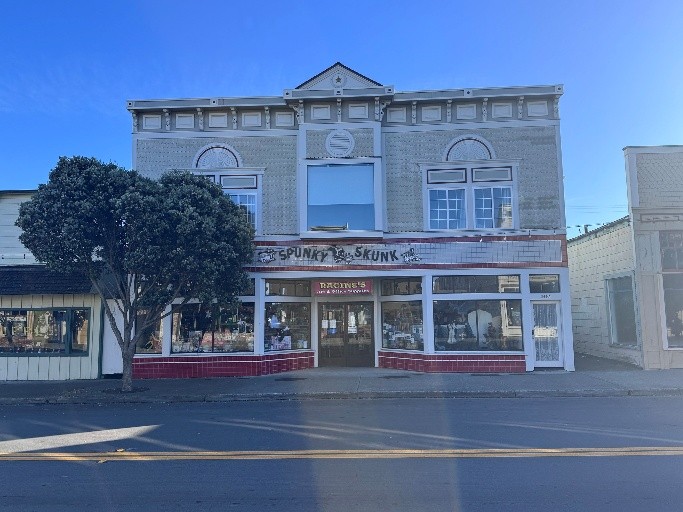
Racine's
344 N. Franklin St. — Where generations of Fort Bragg residents have gone for paper, paint, toys, pens, office supplies, art materials, gifts, and that unmistakable old-store feeling.
Last updated: July 31, 2026
Overview

Some downtown buildings matter because of their architecture, and some matter because they held everyday life.
Racine's is one of the second kind.
For generations, the Racine name has been connected with art materials, office supplies, stationery, toys, gifts, pens, paper, paint, sporting goods, hobbies, and the kinds of useful things people needed for school, work, recreation, and home.
It was never simply a store people admired because it had been around a long time.
It was a place they actually used.
Students went there for school supplies. Artists went there for paint and paper. Offices depended on it for everyday materials. Children spent their allowances on toys, models, squirt guns, bicycles, railroad equipment, and whatever else caught their attention.
That combination of usefulness and memory is what gives Racine's its place in Fort Bragg history.
Location
Racine's is located at 344 North Franklin Street in downtown Fort Bragg.
The building stands along one of the town's oldest commercial blocks, where stores were historically packed close together and connected by sidewalks, alleys, awnings, delivery areas, and the daily movement of shoppers through downtown.
The small alley near the store has become an important part of local memory because it helps people describe where earlier businesses stood.
Some residents remembered Racine's south of the alley. Others remembered Sprouse-Reitz in or near the present building. Several recalled that businesses occupied more than one storefront or shifted between neighboring spaces.
That makes the exact history of the block complicated.
Buildings burned, stores moved, storefronts were combined, addresses changed, and later businesses occupied spaces that earlier generations remembered differently.
Even when people disagree about the precise location of each old storefront, they agree that Racine's was a central part of this section of Franklin Street.
History
Racine's history reaches well back into the twentieth century.
According to the store's own account, Paul Racine later passed the business to his son Everett during the 1950s. Another ownership transition followed in 1976, and the store continued into its modern era while retaining the Racine name.
That continuity made Racine's more than one particular building.
The name came to represent the entire experience of shopping there—the merchandise, the wooden floors, the smell of paper and paint, the employees, the toys, the office supplies, and the feeling that there was always something worth looking at.
The exact sequence of Racine storefronts and building changes is still difficult to reconstruct completely, but the business itself remained a recognizable part of downtown Fort Bragg through generations of change.
The Earlier Store
Many longtime residents remember an earlier Racine's located south of the small alley near the present store.
That earlier business was remembered as occupying two storefronts and having the character of a broad, old-fashioned variety store.
Depending on the decade, shoppers recalled sporting goods, office supplies, toys, model kits, bicycles, archery equipment, baseball gloves, railroad sets, BB guns, pens, paper, art materials, and other practical merchandise.
The old store reportedly had an open upper storage area that customers could see but were not allowed to enter.
That upper level gave the building a slightly mysterious feeling. Shoppers could see merchandise stored above them, much like the visible upper area remembered in the later store, but it remained off limits.
For children, that only made the place more interesting.
The Old-Store Feeling
Racine's is remembered as much for how it felt as for what it sold.
People recalled creaking wooden floors and a distinctive smell described as a mixture of paper, wood shavings, paint, art supplies, and old-store air.
Those sensory memories are often stronger than dates.
A person may not remember exactly which year they bought something or which storefront the business occupied at the time, but they remember the sound of the floor, the feel of the aisles, and the smell that greeted them when they walked inside.
That is part of what made Racine's different from a modern office-supply store.
It felt like a place that had accumulated years of use, merchandise, and memory.
Toys, Models, and Allowances
For many Fort Bragg children, Racine's was one of the most exciting stores downtown.
People remembered spending their allowances there and browsing even when they did not have enough money to buy much.
Revell model airplanes, HO-scale railroad tracks and cars, squirt guns, baseball gloves, bicycles, BB guns, toys, art supplies, and sporting equipment all appear in local memories.
Some people recalled receiving Schwinn bicycles purchased from Everett Racine. One bicycle was remembered as burgundy and cream colored and treasured by its owner. Others remembered buying model kits or railroad equipment, looking through toy shelves, or saving money for something they had seen during an earlier visit.
Racine's encouraged browsing. Children could look at things they hoped to own someday while adults searched for pens, paper, paint, or office supplies nearby.
Everett Racine
Everett Racine remains closely tied to memories of the store.
He was remembered not only as the owner, but as a familiar downtown figure connected with sporting goods, toys, bicycles, archery, and the day-to-day life of the business.
One story recalls Everett stringing a bow inside the store and firing an arrow upward, possibly toward a target near the ceiling. Another memory places his Volkswagen van in the alley, parked with the front pulled back slightly from the sidewalk.
Those details help make the history personal. They move the story away from business dates and ownership records and back toward the people who gave the store its character.
For many residents, Racine's was Everett's store, even when the merchandise and building changed around him.
The Canvas Awning
The old store was also remembered for its canvas awning.
Like many Franklin Street storefronts, the awning could be cranked outward over the sidewalk during business hours and rolled back up when the store closed.
That awning belonged to an older downtown rhythm.
Storefronts used practical shade coverings. Delivery vehicles used narrow alleys. Businesses opened directly onto the sidewalk. People walked from one shop to another rather than driving between every stop.
The awning, alley, wooden floors, and upper storage area together help reconstruct the physical experience of shopping on Franklin Street in an earlier period.
The Sprouse-Reitz Question
One of the largest debates surrounding the Racine's location involves Sprouse-Reitz.
Several residents remembered the present building or its immediate location as a Sprouse-Reitz store during the 1950s and 1960s.
Others remembered Racine's south of the alley and Sprouse-Reitz on the opposite side.
Some believed the current Racine's building occupies the former Sprouse-Reitz location. Others remembered both stores operating beside one another.
Old photographs, red tile along the base of a storefront, rebuilt structures, changing addresses, and the movement of businesses between neighboring spaces have all contributed to the confusion.
There is historical evidence that Fort Bragg had a Sprouse-Reitz store by the early 1960s, but a complete storefront-by-storefront timeline has not yet been established.
For now, the most careful conclusion is that Racine's and Sprouse-Reitz were both important parts of this section of downtown retail history, but their exact locations and building transitions became blended together in community memory.
Fire and Rebuilding
Community memory also connects this block with a significant fire.
Some residents remembered an older building being damaged or destroyed and the present structure being newer than the storefronts they knew as children.
One recollection placed the fire during a severe week-long storm when many trees came down and the town experienced widespread disruption.
The exact date, extent of the damage, and relationship between the fire, Sprouse-Reitz, Racine's, and the current building still require further documentation.
Even without a complete record, the fire may explain why different generations remember the same address differently.
A familiar business can remain in the same general part of downtown while the building around it changes substantially.
Stores may shift into neighboring spaces, combine storefronts, move across an alley, or return after rebuilding while the familiar name continues.
Pens, Paper, and Practical Things
Racine's was not remembered only for toys.
For many adults, it was the place to find a particular pen, document, notebook, paper, office item, or art supply that was difficult to locate elsewhere.
One resident remembered Racine's as having an unusually good selection of pens and the satisfaction of finding exactly the right one.
Others recalled buying documents, stationery, gifts, paint, and useful items while wondering how the store managed to carry so much.
That range of merchandise was one of Racine's strengths.
It could serve a child looking for a toy, an artist needing supplies, an office worker searching for paper, or someone simply trying to find a practical gift.
It combined several kinds of stores under one roof.
Artists and the Upstairs Space
One memory connects Racine's with an artist who worked upstairs.
A child was allowed to watch him work while a parent shopped for supplies downstairs.
That small experience stayed memorable because it turned an ordinary shopping trip into something special.
The visit could become even better if a grandmother working at a nearby bakery provided a cookie afterward.
Stories like that show how downtown businesses were linked together through family routines.
A trip to Racine's might also include a bakery, hardware store, theater, restaurant, or another stop nearby.
The store was part of a broader downtown experience rather than an isolated destination.
Nearby Downtown Businesses
The discussion surrounding Racine's brings up many other remembered Fort Bragg stores.
People mentioned Sprouse-Reitz, Ben Franklin 5 & 10, Shafsky's, Doran's Hardware, Wakerly's, Coast Hardware, Safeway, and neighboring Franklin and Main Street businesses.
Not everyone remembered the locations the same way.
Some stores moved. Others closed. Buildings were replaced or combined. Owners retired, and new businesses appeared behind familiar storefronts.
What one person remembers as Racine's, another may remember as Sprouse-Reitz or as the store next door.
That confusion does not make the memories useless.
It shows how active downtown Fort Bragg once was and how closely the stores were packed together in people's daily lives.
The Building Today
Today, Racine's continues as an art, office, stationery, toy, and gift store on North Franklin Street.
Its merchandise has changed with the times, but the basic purpose remains familiar.
It is still a place where people can buy materials for school, work, art, hobbies, gifts, and everyday projects.
That continuity is increasingly unusual.
Many independent office-supply stores, toy departments, variety shops, and small art stores have disappeared.
Racine's has managed to retain parts of all those roles within one downtown business.
The store remains useful rather than surviving only as nostalgia.
That may be the most important part of its story.
Why It Matters
Racine's was never just a place to buy supplies.
It was where children spent their allowances, where families purchased bicycles and toys, where artists found paint and paper, where offices bought everyday materials, and where people could browse without needing a particular reason.
The memories attached to the store include creaking floors, canvas awnings, the smell of paper and wood, model airplanes, railroad sets, pens, cookies, bicycles, sporting goods, and Everett Racine's Volkswagen van parked in the alley.
The debate over Racine's, Sprouse-Reitz, the alley, the fire, and the older storefronts shows how complicated downtown history can become when buildings and businesses change together.
Even when the details blur, the importance of the place does not.
Racine's belongs in Fort Bragg history because it helped supply ordinary life for generations.
Sources & Original Research
This article blends verifiable historical records with personal recollections shared by longtime Fort Bragg residents. Much of this information comes from community memory and is not available in any published source.
Original research post and discussion: https://www.facebook.com/media/set/?set=a.10153269104881177&type=3
Sources: Original post text and photograph provided by Gee Bee; original research post and discussion at https://www.facebook.com/media/set/?set=a.10153269104881177&type=3; Racine's About Us page; Visit Fort Bragg Main Street listing; historical references confirming a Sprouse-Reitz presence in Fort Bragg; and comment threads provided by Gee Bee with contributor memories from Evelyn Bishop Anderson, Anna Roeth, Rus Jewett, Diane Williamson Swingle, Pamela Hunter, Michelle Nadeau, Judith Smith, Candy Jacomella-Blass, Shelley Sharp-Yount, Richard Lina, Stephanie Gully Osbrink, Donna Winters, Donna Hargreaves-Murray, Sandi Zap, Fred Howard, Virginia McNeill, Bess Mahaney, Linda Stanton, Sandra Liljeberg, Camille Parsons, Kelly Hilliard, Joe Wagner, Janet Del Fiorentino Lewis, Loretta Joan Driggers, Michelle Braga, Darilyn Fenech, Patricia Simon Martinez, Tom Van Pelt, Heather Capps, and others. Additional research is still needed to establish the exact location and operating dates of the Fort Bragg Sprouse-Reitz store, the sequence of Racine's storefronts north and south of the alley, the date and extent of the remembered fire, and the construction history of the present building.